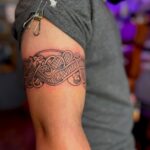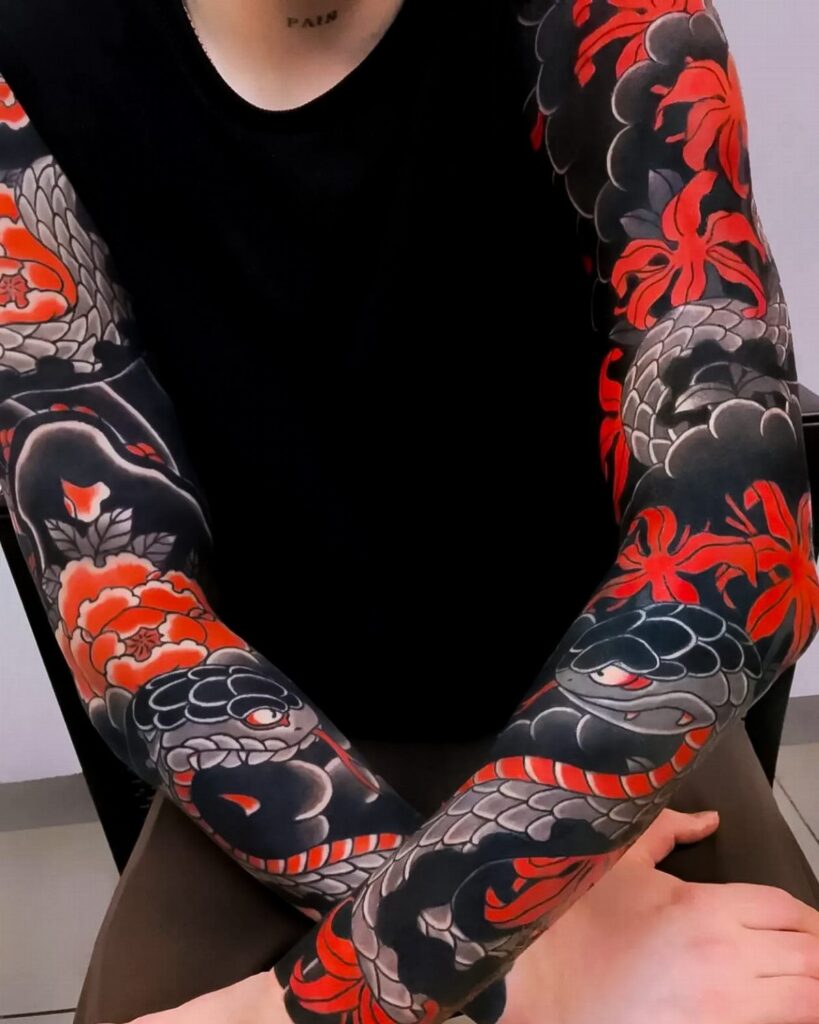
A full sleeve takes 30–35 hours across 7–9 sessions, while a three-quarter design extends past the elbow and finishes faster.
Your choice turns on whether you need the option to hide the piece under a short-sleeved shirt: shichibusode stays below the shoulder line, and hikae extends onto the chest.
Traditional Japanese motifs follow fixed rules for subject and background, so picking a dragon, koi or samurai mask isn’t about preference alone.
1. Japanese Full Sleeve Tattoo
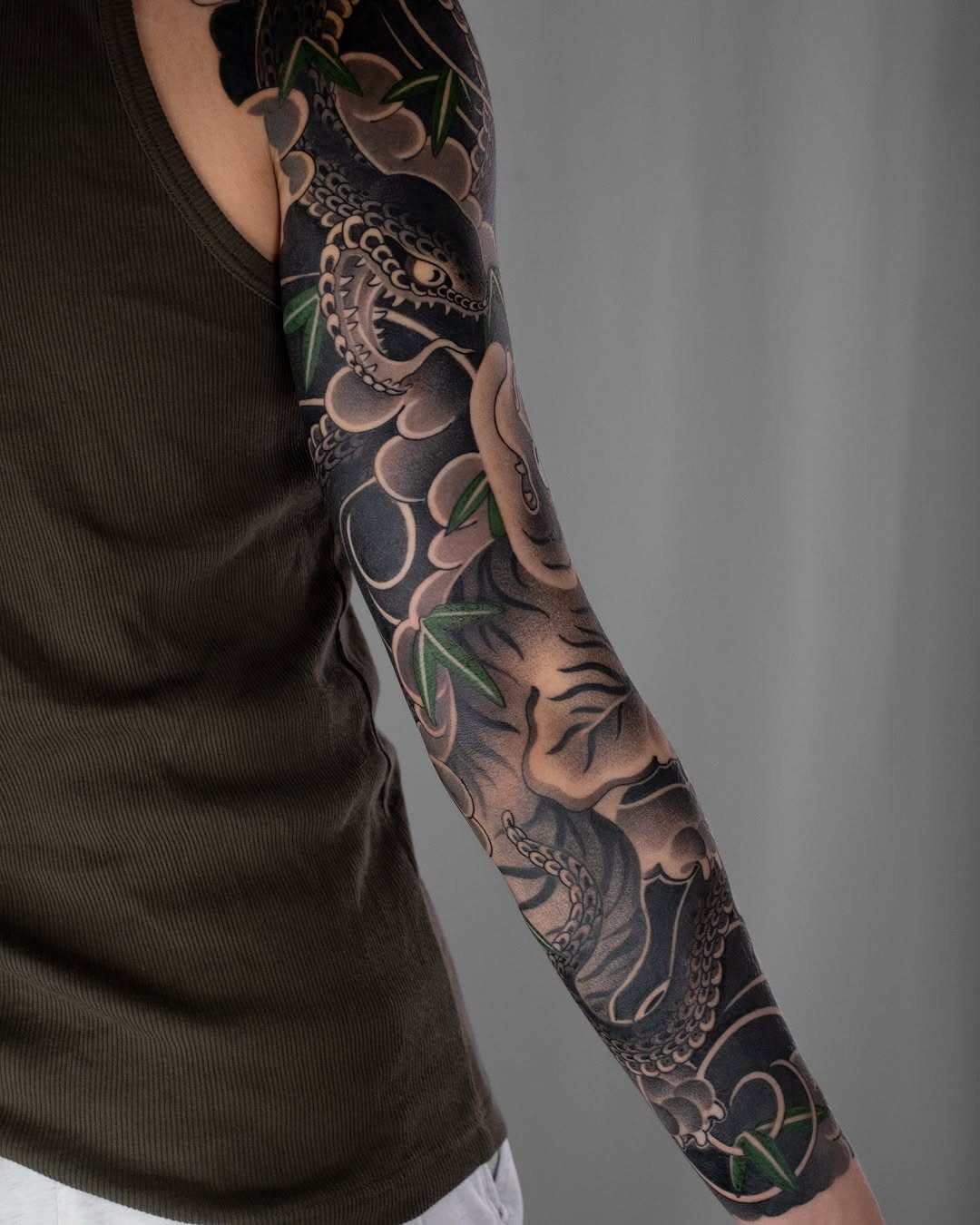
The design runs unbroken from wrist to shoulder, taking up every inch of the arm.
The length gives traditional Japanese motifs room to breathe: dragons can coil through clouds, waves can stack from forearm to bicep, and backgrounds stay dense while keeping the subject clear.
Most take several sessions to complete.
Sitting for that long means you’ll feel every stage of healing, often one part swollen while another peels. The result is coverage that reads as a single composition instead of patchwork.
If your upper arm carries more mass than your forearm, the design needs to account for that taper or risk looking unbalanced when your arm hangs straight.
2. Hikae
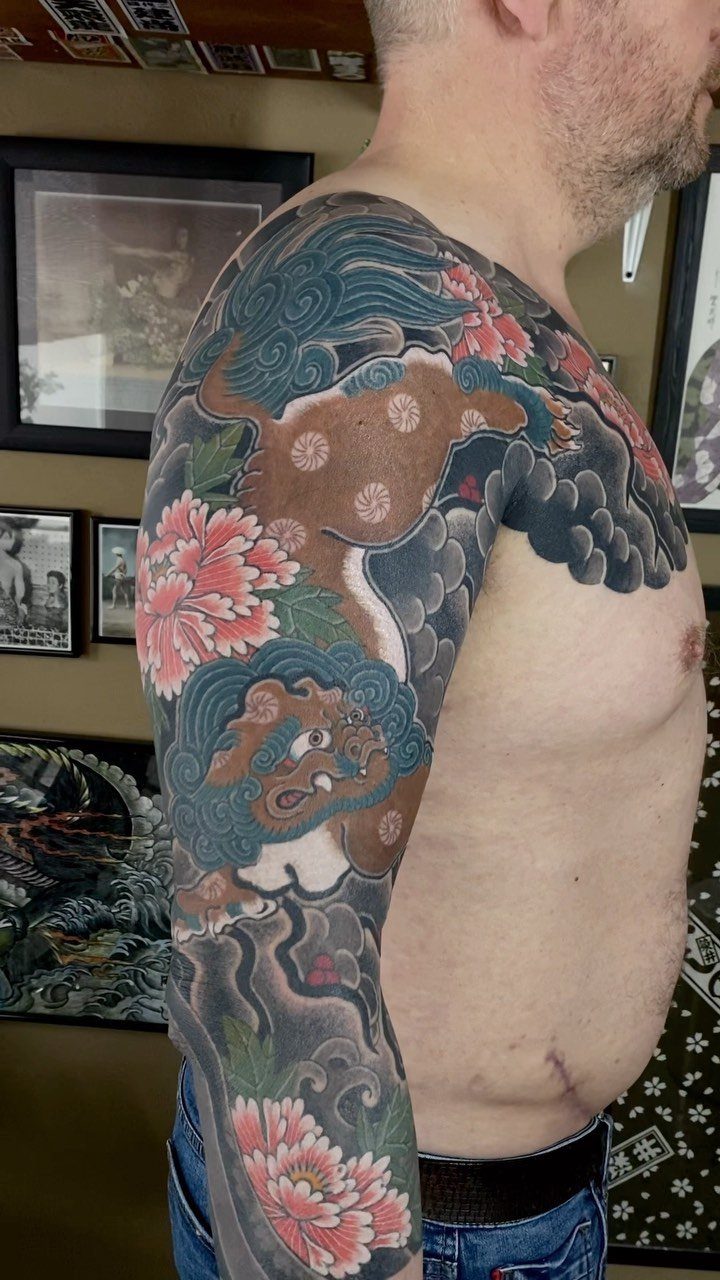
Hikae extends a sleeve onto the chest, usually stopping short of the sternum and covering the pectoral on one side.
The chest panel gives you space for a second focal point: a deity, a second animal, or a landscape that balances the arm’s main image.
Ribs and sternum hurt more than the shoulder or outer bicep, so most artists split this into separate sessions after the sleeve is finished. Healing takes longer because fabric rubs the chest panel every time you move.
The style suits asymmetry. One side stays bare or holds a smaller design, which keeps the composition from feeling locked in place.
3. Shichibusode
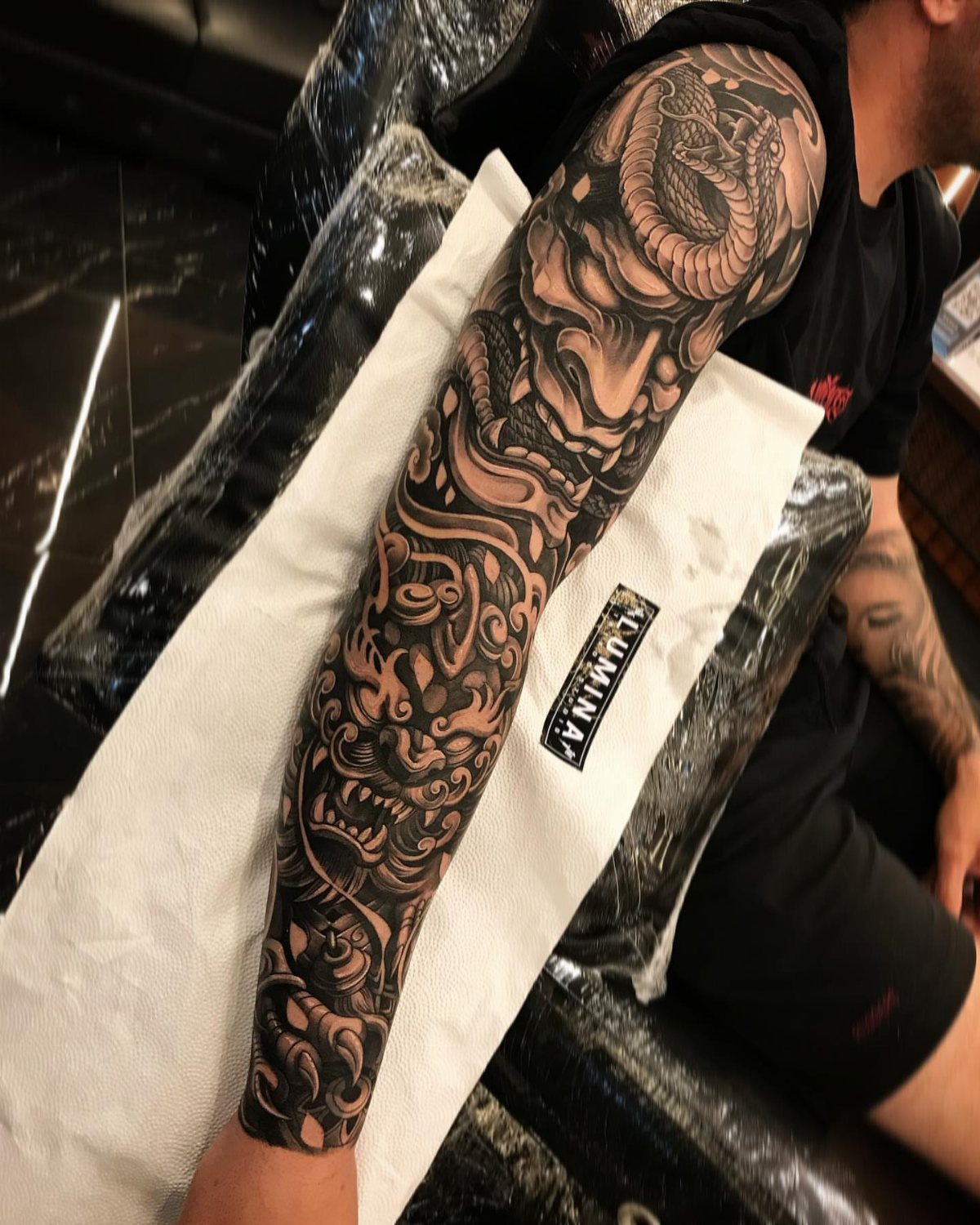
Shichibusode extends past the elbow onto the mid-forearm, covering roughly seven-tenths of the arm. The shorter length leaves the shoulder open, so the design stays visible in a short-sleeved shirt without spilling onto the bicep.
Placement matters here more than in full-arm coverage.
If the main subject sits too high, it disappears under fabric; too low and the composition feels bottom-heavy. I’d put the focal point just below mid-forearm where it stays centered when your arm bends.
Fewer hours than full-arm work. Healing is simpler because less surface area swells at once.
4. Traditional Japanese Tattoos
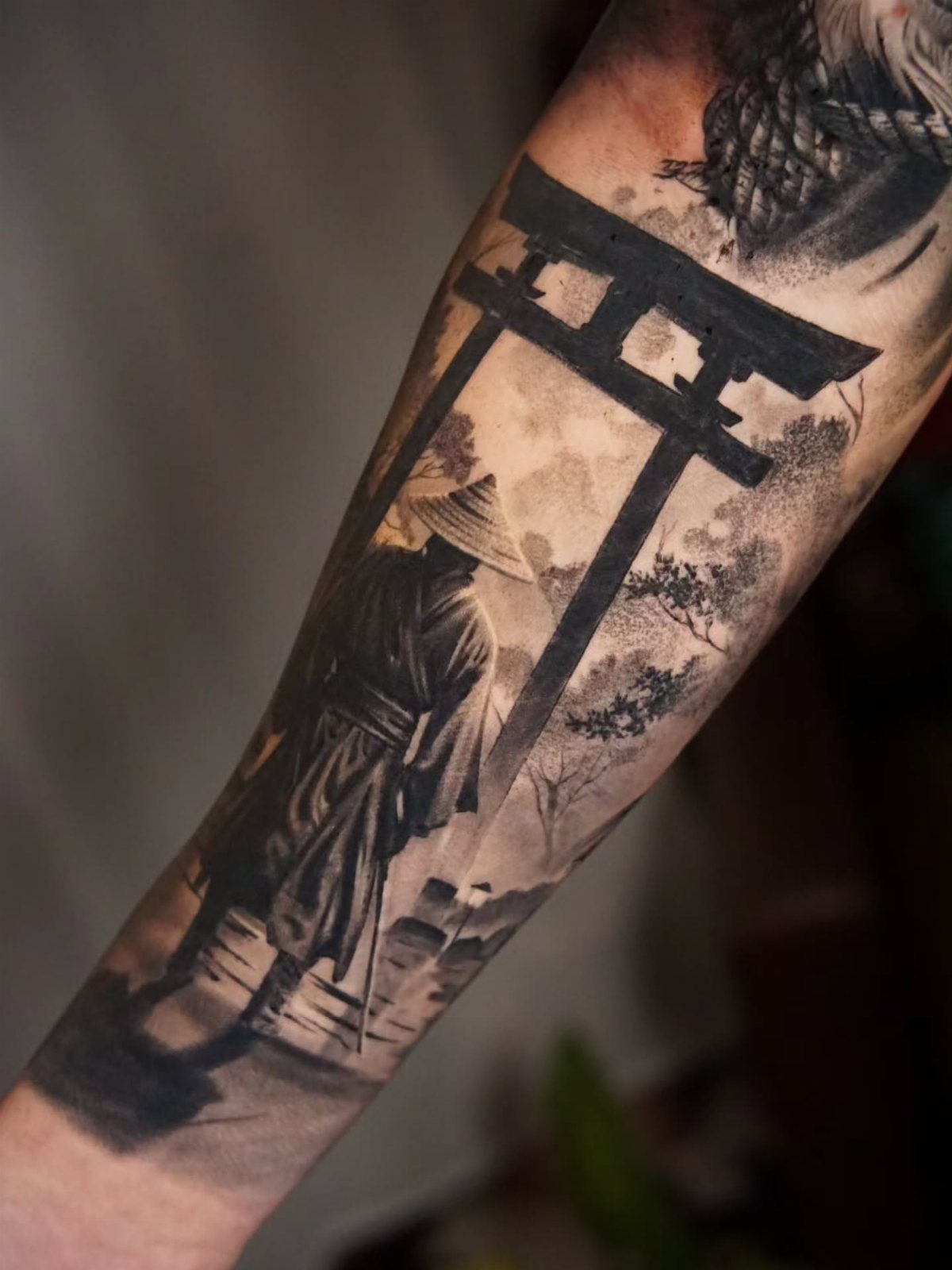
Traditional Japanese tattoos follow centuries-old rules for subject, background and color. Deities, yokai, animals and warriors each carry specific meanings, and the background motifs like water, wind bars and flowers are never random filler.
Black outlines stay bold even as the ink settles, and color sits inside those lines with little blending. The style prioritizes readability over realism, so a dragon looks like a dragon from a distance instead of a smudge of scales.
Finding an artist trained in this tradition matters more than the size of the piece. A poorly executed back piece in this style ages worse than a small one done right.
5. Japanese Half Sleeve Tattoo
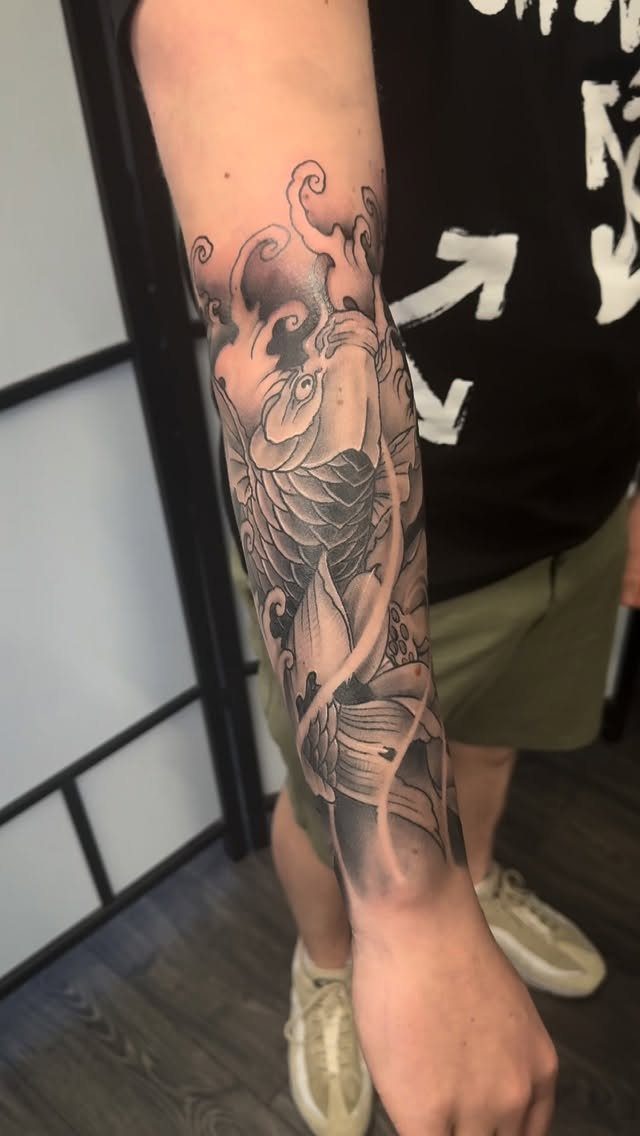
This format covers either shoulder to elbow or forearm from elbow to wrist. The shorter canvas suits single-subject designs like a koi, tiger or peony cluster that don’t need a second element to fill space.
Forearm halves stay visible year-round and hurt less than the inner bicep or ditch.
Upper arm halves hide under most shirts, which matters if your workplace has visible tattoo rules. I’d choose based on whether you want the piece seen or covered by default.
Time and cost both drop with the smaller area. A half sleeve also tests how you heal and sit before committing to a full arm.
6. Gaku-Bori Style Japanese Sleeve Tattoo
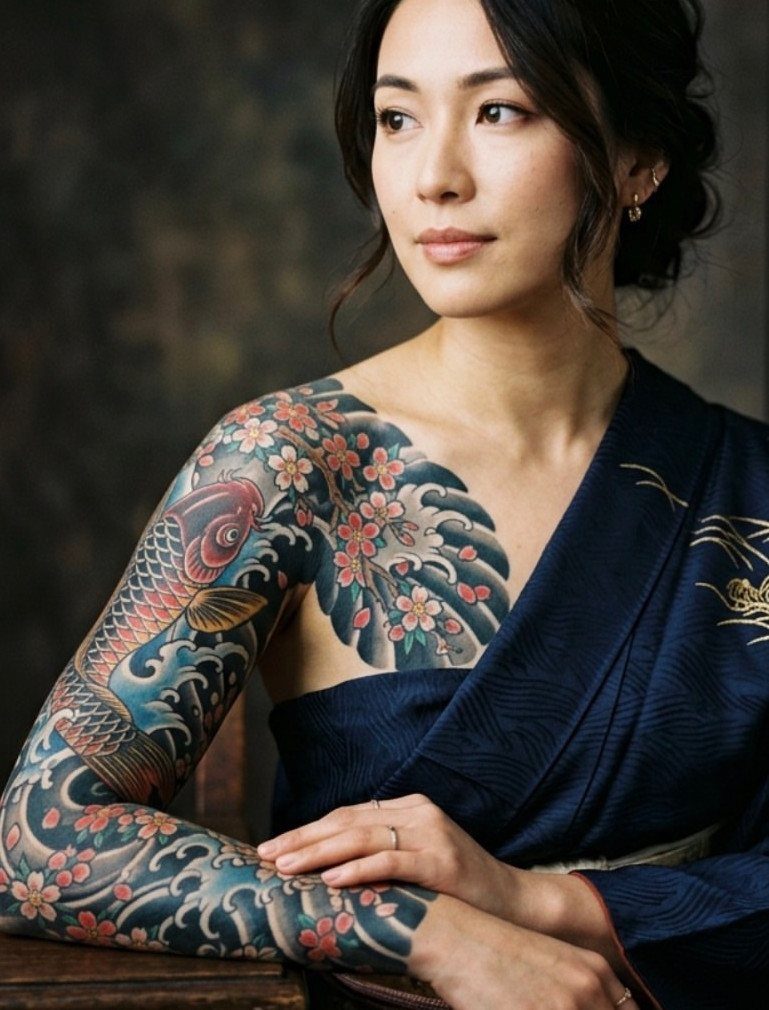
Gaku-bori fills the background with dense traditional elements like clouds, waves and wind bars, framing the main motifs instead of leaving them to float alone.
The borders stay sharp and geometric, often following the natural lines of the arm or torso.
The framed look comes from traditional Japanese body suits, where each panel stood alone before blending into the whole.
On a sleeve, that means the upper arm might hold one complete image, the forearm another, and the space between them stays bare.
Aging works in your favor here. As the ink spreads slightly over decades, the borders keep each section distinct instead of bleeding into one another.
7. Koi Fish Sleeve Tattoo
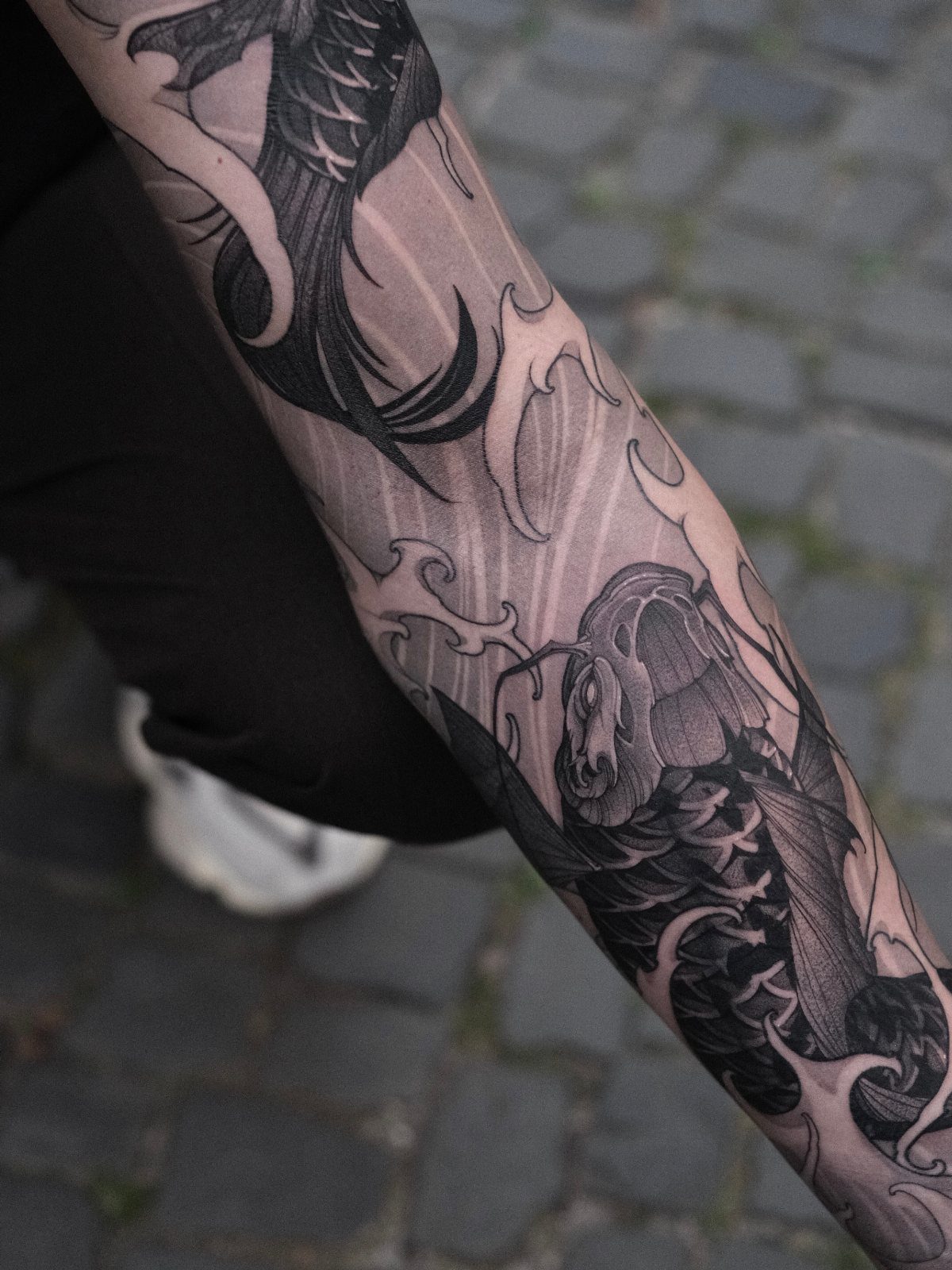
Koi fish tattoos pair naturally with flowing water because the fish reads clearest when the background shows current.
Black and grey keeps the scales distinct without competing color, and the gradient from dark dorsal fin to pale belly gives depth that holds up as the ink settles.
Most compositions run the fish diagonally up the forearm so the head sits higher than the tail, following the way koi actually swim upstream. Waves or ripples fill the negative space without crowding the body.
If you want color later, grey foundation takes it well. Starting in black and grey also costs less per session.
8. Samurai and Dragon Sleeve
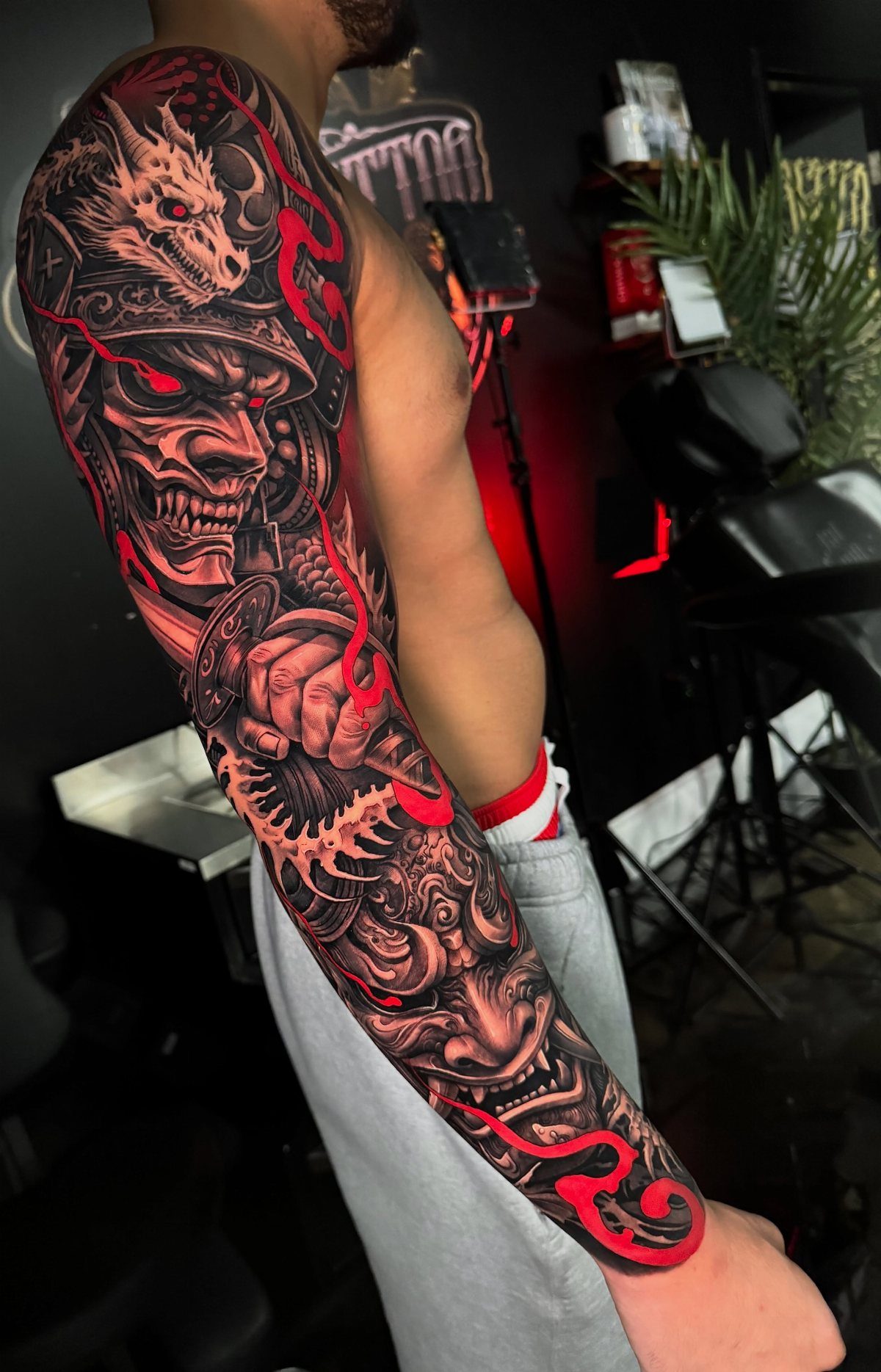
Pairing a samurai mask with a dragon fills the arm with two strong subjects instead of one large figure and filler.
The mask usually sits on the shoulder or upper bicep, the dragon coils down the forearm, and red accents pull the eye to specific details like eyes, flames or armor trim.
Red ink fades faster than black, so touch-ups every few years keep those accents sharp. I’d ask the artist to keep the red concentrated in small areas rather than spread thin across large sections.
The dual-subject layout works best when one element faces or opposes the other, giving the composition direction instead of two separate images stacked on the same arm.
9. Floral and Clouds Japanese Sleeve
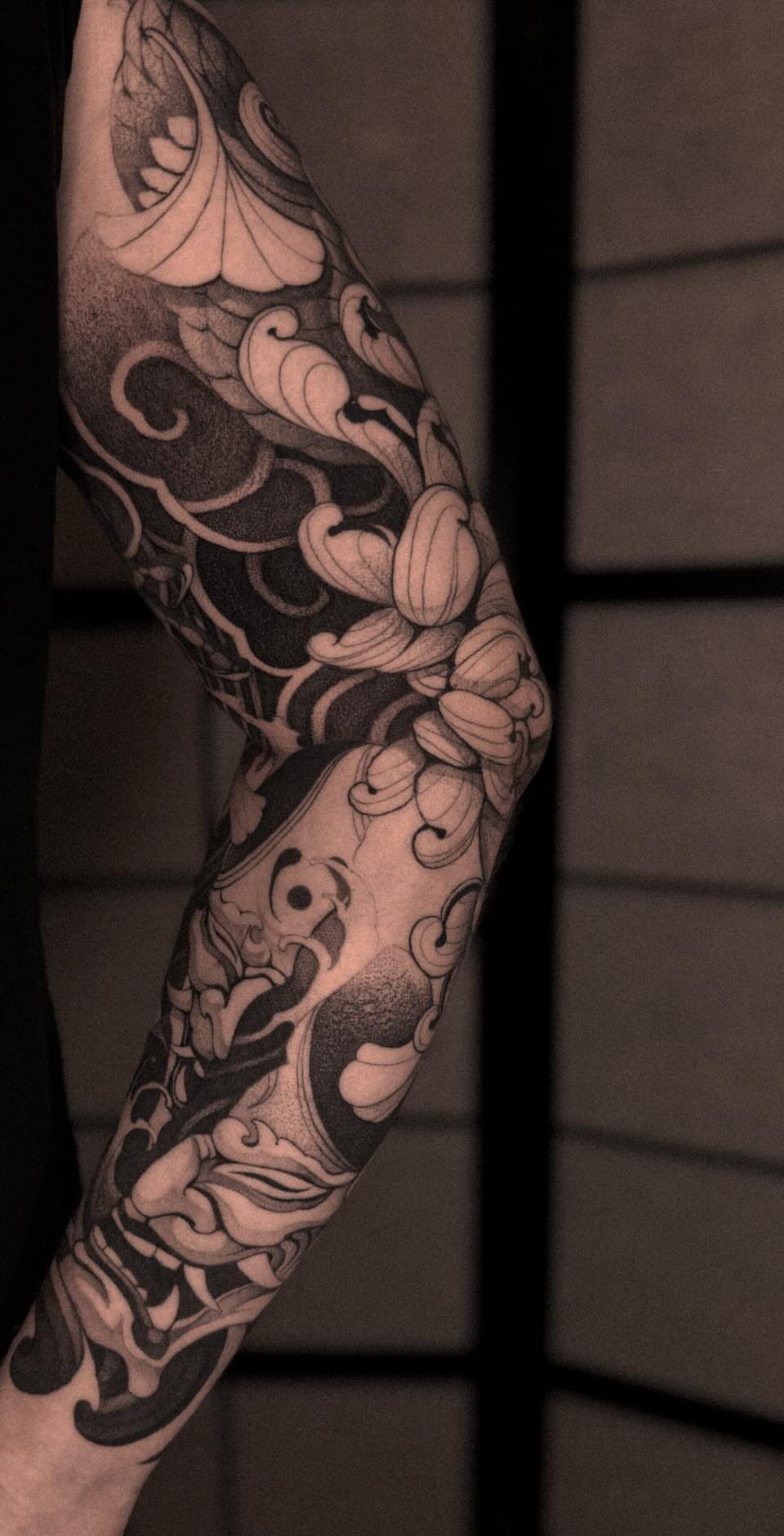
Floral motifs soften the harder edges of masks, dragons or warriors without losing the structure Japanese sleeve work needs. Peonies, chrysanthemums and cherry blossoms each carry meaning, and clouds give the flowers a background that doesn’t compete for attention.
Black and grey keeps the design readable in low light and ages more predictably than color. Shading inside the petals adds dimension, but too much blending turns flowers into smudges after a decade.
Placement matters: flowers on the forearm stay visible, while a mask or secondary figure higher up stays covered in short sleeves. I’d put the boldest bloom where the arm bends so it’s the first thing seen.
Tattoo Placement and Flow
Japanese sleeve designs follow muscle lines and joint breaks because those boundaries stay fixed while your arm moves. A composition that ignores where the bicep meets the forearm will look fractured when you bend your elbow.
Traditional placement treats the body in pairs. Both arms get tattooed in tandem, using the same motif handled differently on each side to create visual tension.
A dragon ascending on the right arm might descend on the left, or waves that crash inward on one side pull outward on the other.
That pairing amplifies the design in a way single-arm work can’t match. If you’re only doing one arm now, consider how a second sleeve would relate to it later, or accept that the arm will stand alone.
The wrist line sits slightly raised to stay hidden under a long-sleeved shirt, which matters if you need the option to cover it.
Cost of Japanese Sleeve Tattoos
A full sleeve takes 30–35 hours, split across 7–9 sessions of around 4 hours each. Sessions are spaced weeks apart to let each section heal before the next one starts.
Arm size and skin condition affect how long each session runs. Larger arms need more coverage, and skin that scars or holds ink unevenly may need extra passes.
Half sleeves cost less because they take fewer hours, usually finishing in 3–5 sessions. Three-quarter sleeves fall between half and full in both time and price.
Hourly rates change based on where you live and how experienced your artist is, so expect the total to shift from that range.
Cultural Significance
Japanese tattooing drew mass appeal after the Suikoden, a book of heroes, circulated during the Edo period. Many characters in the book wore full-body tattoos, and readers wanted the same imagery on their own skin.
Many designs trace back to ukiyo-e woodblock prints, which showed theater actors, mythical creatures and sweeping landscapes. Those motifs moved directly into tattoo work and still anchor the style today.
Shintoism supplies much of the symbolic weight.
Kami are spirits that live in wind, mountains and rivers, which is why natural elements fill so many Japanese tattoo backgrounds. Buddhism contributes figures like the Buddha and protective deities, similar to how Christian imagery appears in Western tattoo work.
Folklore and religion shape what each image means, so choosing a subject based only on how it looks ignores half the design’s function.