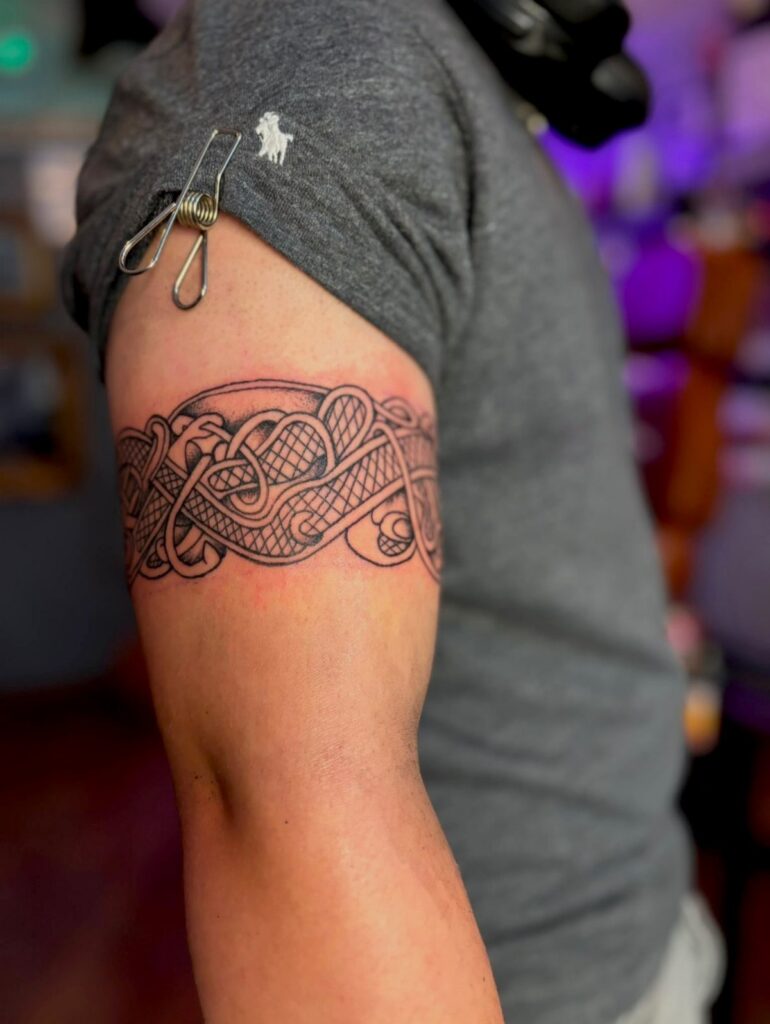
Celtic knotwork stretches from a single trinity knot on your wrist to a full sleeve that takes months and several thousand dollars to complete.
The right size depends on how much detail the pattern holds: simple designs with one continuous loop stay crisp at finger or wrist scale, while layered knots need forearm width or larger to keep the individual strands readable.
1. Celtic Cross
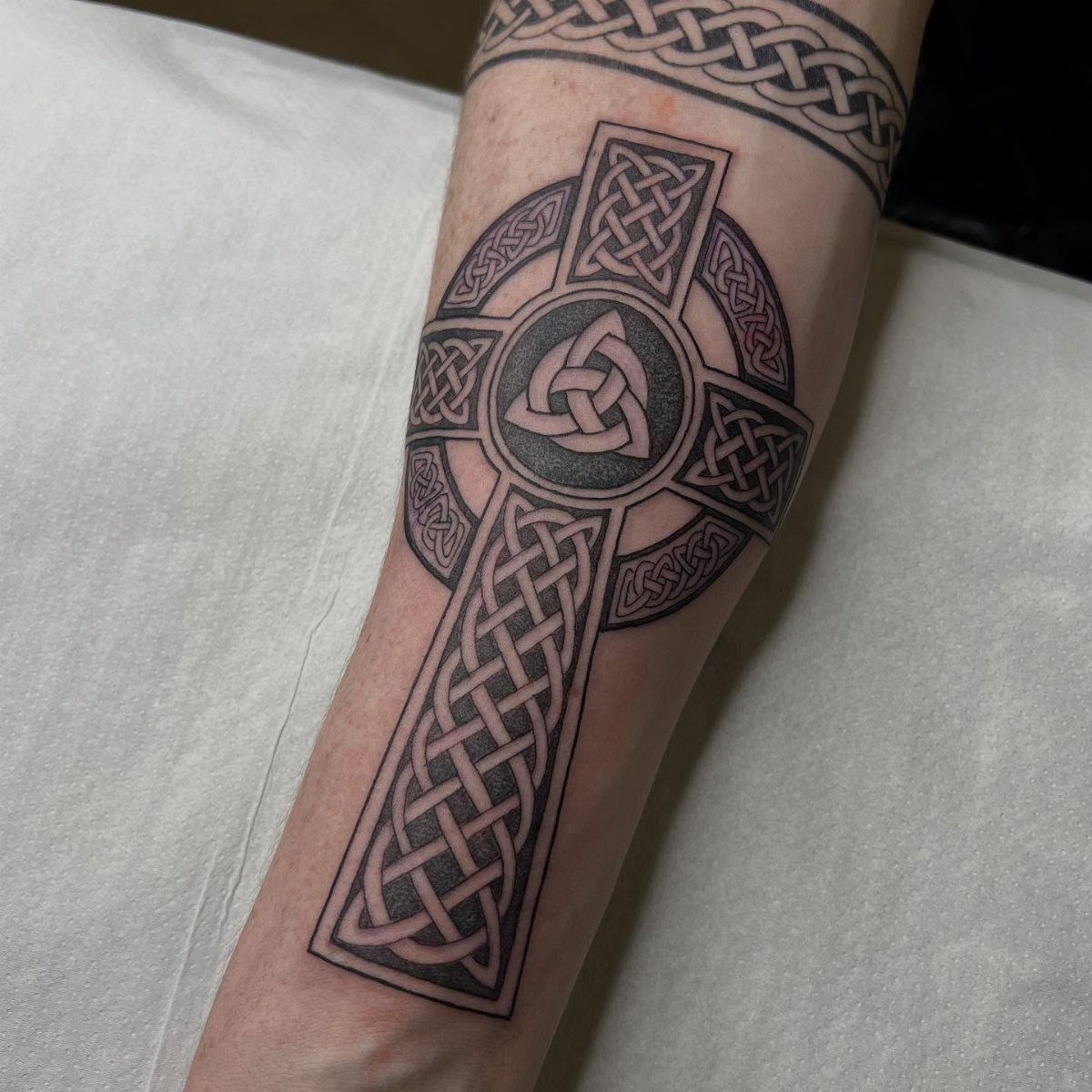
The Celtic cross merges the circle of pre-Christian knotwork with the vertical and horizontal arms of the Christian symbol, giving you a design that bridges two traditions in one piece.
The circle often holds a trinity knot or other interlocking pattern that reads clearly even at smaller sizes.
Forearm and upper arm are the most common spots, where the vertical proportion of the cross fits the natural taper of the limb.
This piece signals both heritage and faith without landing too heavily on either.
2. Celtic Love Knot
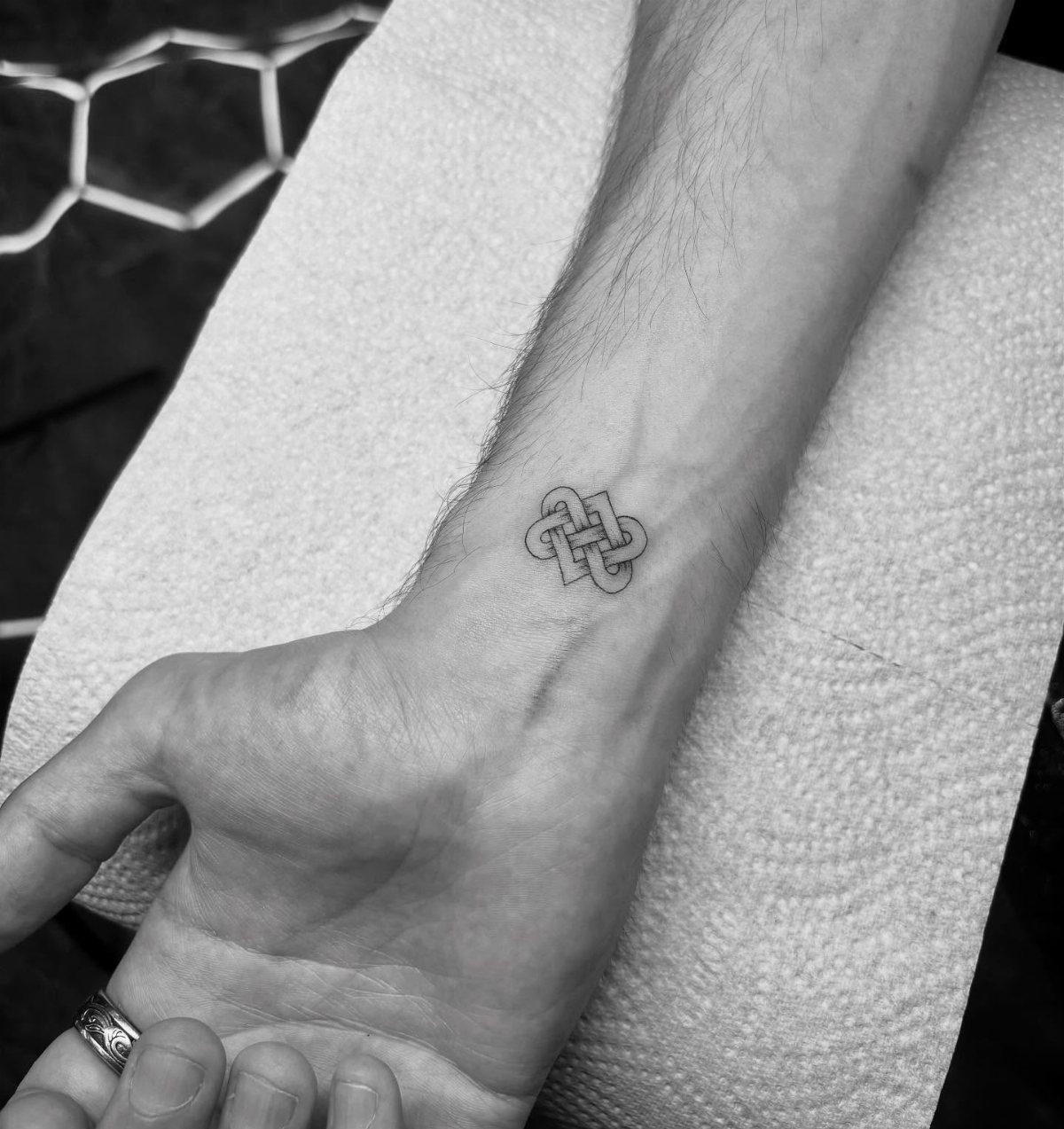
A love knot forms one continuous line that loops back on itself with no start or end, making it a compact choice for an inner wrist or collarbone.
The unbroken path is the point: it reads as permanence and connection, whether that’s romantic, familial or friendship.
At wrist size, line weight matters. Too thin and the detail blurs over time; too heavy and the pattern loses its delicacy.
I’d go slightly bolder than you think you need, especially if your skin tends to spread ink.
3. Tree of Life
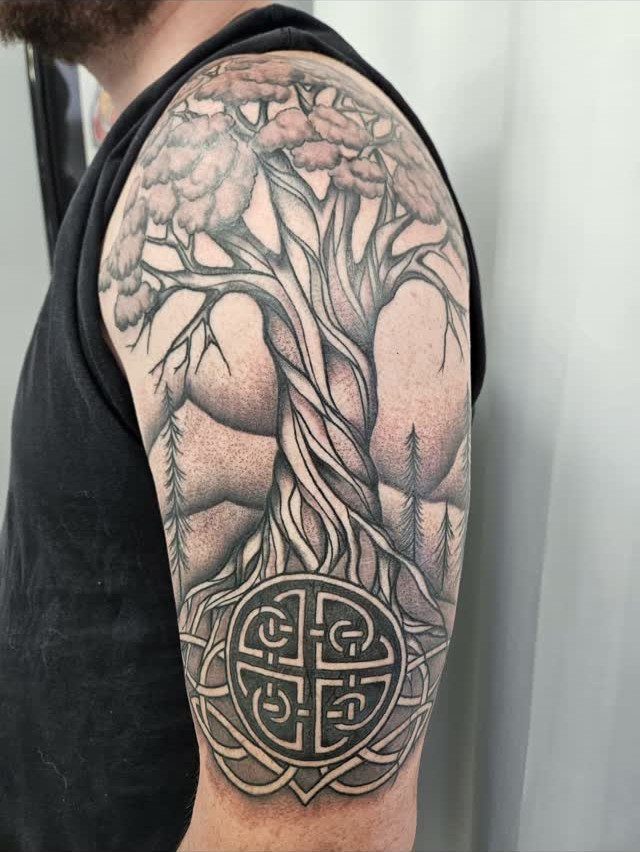
Roots mirror branches in most versions, creating symmetry that fills a circle or an oval cleanly.
Upper arm and back are the most forgiving placements, where you can go large enough to keep the individual lines readable. Small versions lose detail fast.
Landscape elements like mountains or forest in the background need enough width to give everything room.
4. Trinity Knot (triquetra)
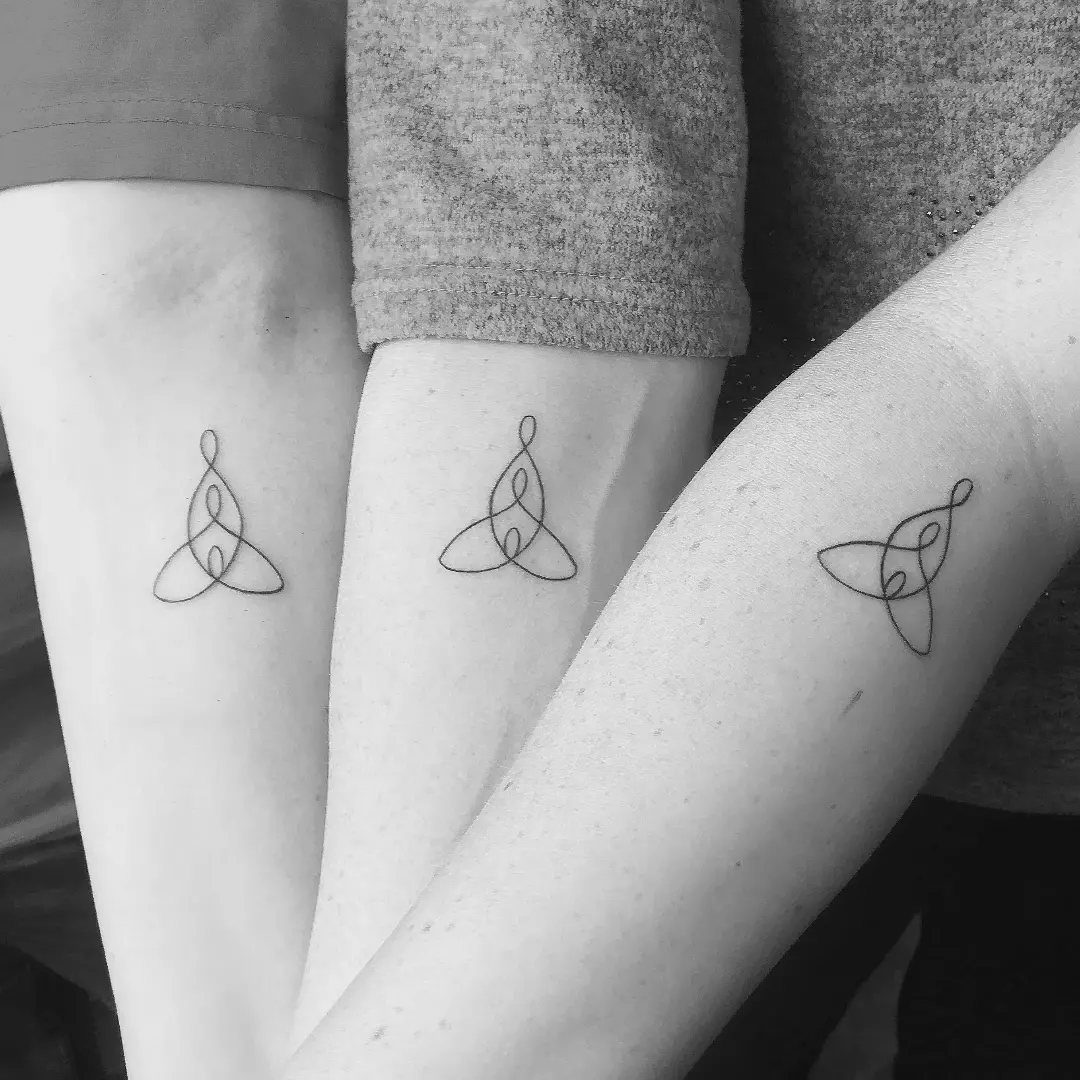
The trinity knot traces three interlocking arcs that share one continuous line, each arc pointing outward from the center.
Matching tattoos work well with this design because the form is simple and consistent, which matters when multiple people sit for the same piece.
Inner wrist, ankle and behind the ear are all small enough to keep the linework crisp without needing a lot of real estate.
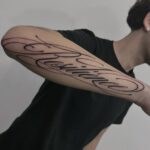
5. Forearm Celtic Knot Tattoo
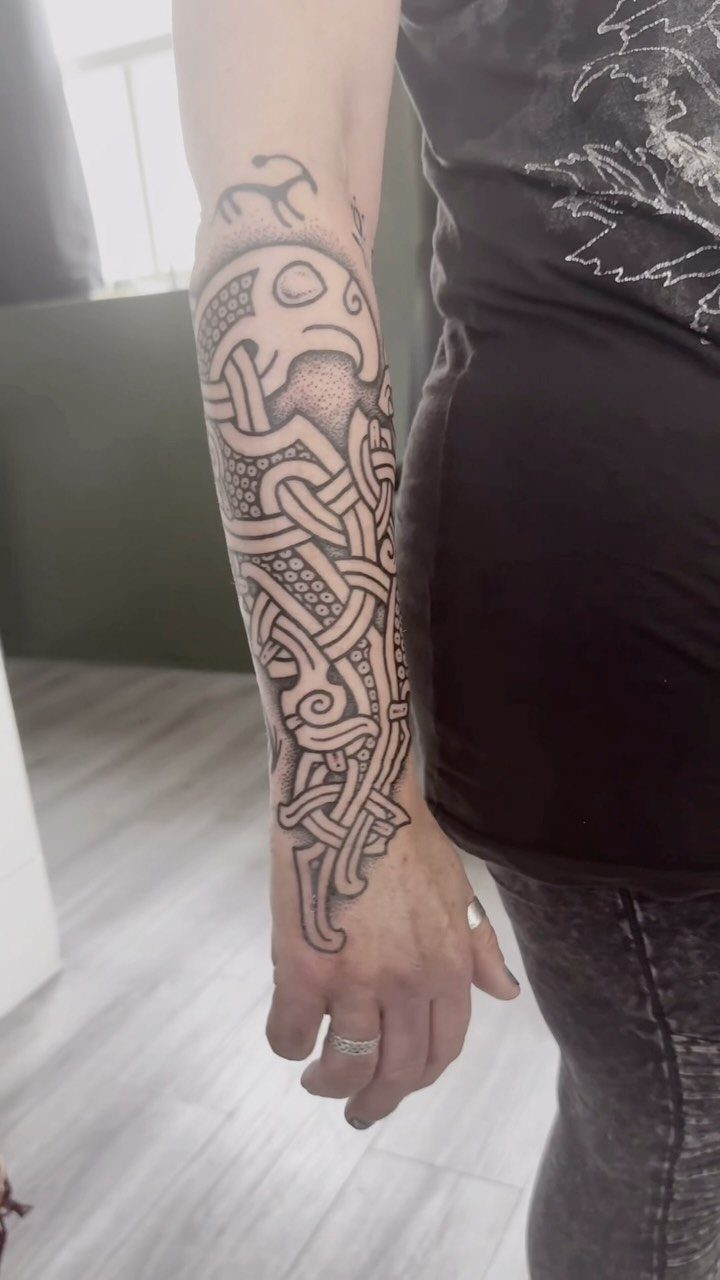
Forearm placement gives you a long, flat canvas where Celtic knotwork can stretch vertically or wrap around the muscle without distorting when your arm bends.
Birds, stags and serpents are common motifs, each carrying its own symbolic weight.
Line thickness should hold up without touch-up, so go at least medium weight. Thin lines will blur, especially where the pattern gets dense.
6. Dotwork Celtic Knot Tattoo
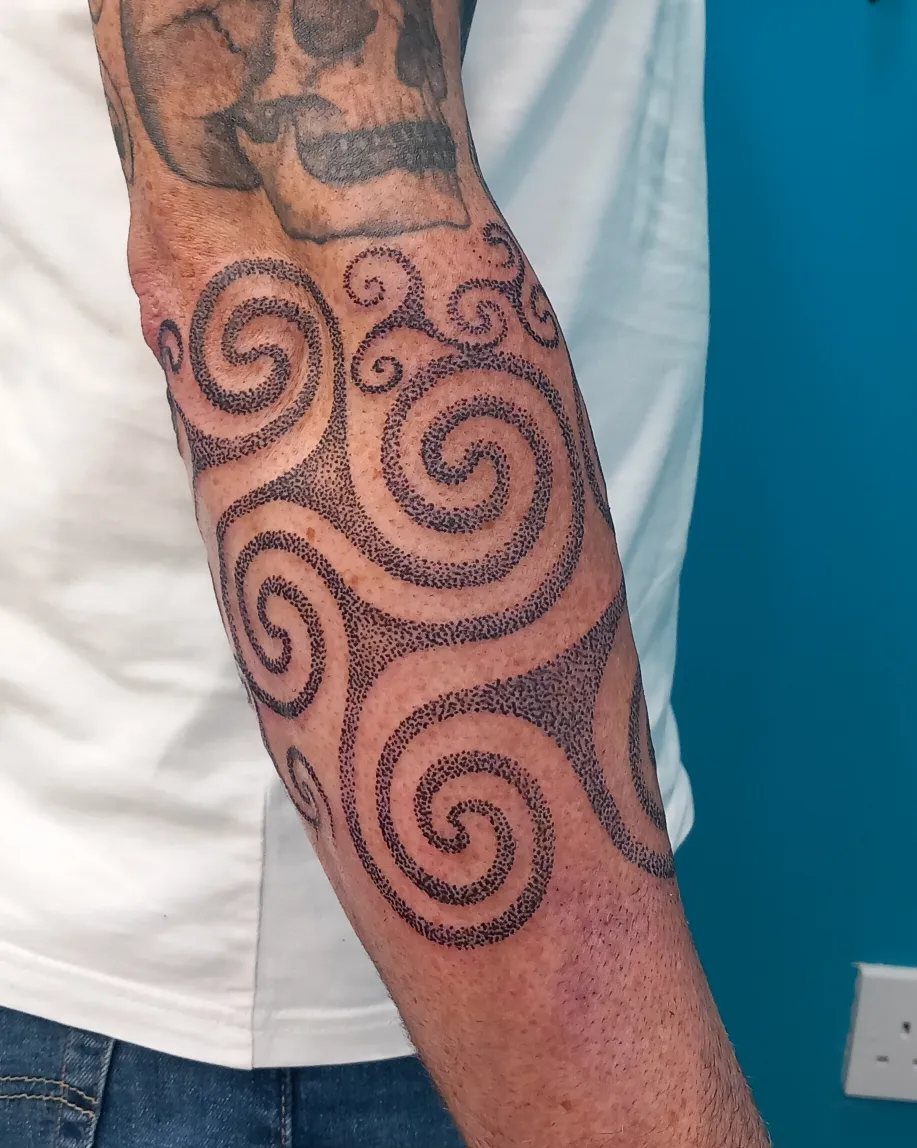
Dotwork builds the design entirely from individual dots, creating gradient and depth without solid fills or shading. Each spiral in a triple-knot pattern is formed by thousands of dots placed at varying density.
The result is softer and more textured than solid linework, but it takes longer to apply and needs an artist comfortable with pointillism.
Forearm is a good spot for this technique because the skin is relatively flat and the design stays visible without needing to rotate your arm.
Healing is straightforward, though the tattoo will look darker immediately after and lighten as it settles.
7. Celtic Knot Full Sleeve Tattoo
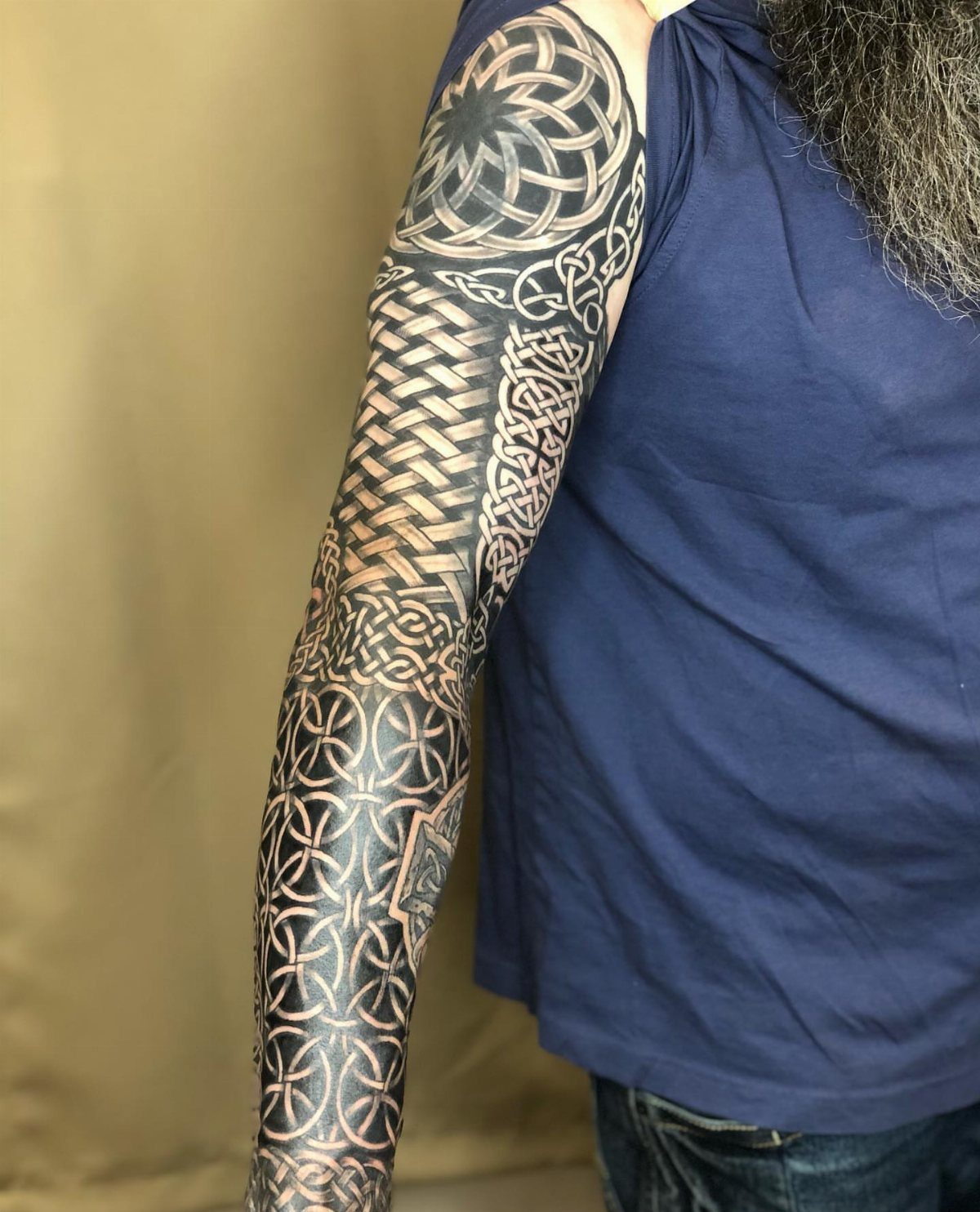
This style fills the arm from shoulder to wrist with one continuous field of knotwork, usually built from multiple patterns that connect without breaking the visual flow.
This takes multiple sessions spread across several weeks, and the cost reflects that. Expect to budget several thousand dollars depending on detail density and your artist’s rate.
The arm bends at different angles, so the design needs to account for distortion when your elbow flexes. Flat, geometric patterns hold up better than designs that rely on perfect symmetry.
Black and grey keeps the focus on line and form without color fade becoming an issue years later.
8. Green Celtic Knot with Shamrocks
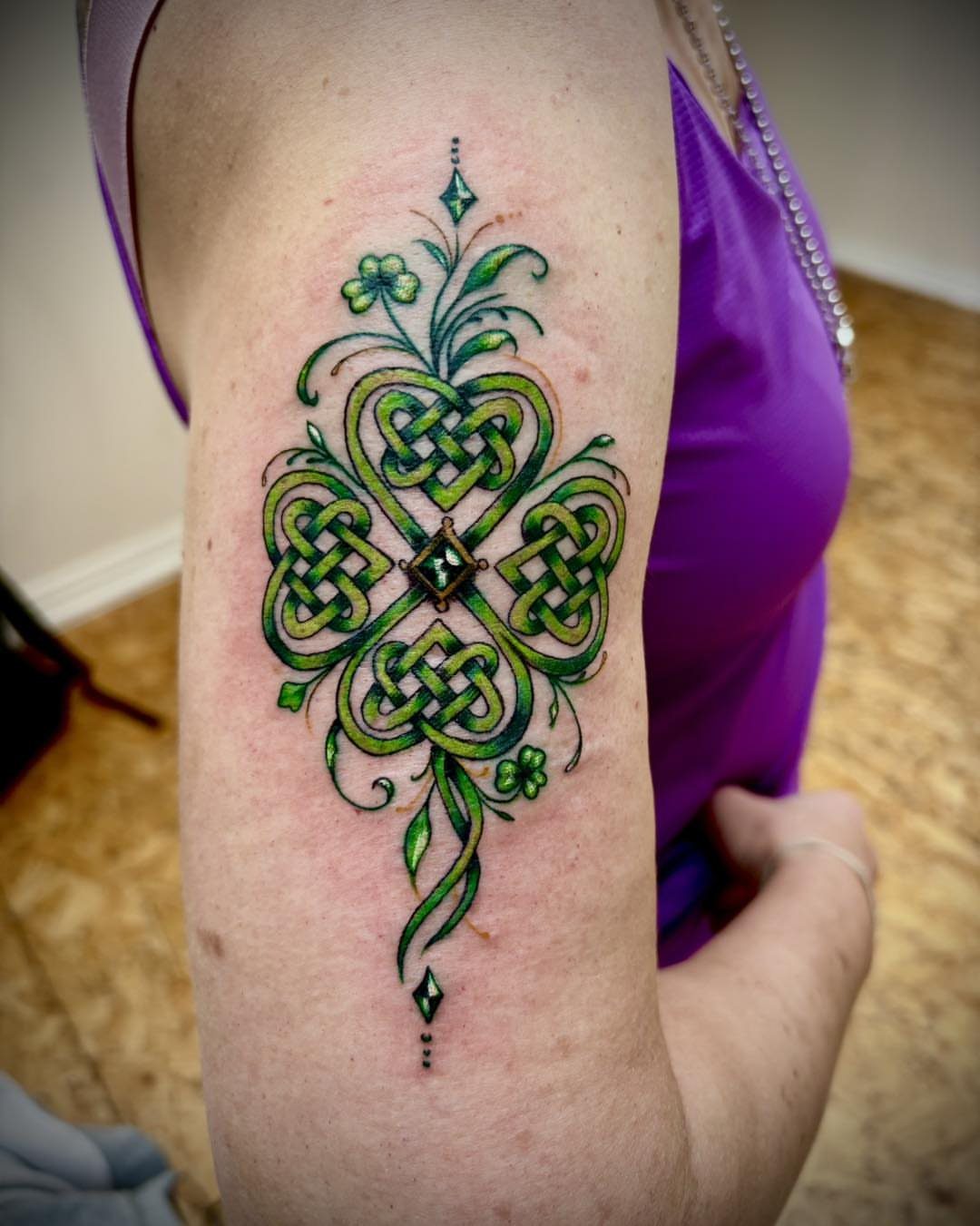
Green ink brings the Irish national color into the design, pairing well with shamrock leaves worked into the outer loops or corners of the knot.
Color will fade faster than black, especially green, which tends to shift toward blue-grey after a few years. A single session touch-up down the line usually brings it back.
Upper arm gives enough room for both the knot and the shamrocks to read as separate elements without crowding. Smaller placements force you to simplify one or the other.
If heritage is the reason for the piece, the green adds an immediate visual cue that black alone doesn’t carry.
9. Celtic Knot Wrist Tattoo
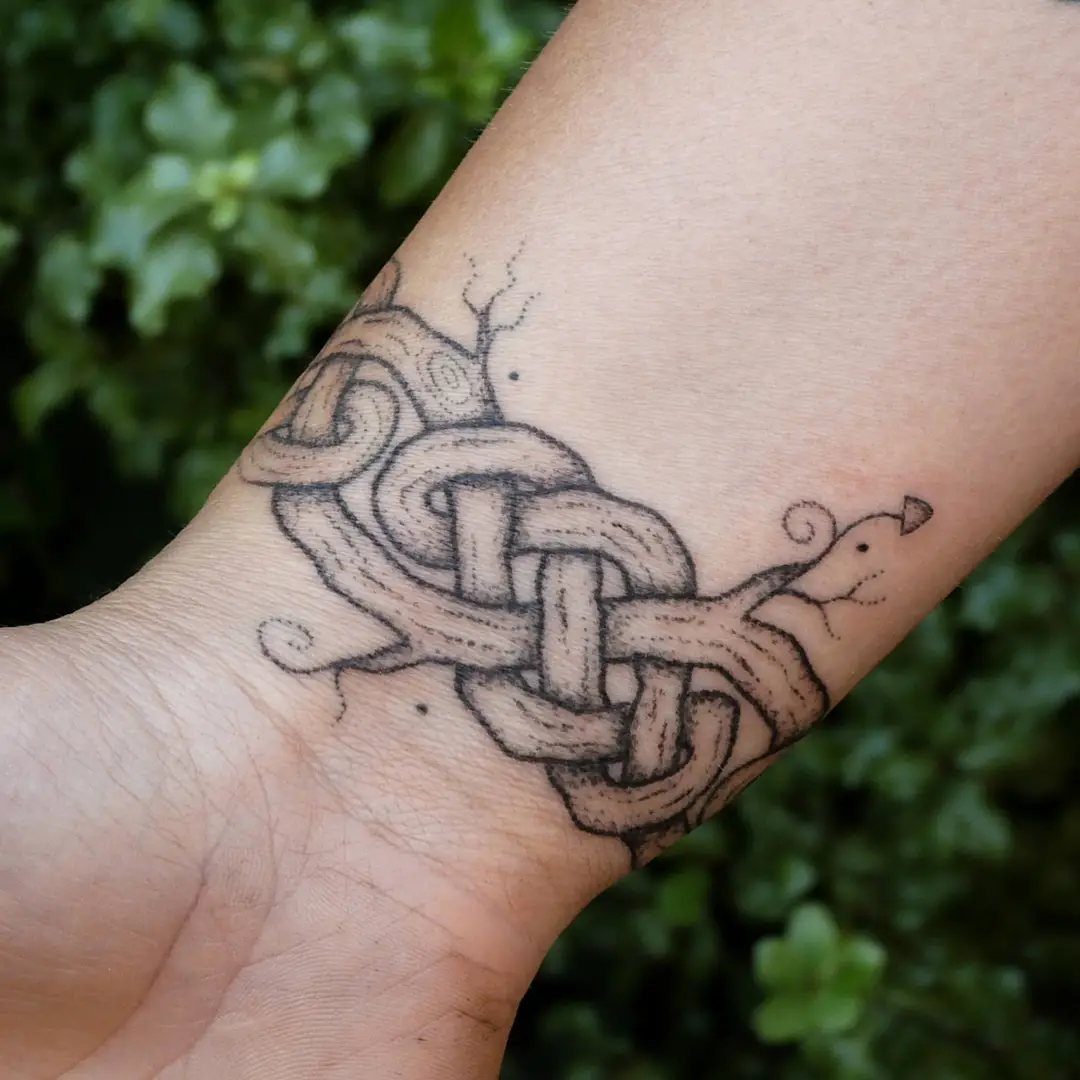
Inner wrist gives you a compact spot where a single knot stays visible without taking up much skin. The design needs to be simple because detail this small will blur.
Stick to one knot with medium-weight lines. Stacking multiple patterns or adding fine detail won’t survive more than a few years before the ink spreads.
Pain is moderate here, with more sensitivity over the tendon than on the outer wrist. You’ll want to avoid tight watchbands or bracelets while it heals.
This placement is easy to cover with a sleeve or bracelet if your job requires it.
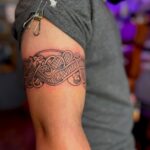
10. Celtic Knot Armband Tattoo
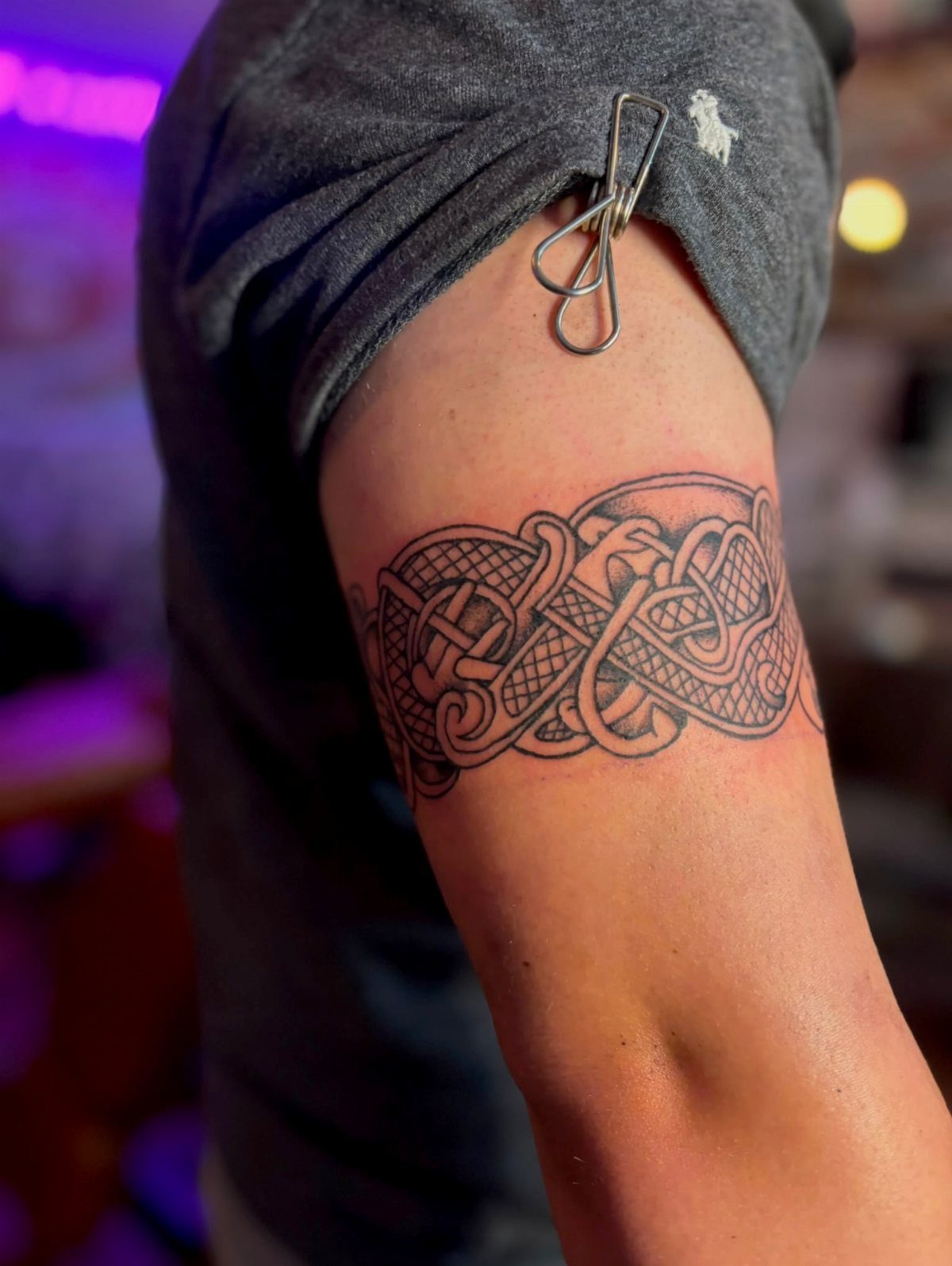
An armband wraps the upper arm in one continuous belt of knotwork, sitting just below the shoulder or at the widest part of the bicep.
Placement on the bicep means the design shifts as the muscle flexes, so symmetry matters less than continuous flow. The band should feel balanced at rest, not perfectly centered when measured.
Line weight needs to be medium or heavier.
Session length depends on how much of the arm you’re covering. Pain is manageable, with more discomfort on the inner arm where the skin is softer.
11. Celtic Knot Finger Ring Tattoo
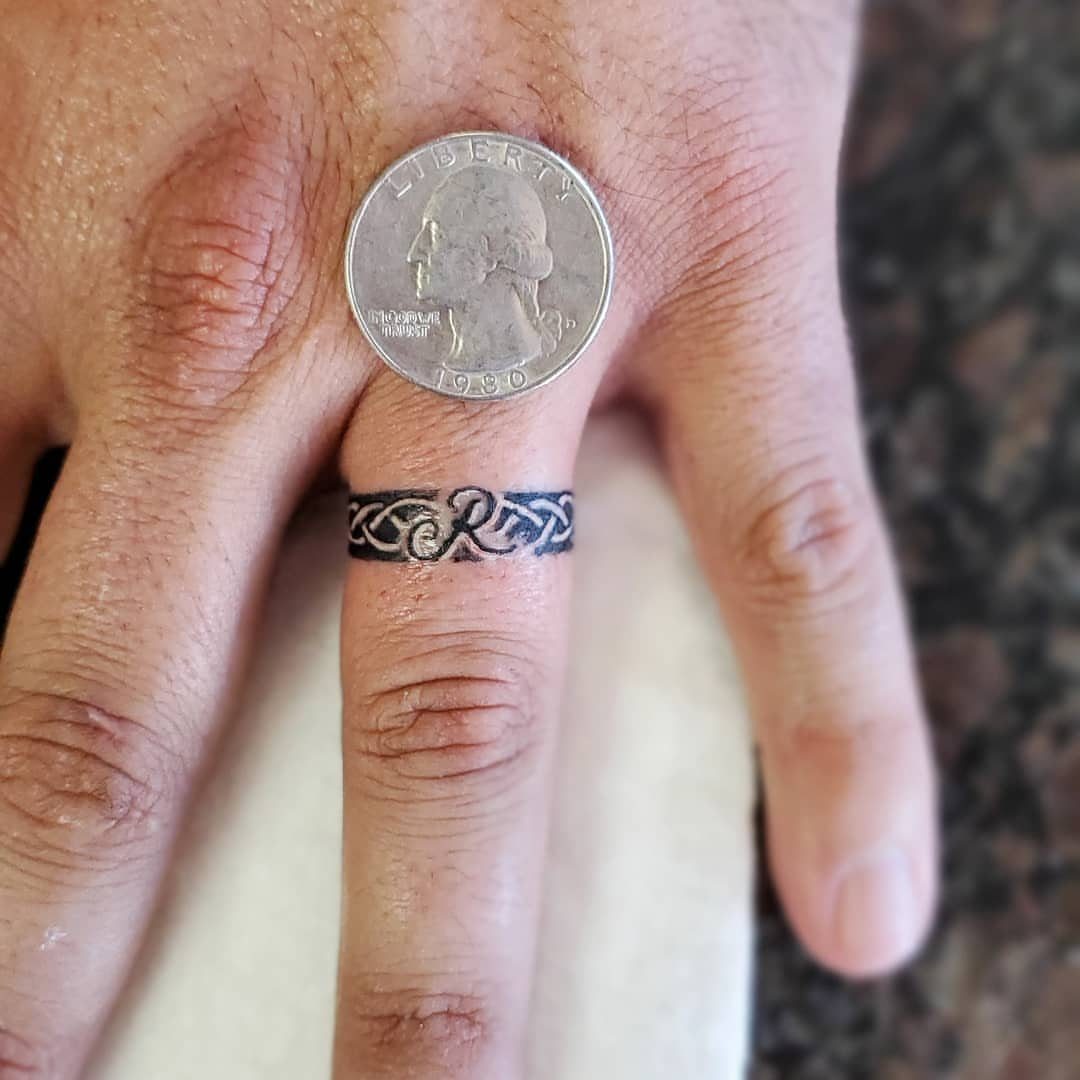
A finger ring tattoo wraps the base of the finger in a thin band of knotwork, replacing or supplementing a metal ring.
Finger tattoos fade faster than almost any other placement because hands see constant friction and washing. Expect to touch this up regularly if you want it to stay crisp.
The design has to be simple.
One or two interlocking loops is the most detail that will hold at this size. Anything more turns into a muddy line after a year.
Pain is sharp but short, since there’s very little flesh between the needle and bone. The session is quick, and you’ll need to keep it clean while it heals.
Choosing a Design
Start with what the piece needs to say. Eternity and connection are the most common themes, both tied to the unbroken line that defines the form.
Heritage is another, especially when you add shamrocks, stags or other culturally specific motifs. If none of those resonate, knotwork still works as pure geometry.
Style comes next.
Minimalist designs use clean linework and leave open space around the pattern, keeping the composition simple. Complex versions layer multiple knots or add animals and landscape elements, covering more skin and requiring more sessions.
Custom work lets you combine symbols that matter to you, but it means more time spent refining the design with your artist before the first session.
Pre-designed knots are ready to apply and cost less upfront. Either way, bring references and talk through what you want the piece to communicate before any stencil goes on.
Techniques for Tattooing
Linework forms the backbone of most Celtic knot tattoos, outlining each loop and overlap with sharp, continuous strokes.
The lines need to be clean because any wobble shows immediately in a geometric pattern. Artists who specialize in this style keep their hand steady and their machine set to a consistent depth.
Shading adds depth where one strand passes under another, making the weave readable. Without it, complex patterns can flatten into a tangle.
Frequently Asked Questions
What does the Celtic knot tattoo mean?
The unbroken line in a Celtic knot represents continuity, eternity and the interconnection between life, death and rebirth.
Some designs carry specific meanings, like the trinity knot symbolizing 3 elements of existence or the love knot standing for eternal union. The design loops without a beginning or an ending, so it represents cycles, eternity and bonds that hold.
What are the types of Celtic knots?
The trinity knot weaves 3 arcs together, each with a point facing out, and can stand for the holy trinity, life through death to rebirth, or past, present and future.
The love knot locks 2 hearts together to mark the bond between partners.
The motherhood knot shows 2 hearts, one cradling the other, with dots sometimes added to mark the number of children. The spiral knot uses 3 spirals to represent water, earth and fire, elements sacred to the ancient Celts.
How big should a Celtic knot tattoo be?
Small versions lose detail fast, so size depends on how much interlocking pattern you want to keep readable.
A simple trinity knot on the inner wrist works at around 3 inches, but anything with multiple strands or added motifs like animals or landscape needs at least the width of a forearm to give each line room.
The gaps between lines should stay as wide as the lines themselves, or the design will blur as the ink settles.
Is Celtic knotwork pagan?
Most interlace knotwork comes from Christian manuscripts and stone crosses dating to the 7th century onward, not pagan sources.
Many modern designs blend both traditions, and the meanings attached to specific knots were often supplied centuries later rather than recorded by the original makers.