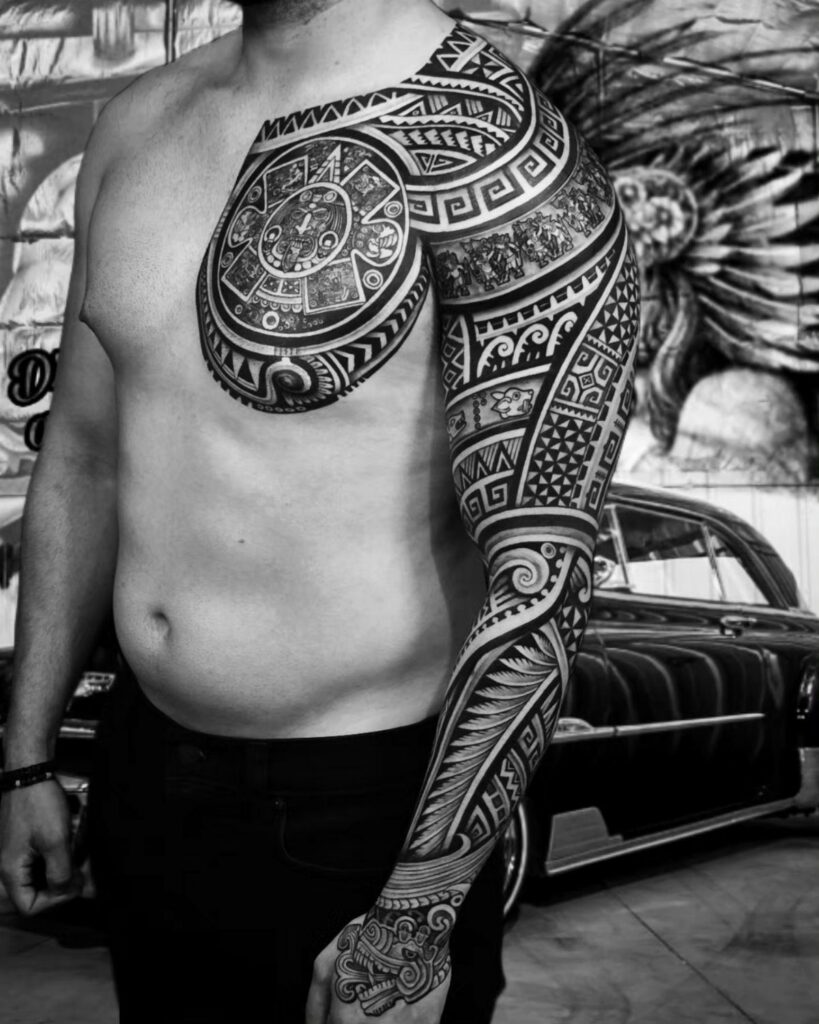
Aztec pattern tattoos pull from a civilization that marked rank and belief directly on the skin, and the designs range from single animals tied to specific gods to full geometric coverage that wraps an entire limb.
Black and grey shading handles the dense patterning and concentric rings of calendar stones without needing color, and the geometric precision requires an artist who can hold crisp lines across multiple sessions.
1. Aztec Eagle
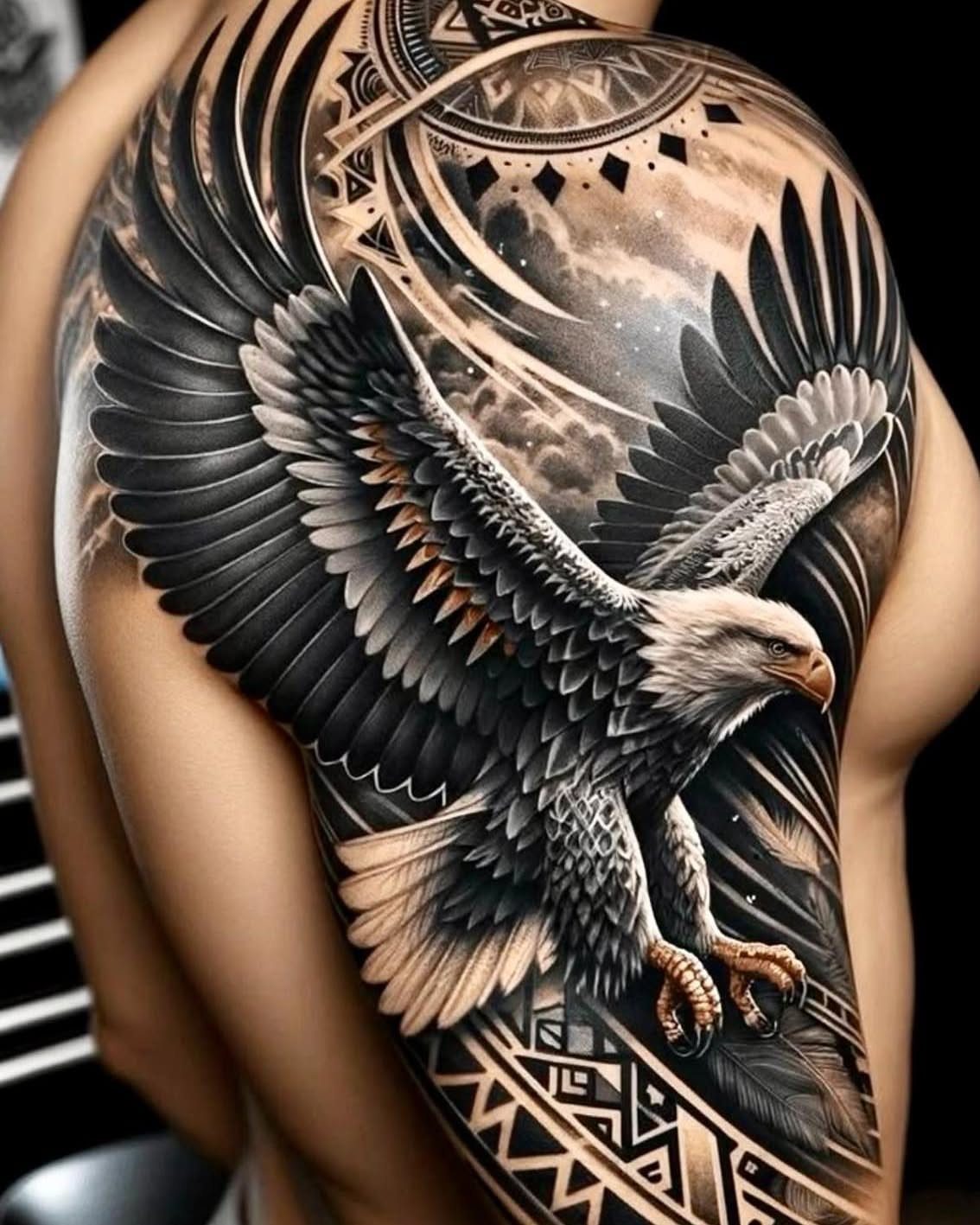
The eagle sits at the top of Aztec cosmology, the warrior’s companion and the sun’s messenger. Choosing this one signals you’re after a design that reads as strength without spelling it out.
Black and grey shading gives the feathers depth, and the geometric borders frame the bird without competing with it. A back or shoulder gives the wingspan room to land properly, and the pattern fills negative space so everything feels balanced.
For something unmistakably Aztec but still centered on one figure, the eagle does that work.
2. Aztec Serpent
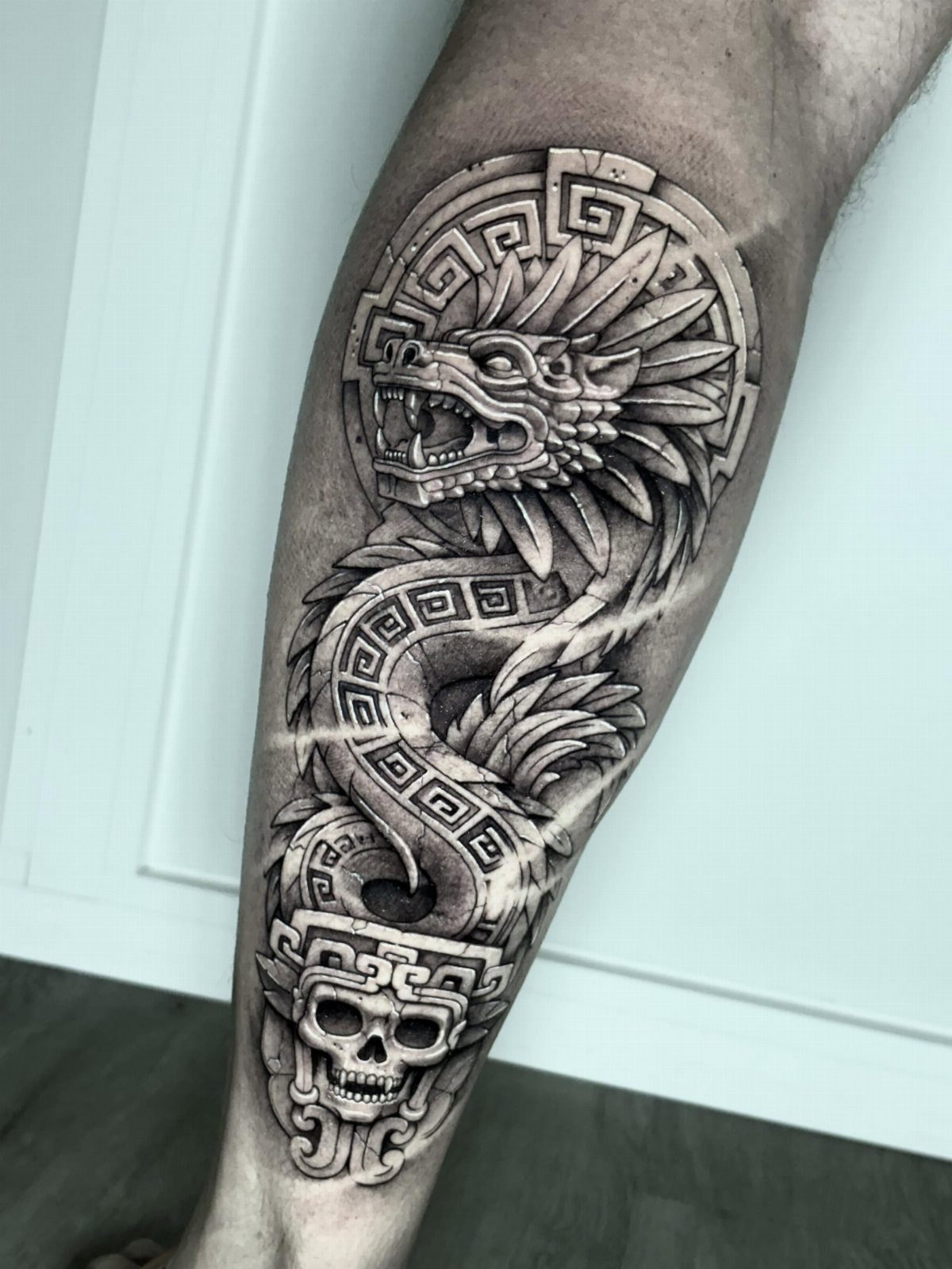
Quetzalcoatl, the feathered serpent, shows up in Aztec art as a god of wind, learning, and the space between earth and sky. A serpent coiled around geometric blocks or a skull brings that duality straight to the surface.
The leg works well here because the body curves with the calf, and the length lets the tail wrap or taper naturally. Black and grey directs attention to line quality, and intricate feather detail separates this from generic snake work.
For anyone drawn to transformation or a design that carries actual mythological weight, this one delivers.
3. Aztec Sun
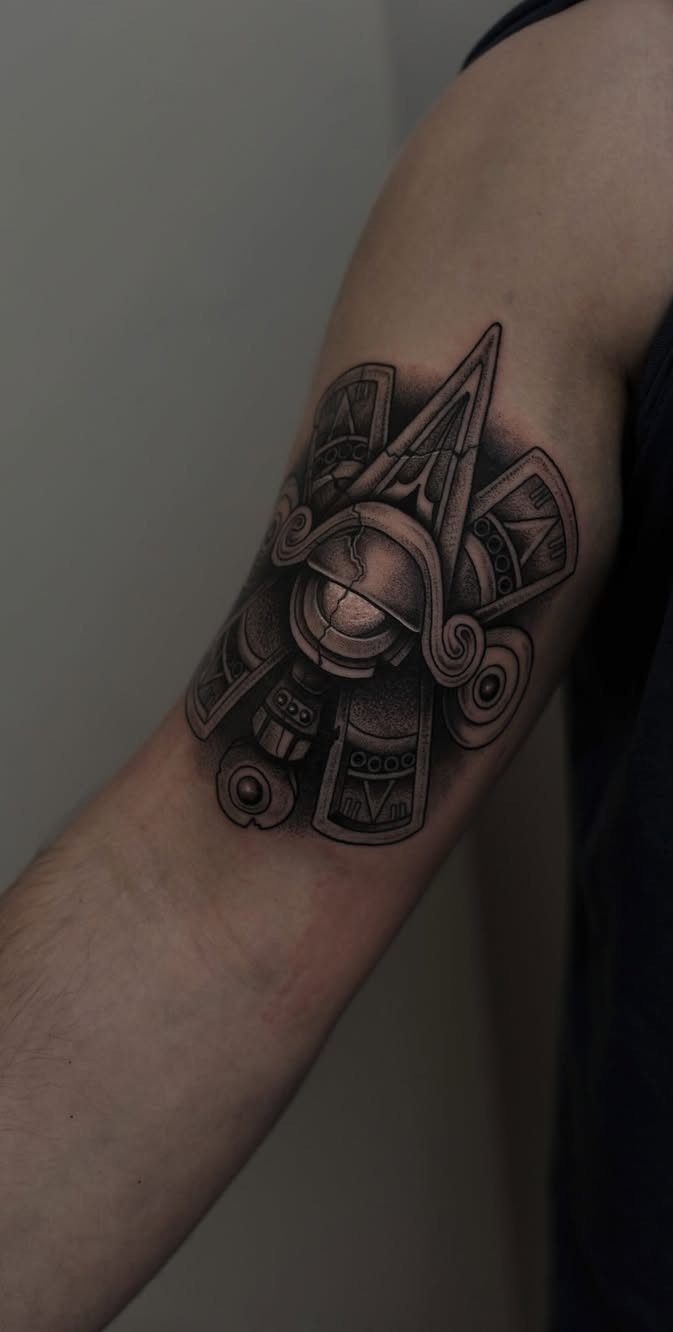
The sun stone face, often mistaken for a calendar, represents Tonatiuh, the sun god who demanded sacrifice to keep the world turning. Circular symmetry and radiating lines make it a natural fit for rounded body parts.
Upper arm placement centers the design and lets the rays extend across the muscle. Black and grey shading adds dimension to the concentric rings, and the face in the middle anchors it all.
4. Modern Interpretations
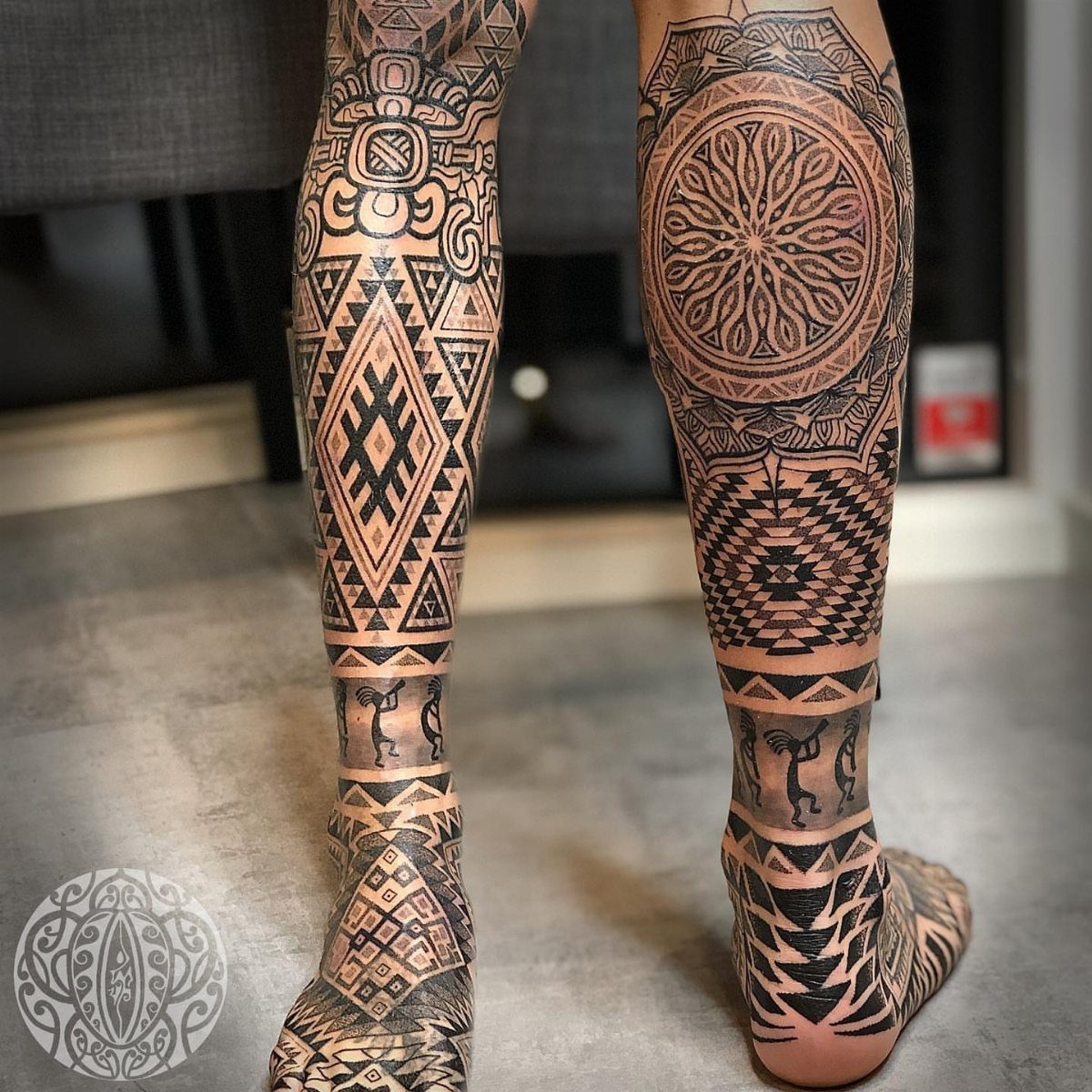
Some artists pull Aztec geometry into dotwork, mandalas, or fine-line layering that wouldn’t have existed in pre-Columbian work. The result feels less like historical recreation and more like a conversation between old symbols and new technique.
Lower legs and feet suit this approach because the skin wraps tightly and shows detail well, though the tops of feet hurt more than most spots.
Full black holds the patterns crisp, and the density creates a cohesive look across multiple sessions.
If strict authenticity isn’t the goal, this opens up design options that still honor the source material.
5. Black and Grey Ink Aztec Pattern Tattoo
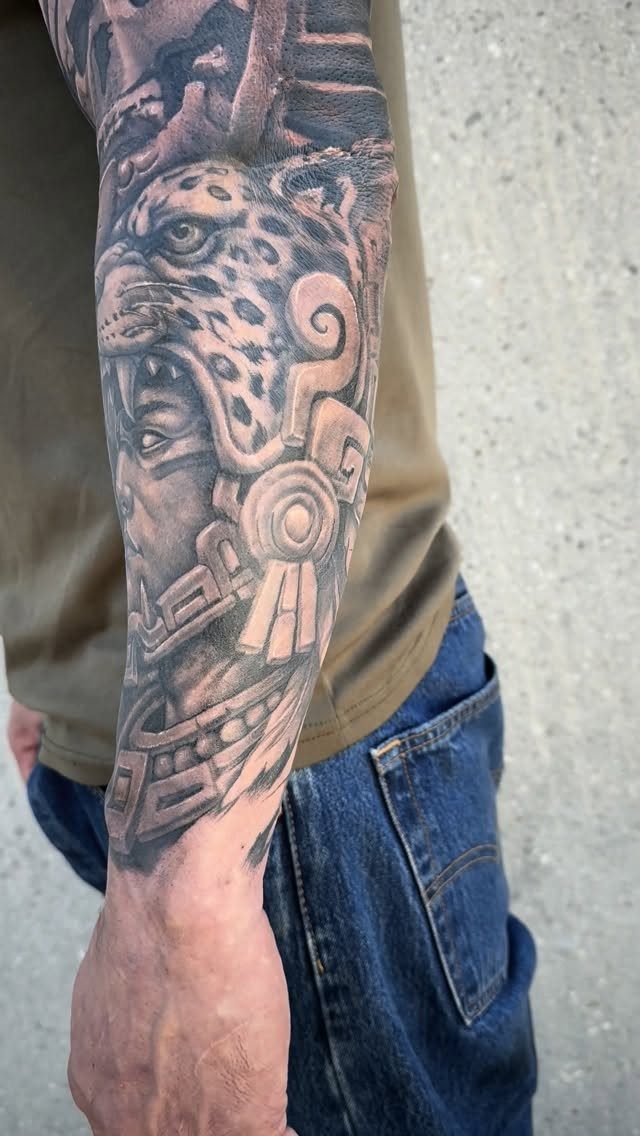
Modern black and grey work mimics that tonal range while adding smoother gradients and finer detail than the original tools allowed.
A warrior in a jaguar headdress combines human and animal symbolism, both tied to elite military orders. The forearm gives a vertical canvas that lets the figure sit upright, and the lack of color directs attention to form and shading.
For anyone who wants the aesthetic without bright pigment, black and grey handles Aztec imagery as well as any style.
6. Aztec Crocodile
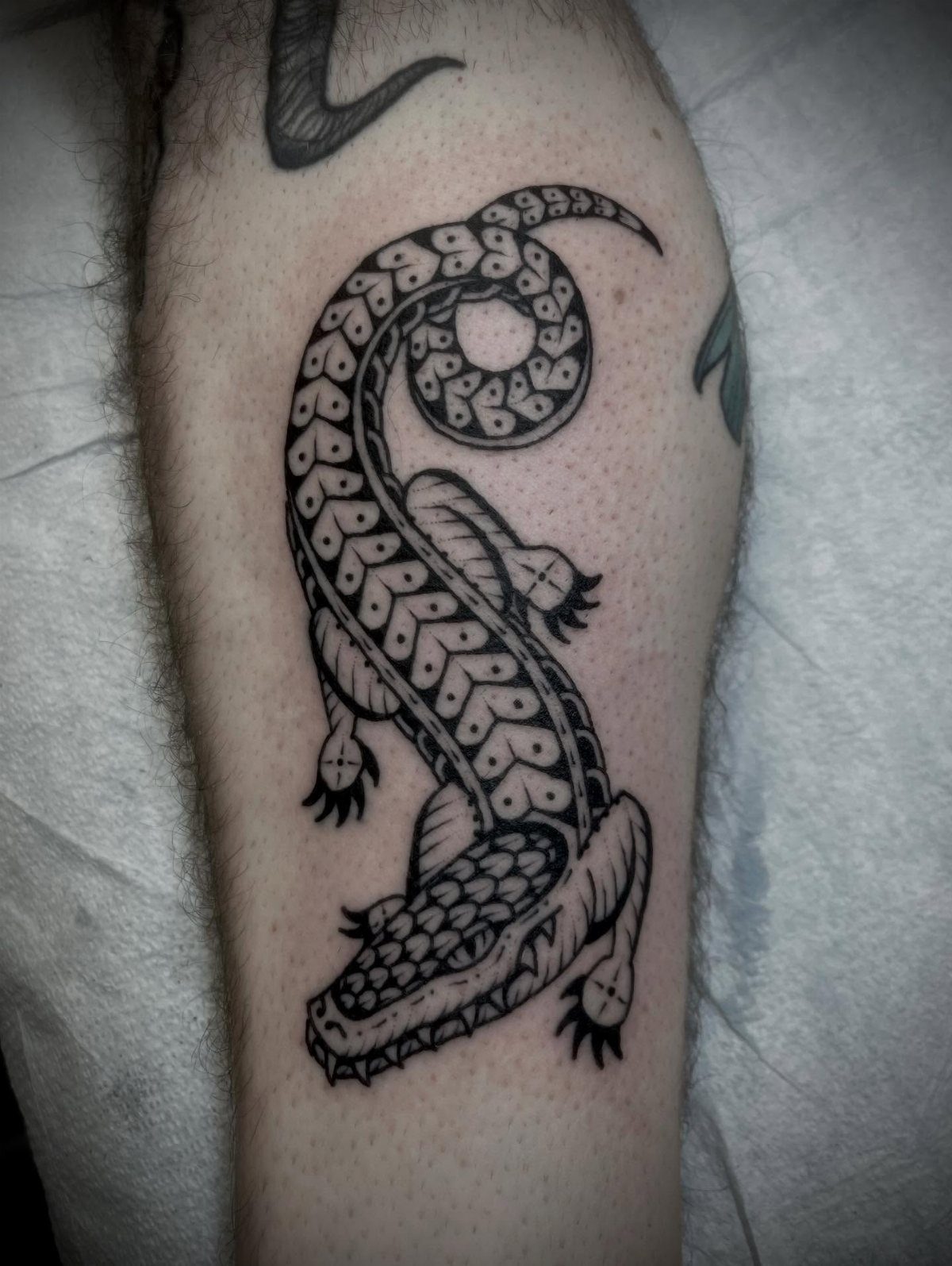
Cipactli, the crocodile or earth monster, is the first day of the Aztec calendar and the base on which the gods built the world. Stylized curves and geometric segmentation turn the reptile into something between creature and symbol.
Leg placement follows the natural taper of the calf, and the tail can curl or extend depending on how much space you’re filling. Black ink and sharp lines hold the design readable, especially when the pattern gets dense.
For a figure tied to creation mythology rather than war or the sun, the crocodile is the one.
7. Aztec Calendar
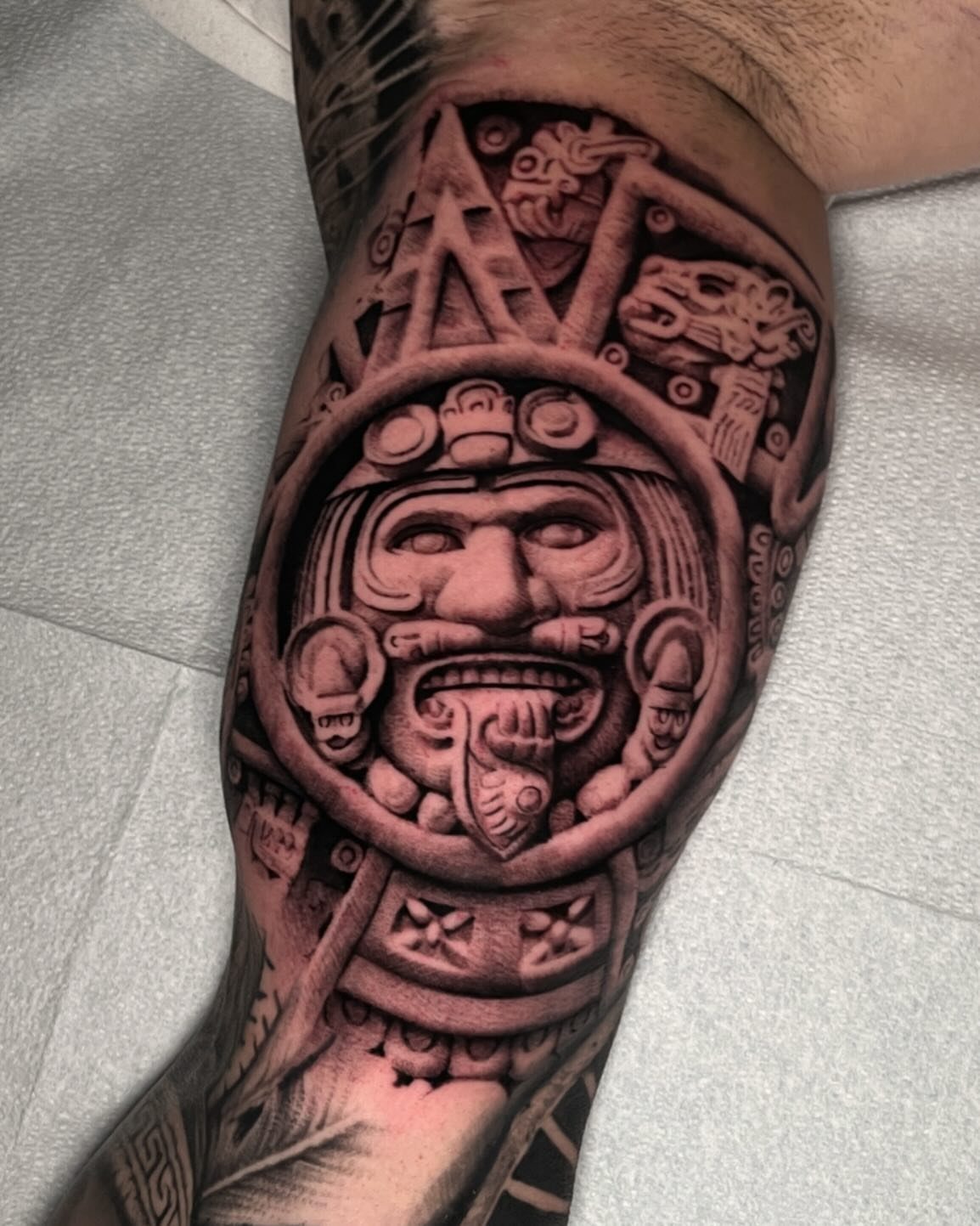
The calendar stone, often called the Sun Stone, stacks concentric rings of glyphs around a central face with its tongue extended. Time, cycles, and the belief that the universe moves through repeating eras all sit in one circular composition.
Forearm placement centers the design and gives the rings room to read clearly.
For a piece tied to cosmology rather than a single deity or animal, this one anchors the concept of eternity in something you can see.
8. Aztec Pattern Tattoo on Arm
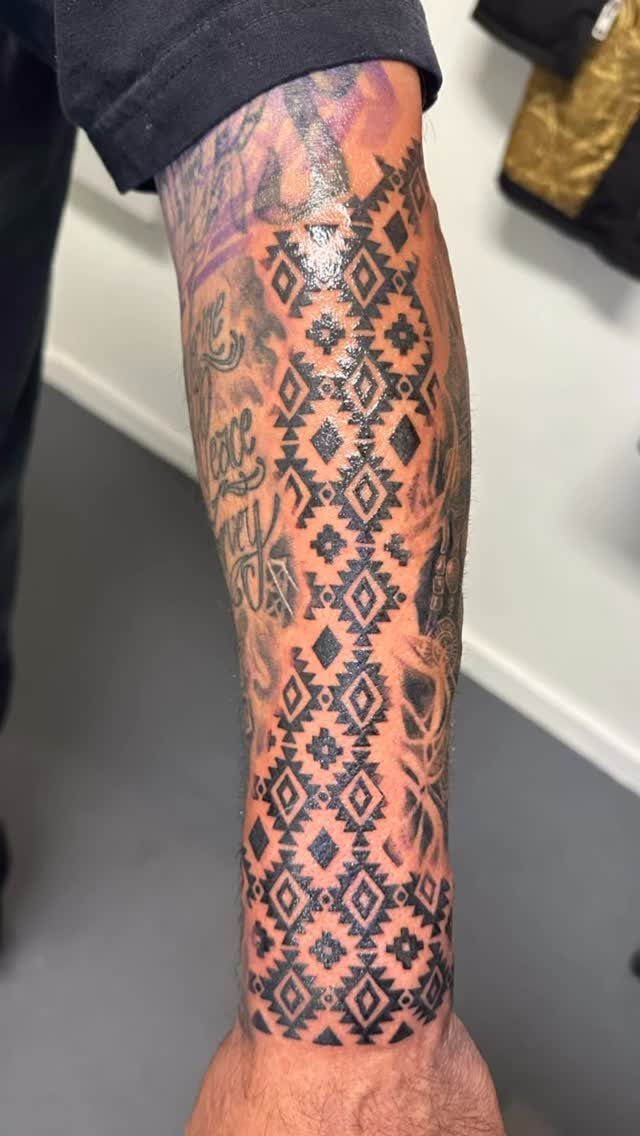
Geometric diamonds and stepped patterns, repeating in straight lines, give the arm a wrapped look without needing a full sleeve.
The forearm shows detail well because the skin stays visible most of the year, and the flat surface keeps lines crisp.
Black ink holds the pattern readable even as it ages, and the symmetry makes placement straightforward. This works for someone who wants Aztec design without centering it on a god or mythological figure.
If you already have other work, the geometric approach layers well next to existing pieces.
9. Aztec Pattern Leg Tattoo
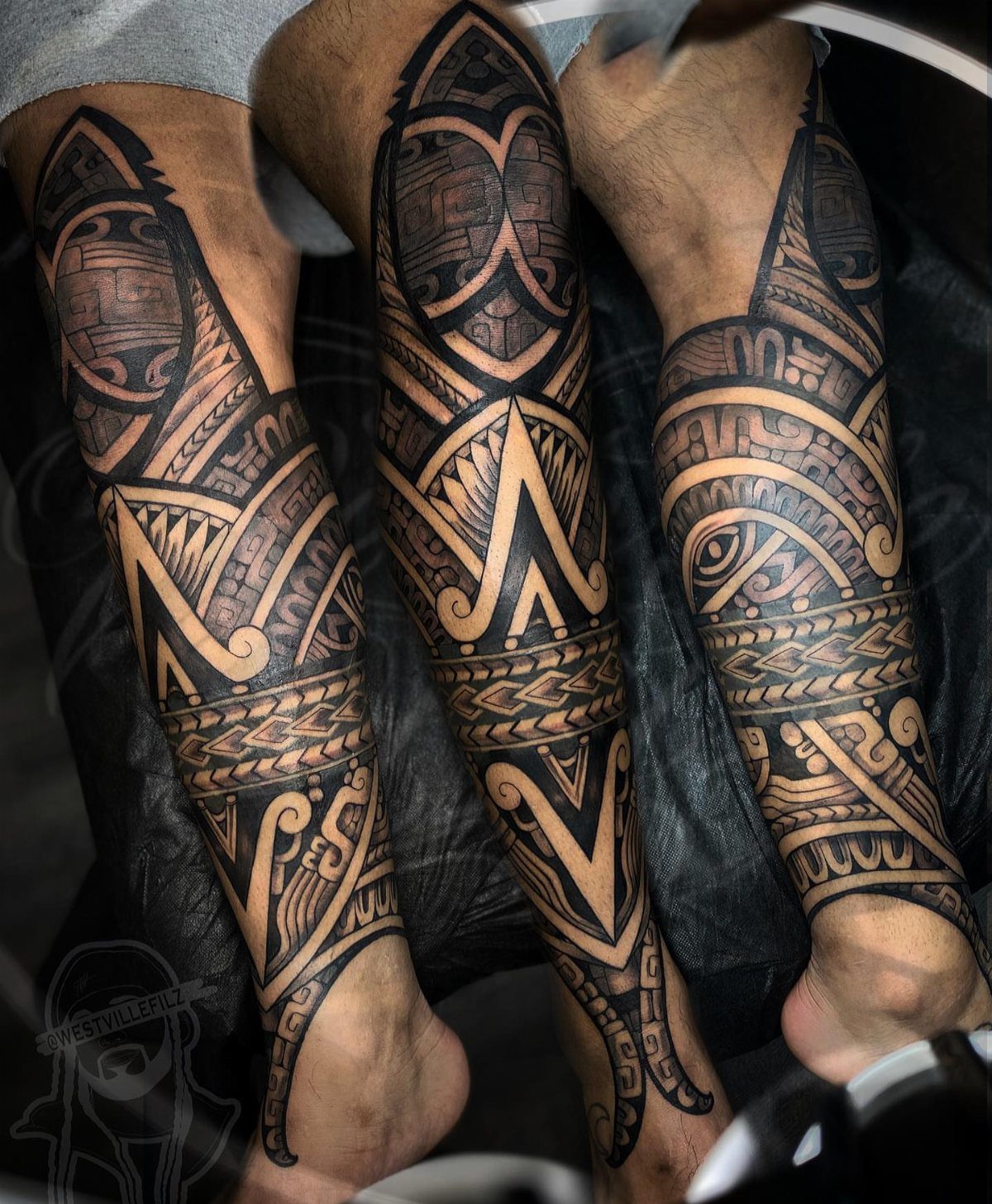
Covering the calves and ankles in solid geometric patterns creates a wrapped effect that follows the leg’s natural taper. The repeating motifs read from a distance, and the density keeps everything unified across a large area.
Lower legs hurt less than ribs or feet, though the ankle bone and Achilles tendon are still sensitive. Black ink stays sharp, and the amount of coverage usually takes multiple sessions.
For someone committed to a bold, high-contrast look that fills the space completely, this approach delivers.
10. Aztec Headdress Skull Tattoo
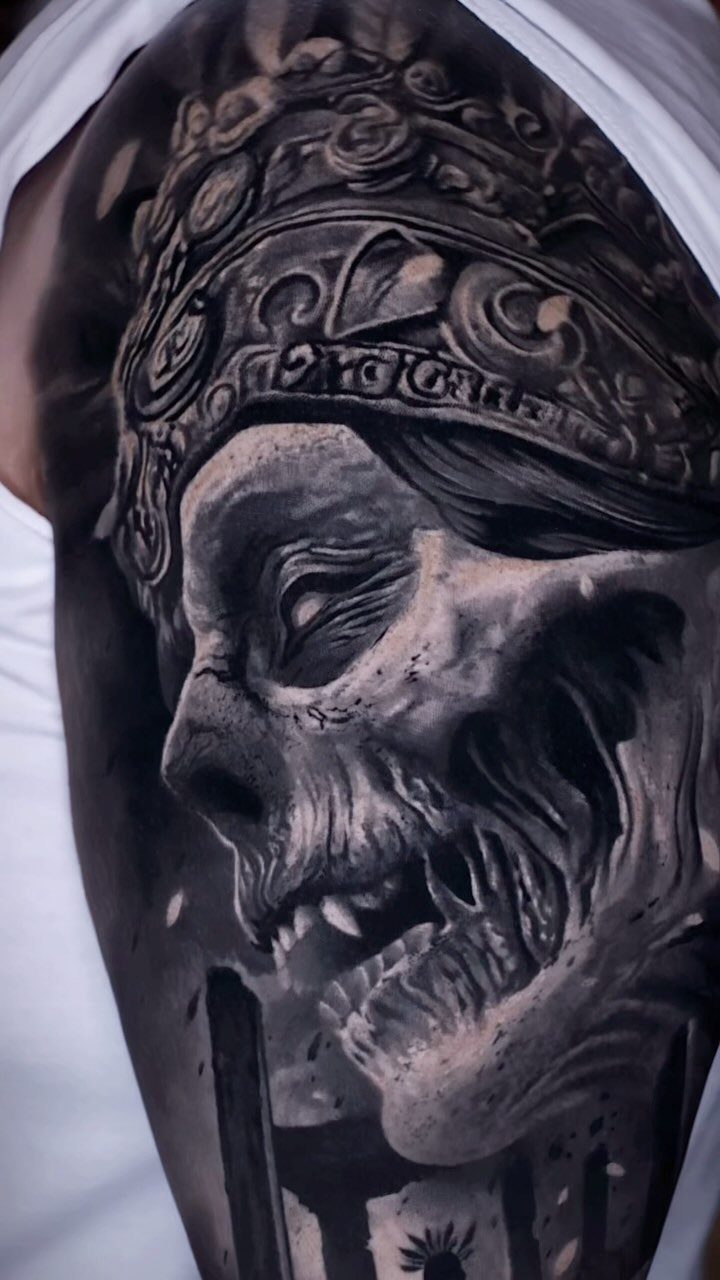
A skull wearing a carved headdress brings together mortality and status, since only elite warriors and priests wore elaborate feather and stone headpieces.
The upper arm curves enough to give the skull dimension, and the headdress extends upward to fill the shoulder.
Black and grey shading separates the bone from the ornamental carving, and the contrast keeps both elements readable. This suits anyone drawn to Aztec imagery but looking for something darker than a sun god or eagle.
Historical Context of Tattoos
Aztec tattoos carried weight in a society that ran on visible rank. The designs weren’t decorative first; they identified who you were and what you’d done.
The civilization itself lasted from the 14th to the 16th century in central Mexico, and its art reflected a culture that explained natural events and human fate through gods and myth.
Protection, favor, and connection to those forces sat behind the imagery, which is why the symbols still read as more than pattern work.
Modern Aztec tattoos draw on symbols that once marked rank, honored gods, and recorded a warrior’s victories.
A god’s face or a warrior’s animal companion ties back to a role or belief, not just a shape that looked good in the codex.
Choosing a Tattoo Artist
Finding an artist who handles geometric precision and dense patterning well matters more here than in looser styles.
Aztec work stacks repeating motifs, sharp borders, and fine detail inside a structured layout, and a shaky line or inconsistent spacing shows immediately.
Bring reference images when you consult, ideally saved to your phone and printed.
The artist may load the digital file into a printer to build a stencil, or they may use the print as a starting point and rework the composition to fit your body and preferences.
Either approach works; the second gives you something closer to a custom piece.
Ask to see healed photos of similar geometric work. Fresh ink always looks crisp, but Aztec patterns need to hold clarity years later.
Tattoo Aesthetics
Aztec designs sit at the ornate end of tattoo work.
That density appeals to anyone who wants a tattoo that rewards a closer look, where the detail reveals itself in stages rather than all at once.
The symmetry and repetition also create a cohesive look across large areas, which is why full sleeves, back pieces, and wrapped legs suit the style so well.
If your taste runs toward bold contrast, high coverage, and designs that read as intentional from across a room, Aztec pattern work delivers that without needing color to hold attention.