Geometric tattoos range from minimal triangles that fit a wrist to full sleeves built from mandalas, dotwork and sacred patterns, the complexity deciding how many sessions you’ll need and whether the design holds up at smaller sizes.
Placement matters because symmetrical patterns like mandalas suit the chest where the composition mirrors your build, while vertical designs like geometric animals work on the forearm or thigh without needing to wrap.
1. Geometric Flower Tattoo
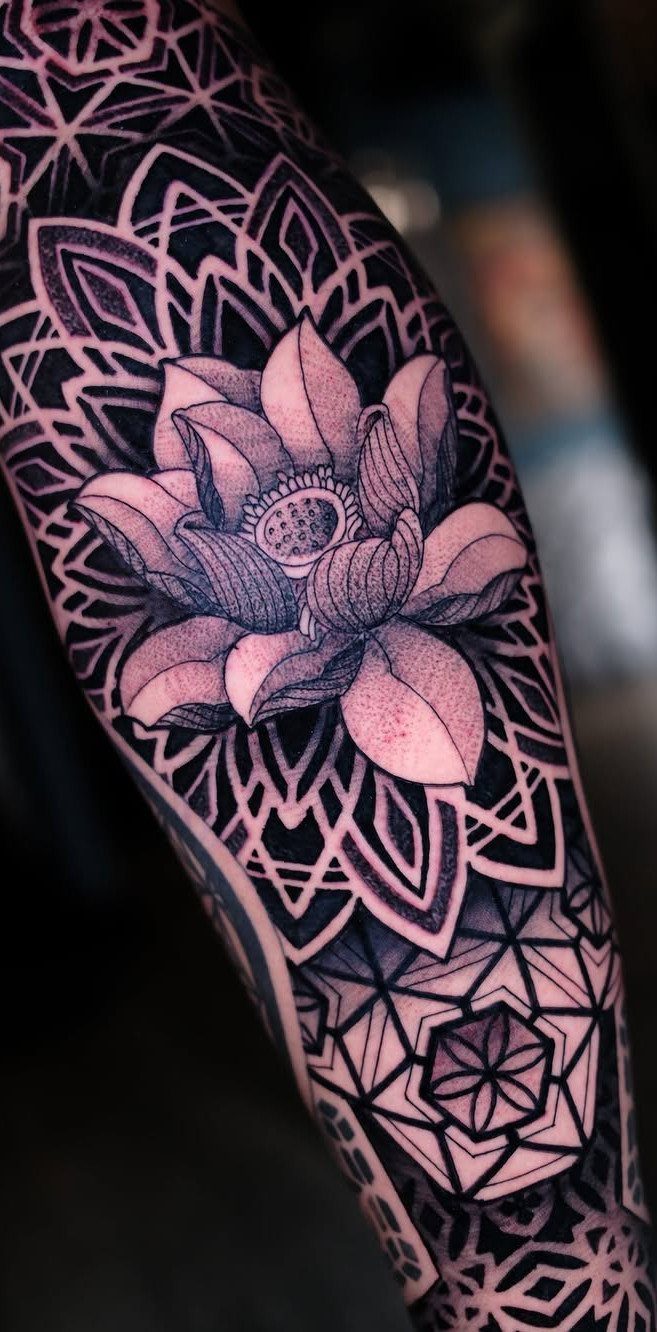
A lotus sits inside overlapping circles, triangles and mandalas, the organic shape of each petal held inside the hard edges of straight lines and compass curves. The contrast pulls attention: soft biology framed by rigid geometry.
Placement matters here.
The wrist and forearm give you room for the full design without cramming detail, and the shape reads cleanly when your arm is at rest. Upper arm works if you want more surrounding pattern.
Linework this fine needs an artist who specializes in geometric precision. One wobbly circle will show forever.
2. Geometric Mandala Tattoo
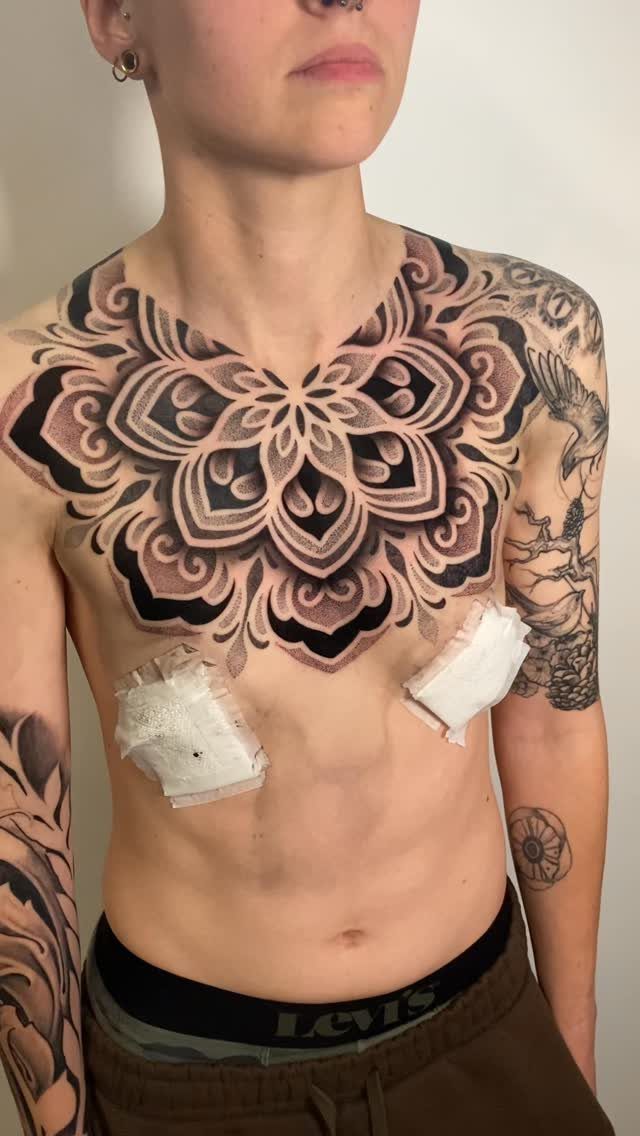
Mandalas are symmetrical patterns that radiate from a center point, built from repeated shapes that mirror in every direction. In sacred traditions they represent balance and the universe, but plenty of people just want the clean geometric look.
The chest gives you a natural circle to fill, and the design can expand as far as your collarbone and ribs allow. This much coverage takes multiple sessions, the number depending on how much shading and detail you add.
Symmetry decides whether the design works. An artist working freehand can drift, so ask to see their portfolio of mandalas specifically before you book.
A particularly popular sect of patterned tattoos is sacred geometric tattoos. Sacred geometric designs play off motifs found in both nature and religion, becoming a beautiful amalgamation that shines a light on any area chosen to be inked, large or small.
3. Flower of Life Sacred Geometry Tattoo
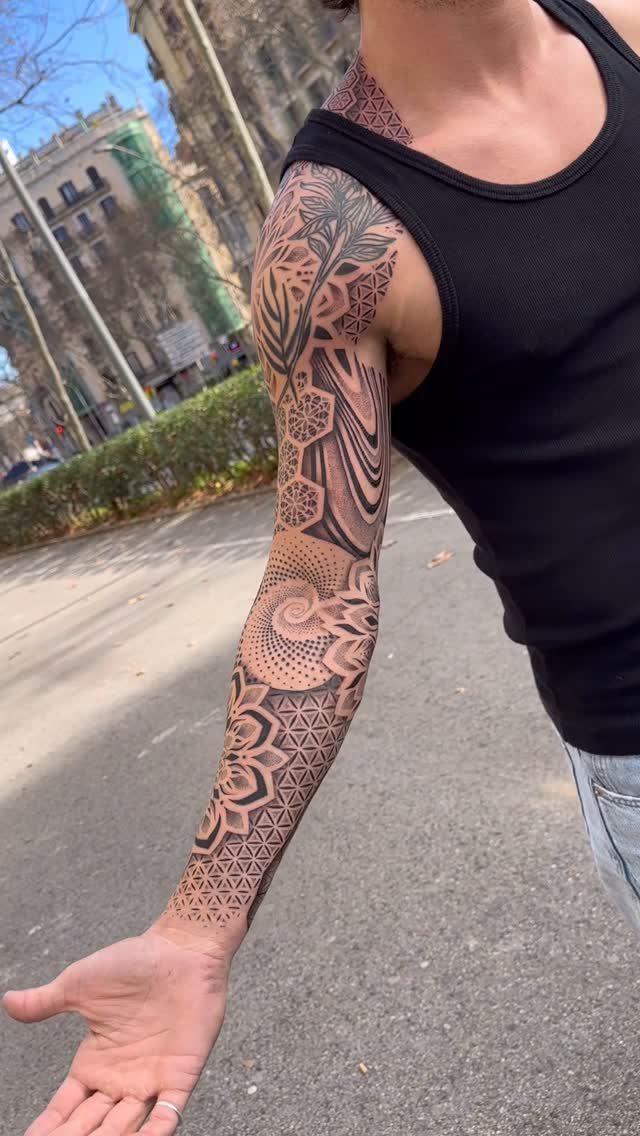
The Flower of Life is a specific pattern: overlapping circles arranged in a hexagonal grid, each one passing through the center of six others. It shows up in sacred geometry across cultures, tied to creation and the structure of existence.
As a sleeve it gives you continuous pattern without needing a narrative or focal image.
The circles can scale up or down, and you can layer them with other sacred forms like the Seed of Life or Metatron’s Cube if you want more density.
4. Geometric Wolf Tattoo
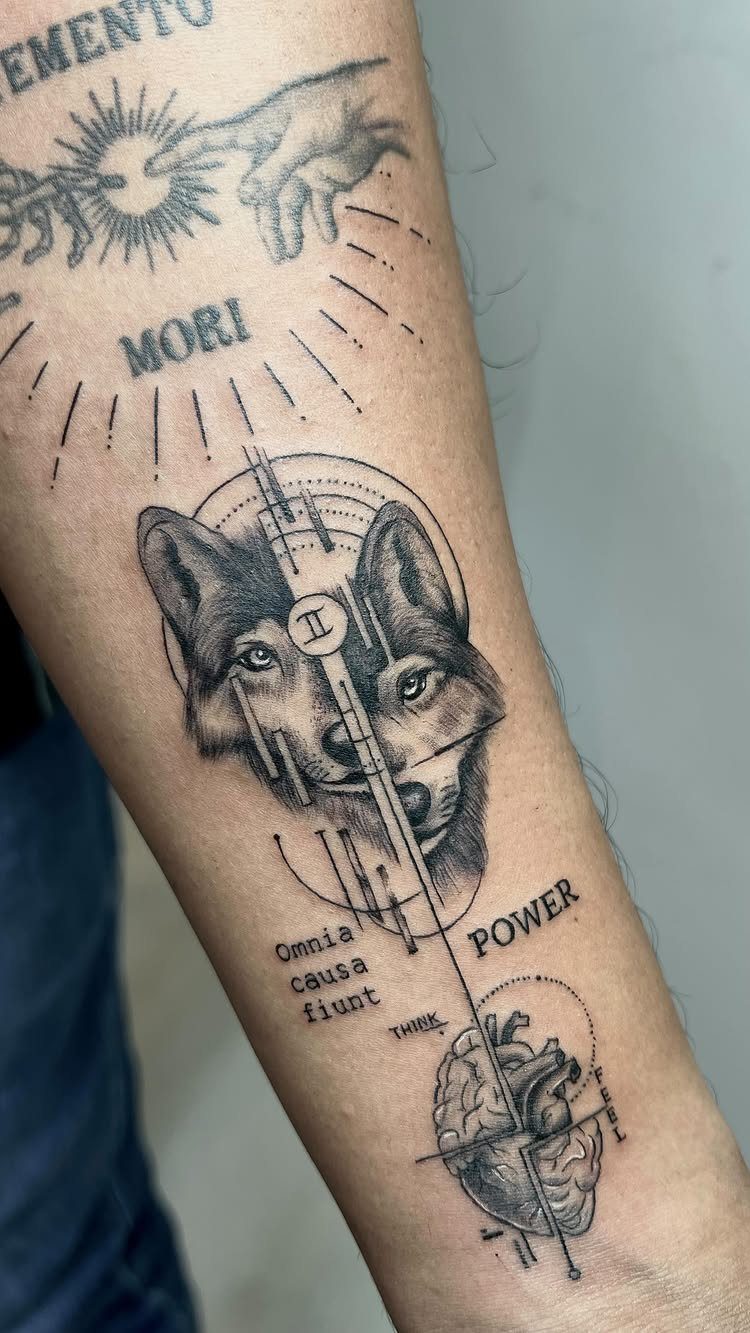
The wolf’s head is broken into facets, each plane of the face mapped as a separate polygon. Some artists keep the shapes crisp and angular, others add stipple shading inside each facet to soften the effect.
Forearm placement lets the wolf face forward when your arm hangs naturally, and there’s room above and below for script or smaller symbols if you want them.
The design scales down better than realism, so a smaller wolf on the wrist or calf still reads clearly.
Line weight matters. Thin lines age poorly on geometric work, so ask your artist to go slightly heavier than you think you need.
5. Geometric Tattoo Sleeve
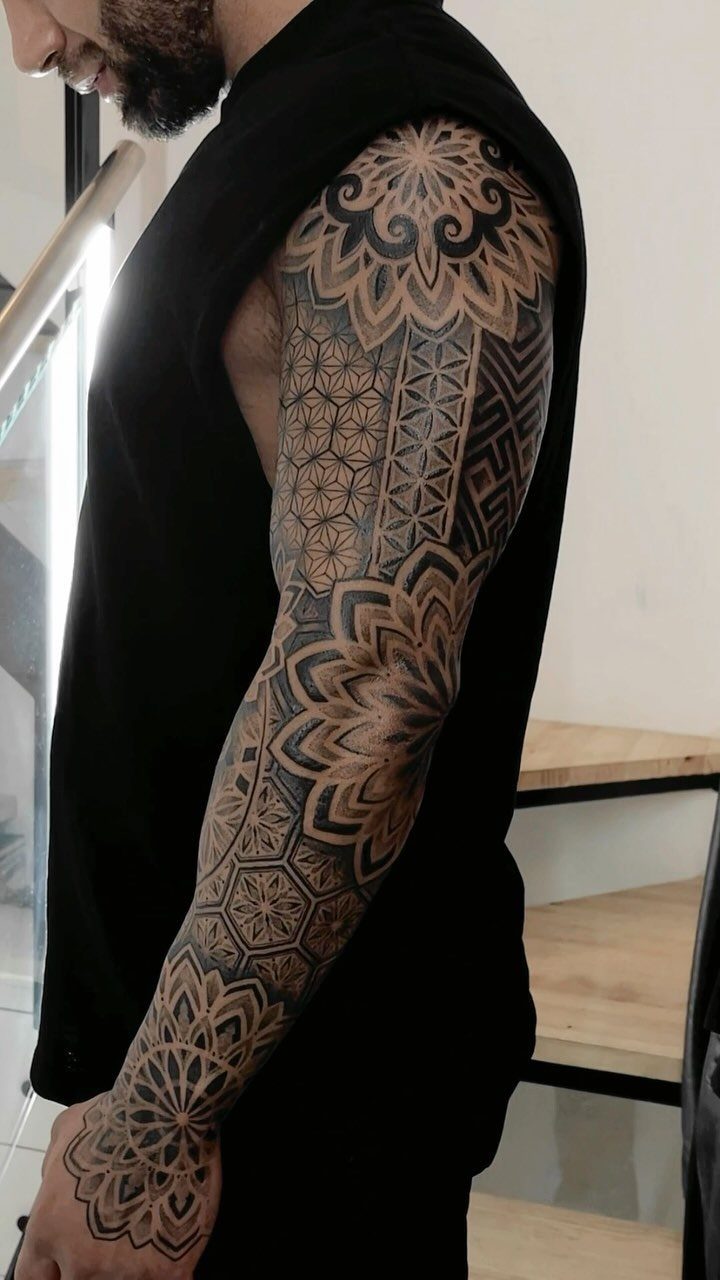
A sleeve built entirely from geometric shapes gives you pattern from shoulder to wrist without a single representational image.
Mandalas, tessellations, dot grids and sacred symbols stack and overlap, the negative space between them doing as much work as the ink.
This approach takes planning.
You can add pieces over time, but the cohesion comes from mapping the whole arm first so every section flows into the next. Budget significant chair time spread across several sessions.
Black ink holds the longest on geometric sleeves. Color can work, but it fades faster and the design relies on contrast to stay sharp.
6. Abstract Geometric Shapes Tattoo
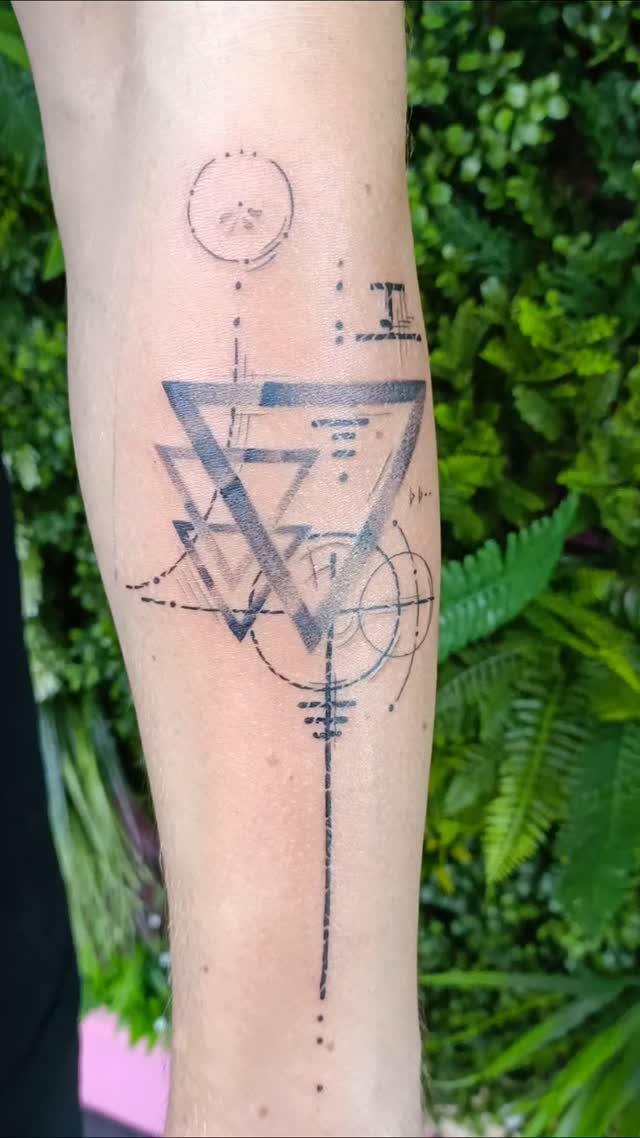
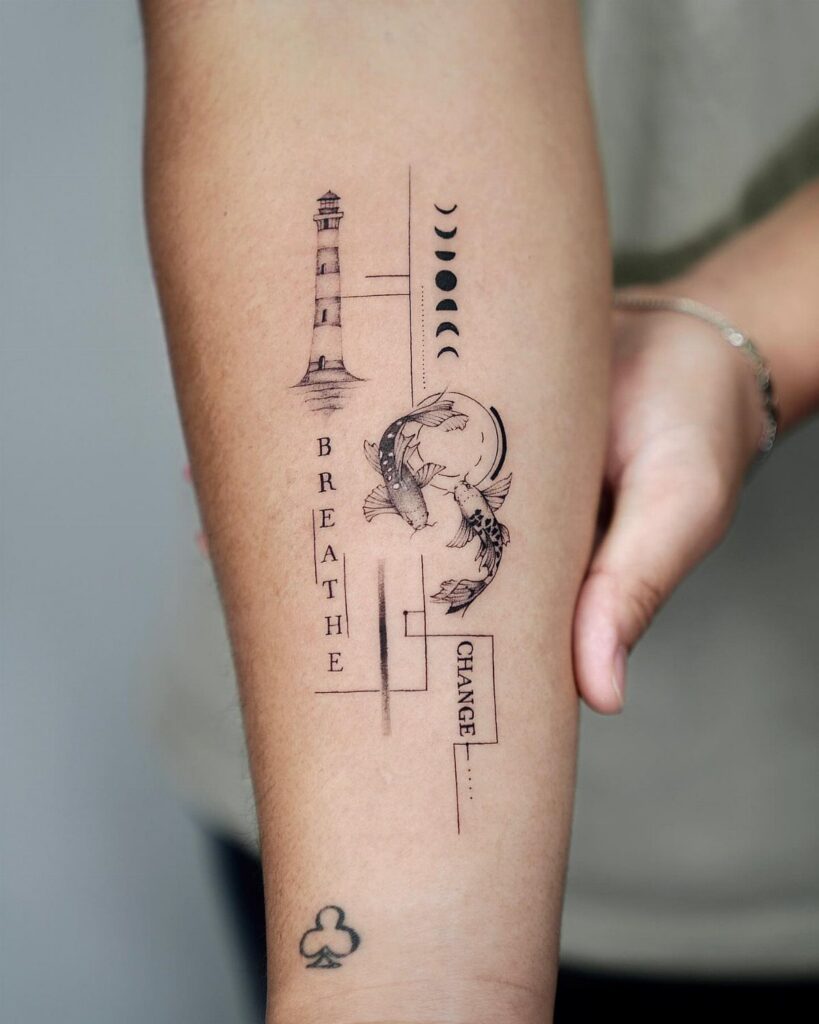
Abstract geometric work drops the symmetry and the sacred meaning. You get triangles, circles, arcs and lines arranged by composition instead of pattern, the shapes layered or scattered with no need to balance or repeat.
This style gives an artist more freedom to play with negative space and asymmetry, and the result feels modern rather than spiritual.
Forearm and upper arm are the most common placements because the design can run vertically or wrap without needing a circular anchor point.
The looser the design, the more it depends on your artist’s eye for composition. Look for portfolios that show clean linework and intentional spacing.
7. Geometric Lion Tattoo
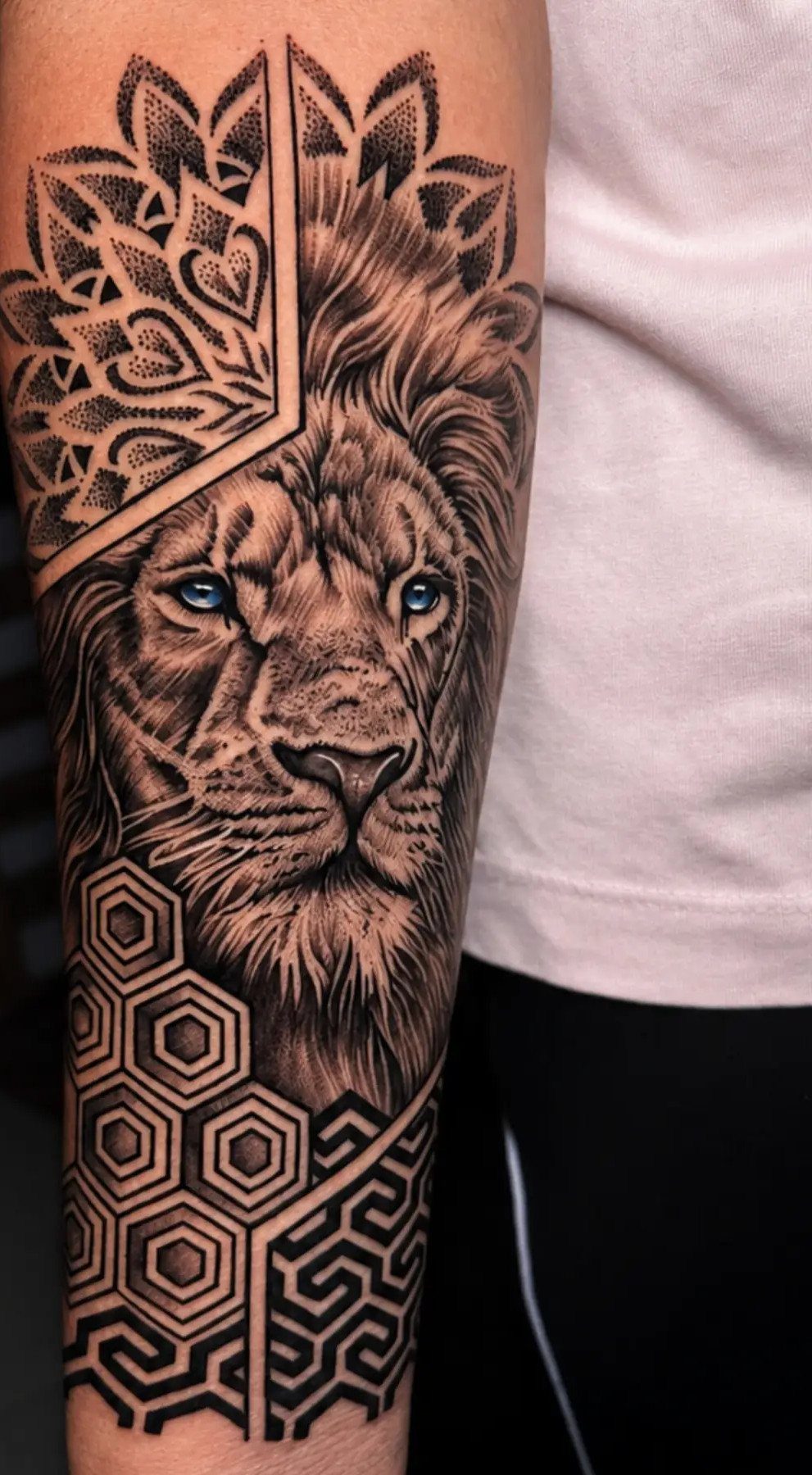
The mane flows into mandala and the face splits into polygons, strength rendered as pattern instead of photorealism. A lion holds symbolic weight without needing realism’s detail, and the geometric version ages better because it never relied on smooth gradients.
Most people place them on the forearm or upper arm. The design needs vertical space for the mane and face to read as a lion rather than abstract shapes.
An artist who works in both realism and geometry can balance the two. Pure geometry sometimes loses the animal entirely.
8. Geometric Bear Tattoo
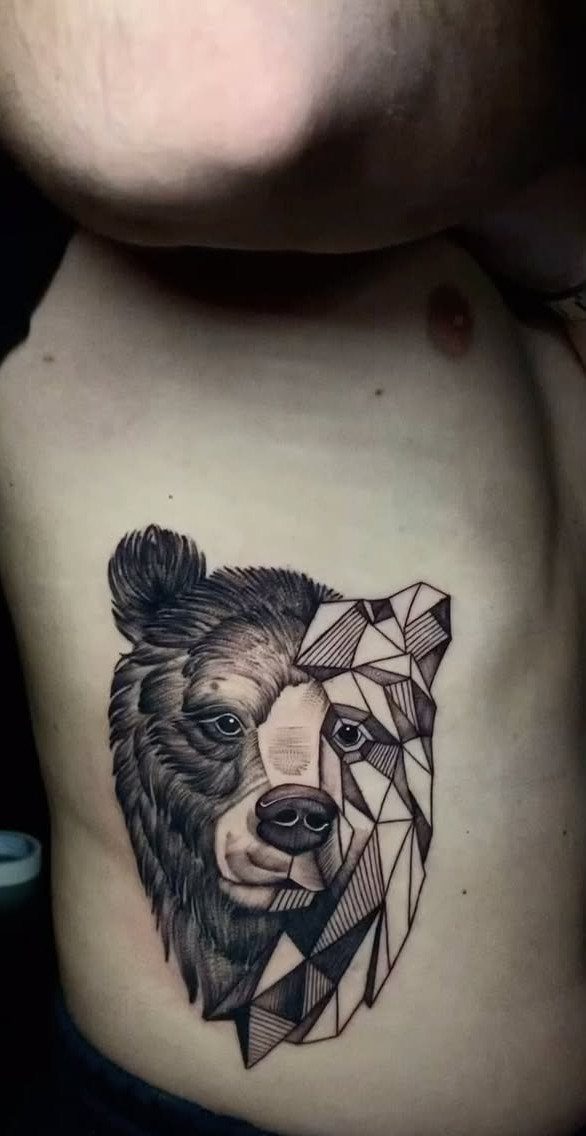
Half the bear’s face stays realistic, fur and shading intact, while the other half breaks into facets. The split composition shows the same subject 2 ways, and the line down the center becomes the focal point.
Chest placement centers the design and gives you width for the full face. Smaller versions on the forearm work if you narrow the composition, but you lose some of the impact when the split is compressed.
This design lives or dies on symmetry. The 2 halves need to mirror exactly or the face looks crooked.
9. Geometric Owl Tattoo
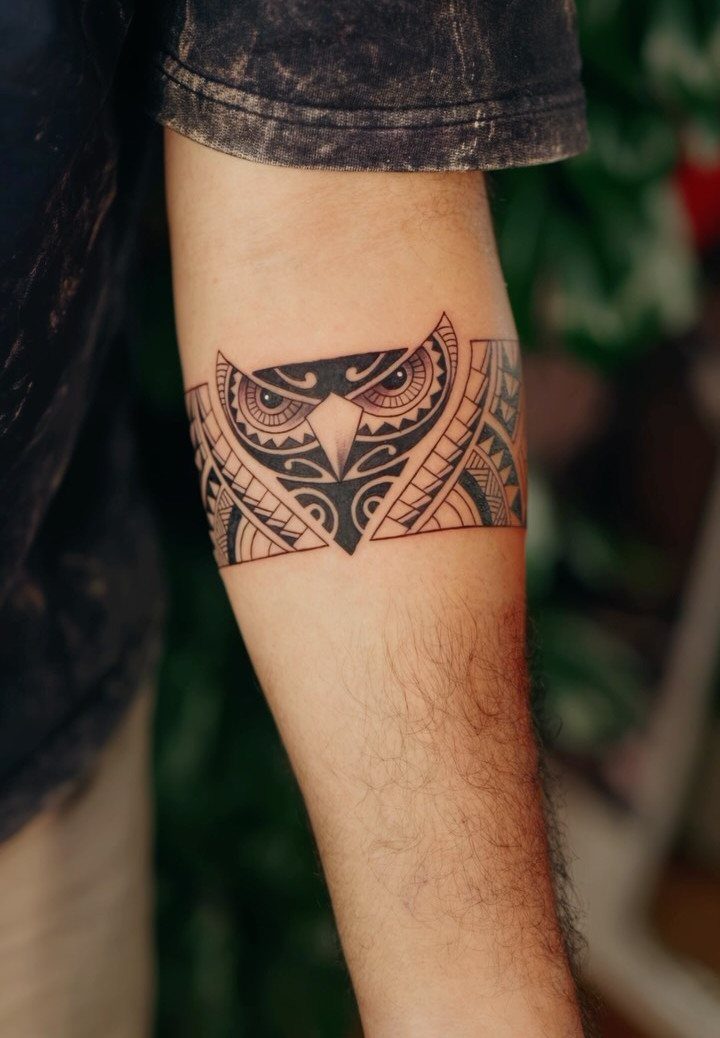
Polygons wrap the forearm as a band, the owl’s body and wings reduced to interlocking triangles and straight edges. The band format gives you a complete design that sits cleanly on one part of the body without needing to expand.
Forearm bands are visible but easy to cover with a long sleeve. The upper arm gives you room to work wider, and the design holds up as it grows.
Line weight should be consistent across every facet. Variation makes the pattern look unfinished.
10. Geometric Tree Tattoo
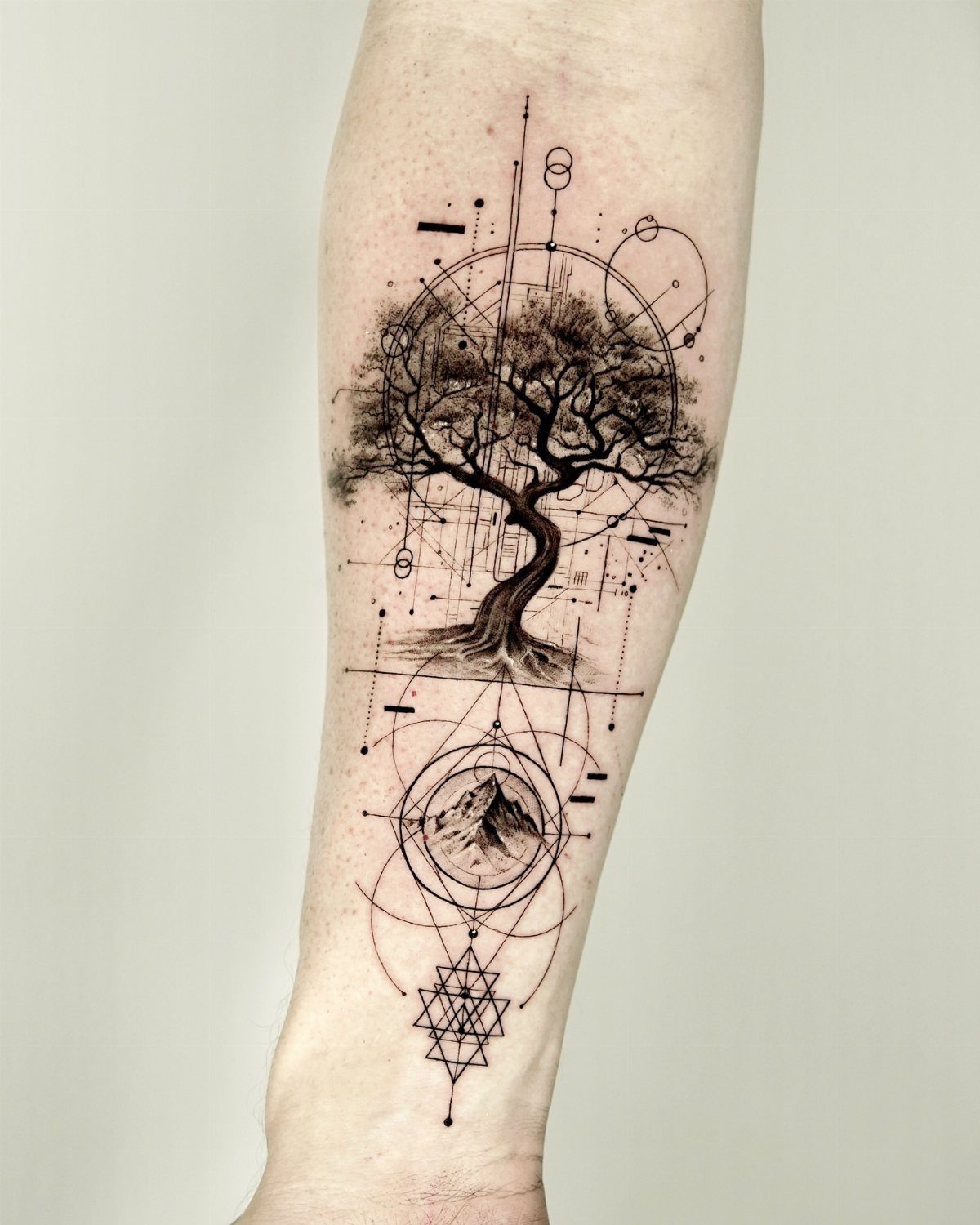
The tree sits inside a circle, roots and branches contained, with triangles and arcs layered behind it. Geometry frames the organic subject instead of replacing it, and the result feels more illustrative than abstract.
Forearm gives you vertical space for the tree and surrounding shapes without crowding the design. A geometric tree translates well at smaller sizes, so wrist and ankle placements stay legible.
Black ink keeps the contrast sharp. Adding color softens the geometric feel.
11. Geometric Color Tattoo
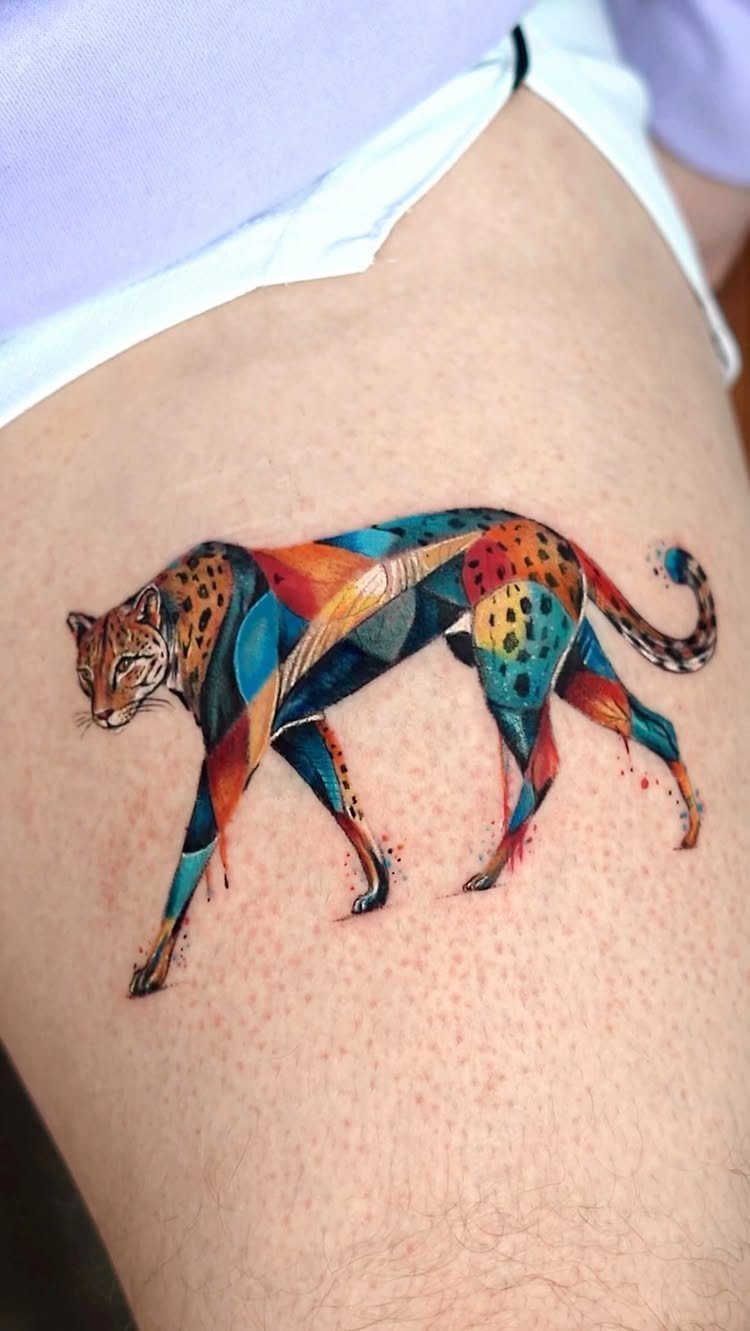
Color fills the polygons instead of leaving them empty, each facet a block of saturated blue, orange or yellow. The geometry stays sharp but the palette pulls attention first, and the design reads more illustrative than structural.
Thigh placement gives you room for a larger animal or object without wrapping. Color fades faster than black, so expect touchups every few years if you want the vibrancy to hold.
Find an artist whose portfolio shows clean linework and solid color saturation. The technique is different from black linework alone.
12. Triangle Geometric Tattoo
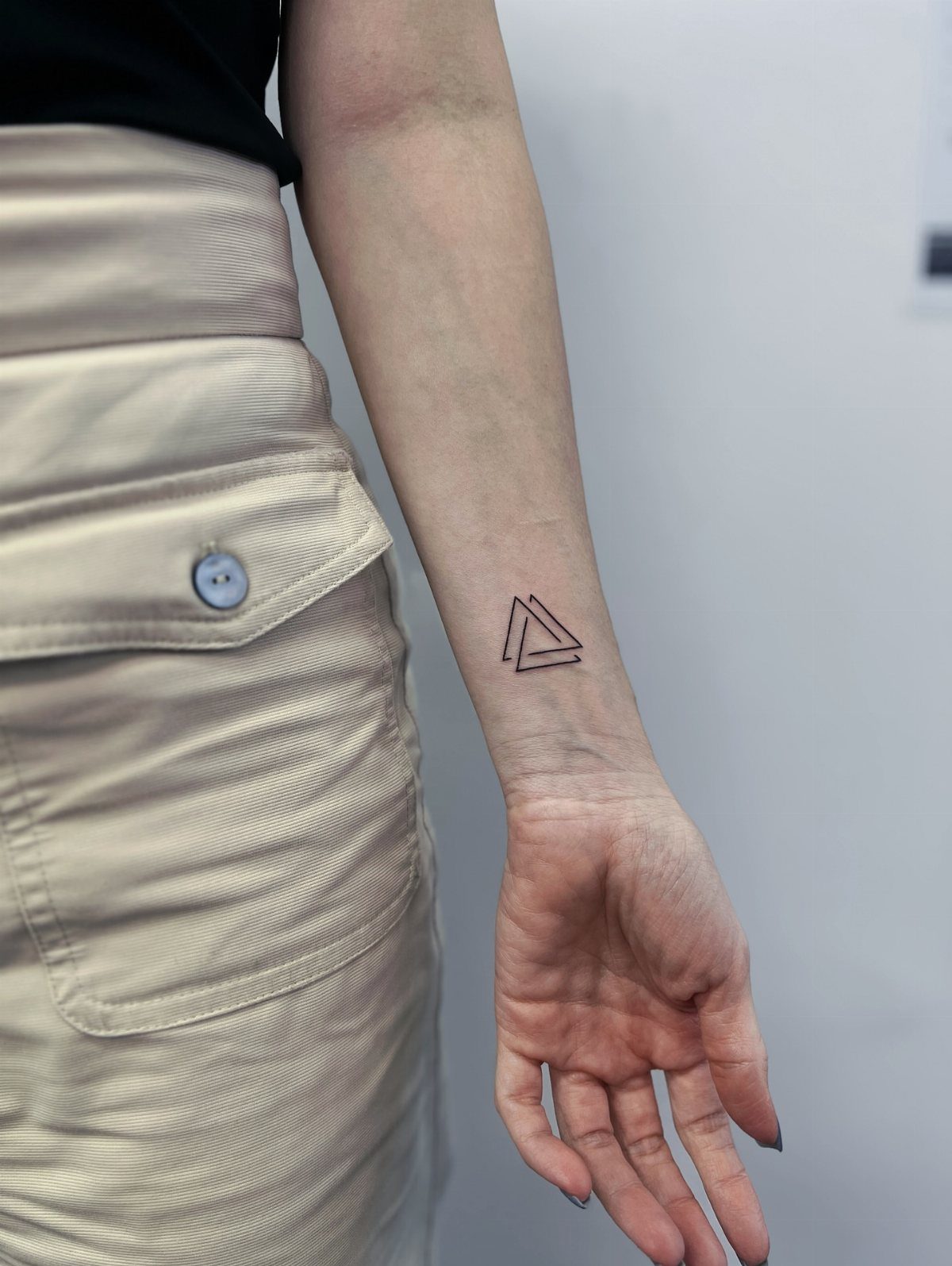
Triangles stack, overlap or interlock, the simplest geometric form arranged into pattern. You can keep it minimal with 2 or 3 shapes, or build complexity by layering more triangles with different orientations and line weights.
Wrist and inner forearm are common placements for smaller designs. The shape reads cleanly at any size, and a single triangle holds meaning on its own without needing surrounding detail.
Thin lines work here because the design is simple enough to stay readable even as the ink spreads slightly over time.
13. Circular Geometric Patterns Chest Tattoo
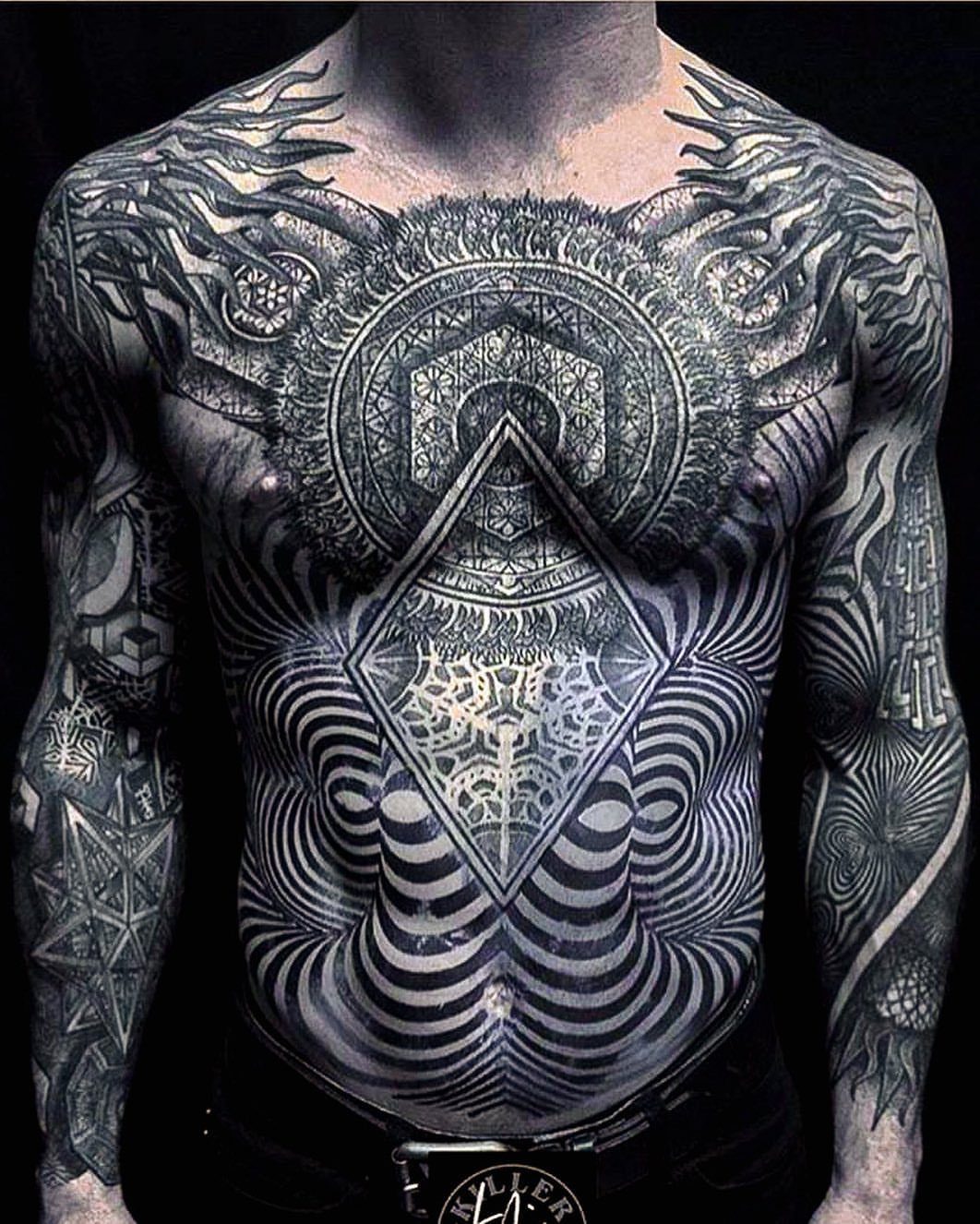
Circular patterns radiate from the sternum, following the natural contours of the chest and expanding toward the shoulders. The symmetry frames your build, and every line follows the muscle underneath.
This placement sits front and center.
It’s fully visible when you want it to be and easy to cover when you don’t. The chest gives an artist room to work at scale without cramping the detail.
Plan for multiple sessions. A piece this size rarely finishes in one sitting, and healing time between appointments keeps the skin from overworking.
14. Geometric Back Tattoo
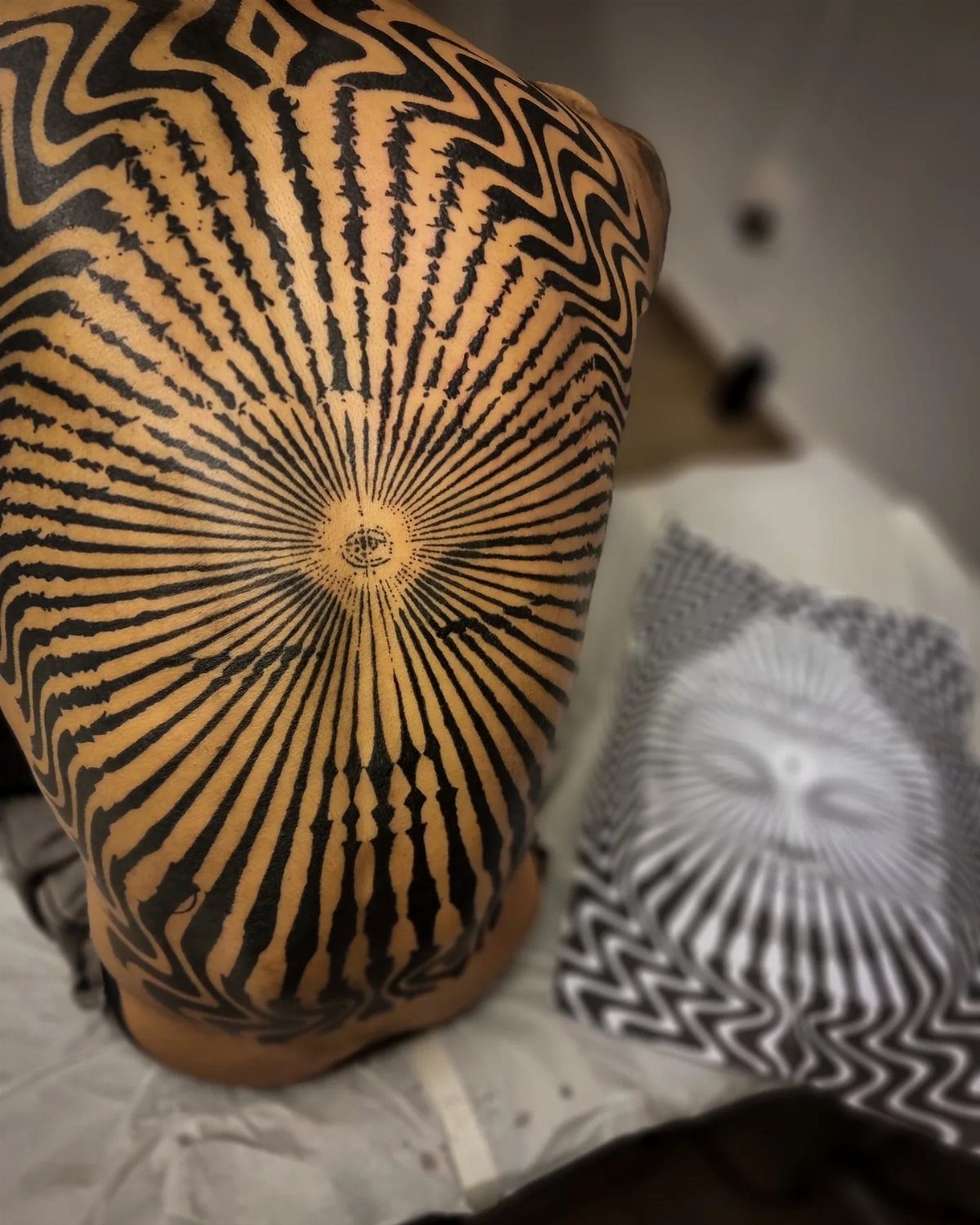
Radiating lines pull the eye toward a center point, the optical effect built from precise repetition and contrast. The back gives you the largest uninterrupted canvas on the body, and a design this dense needs that space to stay legible.
Sessions add up. Coverage this extensive takes time to complete, and sitting for your back can be rougher than arms or legs because you can’t shift position easily.
Black ink holds sharpest here. The lines need to stay crisp for the illusion to work, and color can muddy the effect.
15. Geometric Thigh Tattoo
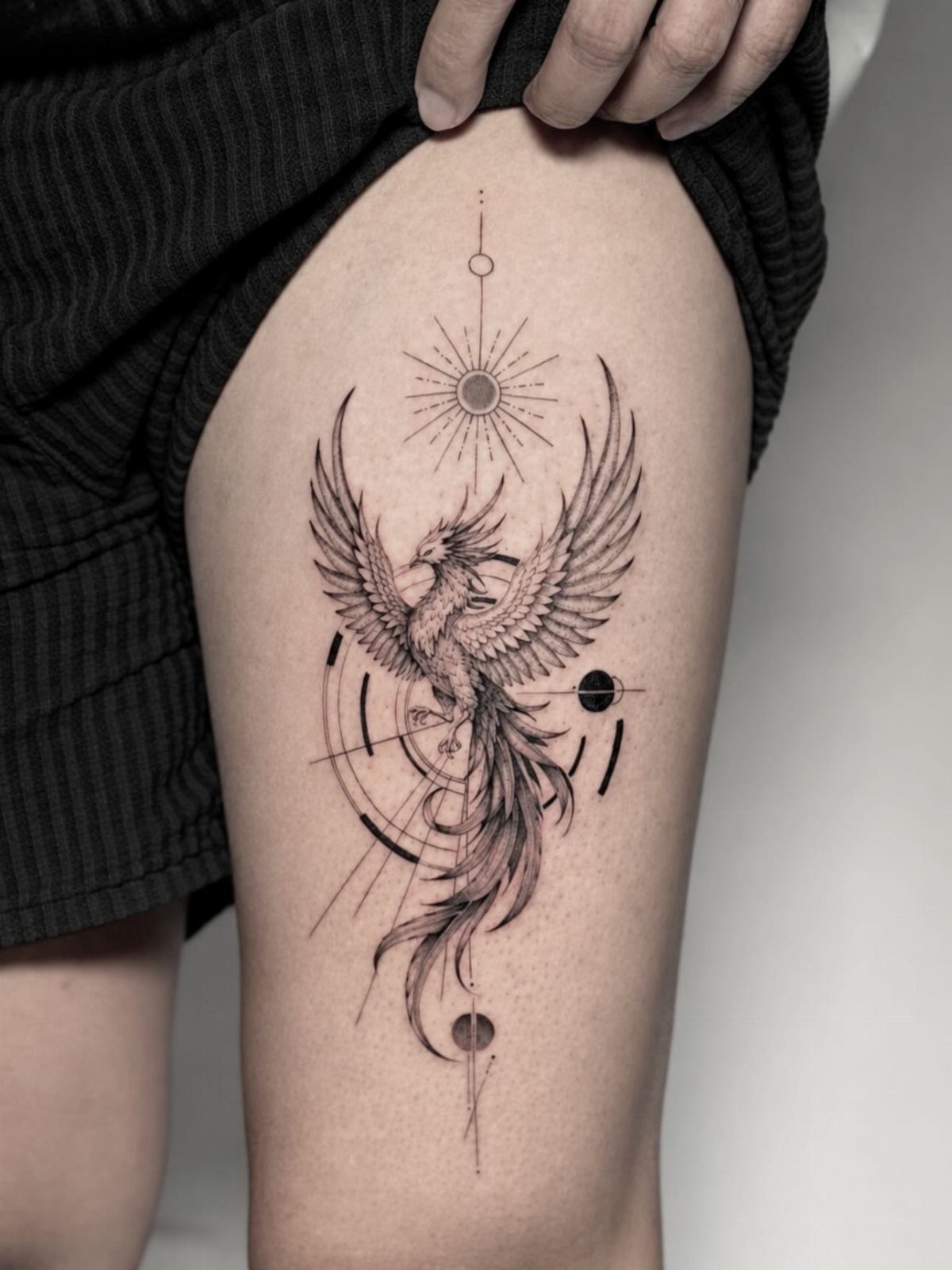
A phoenix breaks into geometric fragments, wings and body framed by circles and linear patterns. The thigh gives you room for a vertical composition without wrapping, and the placement stays hidden under pants or shorts.
This spot works if discretion matters. Office dress codes and family events won’t force you to explain it, but you still get a design large enough to carry detail.
Pain varies. The outer thigh is manageable, but closer to the inner thigh or near the hip bone gets sharper.
16. Geometric Cat Tattoo
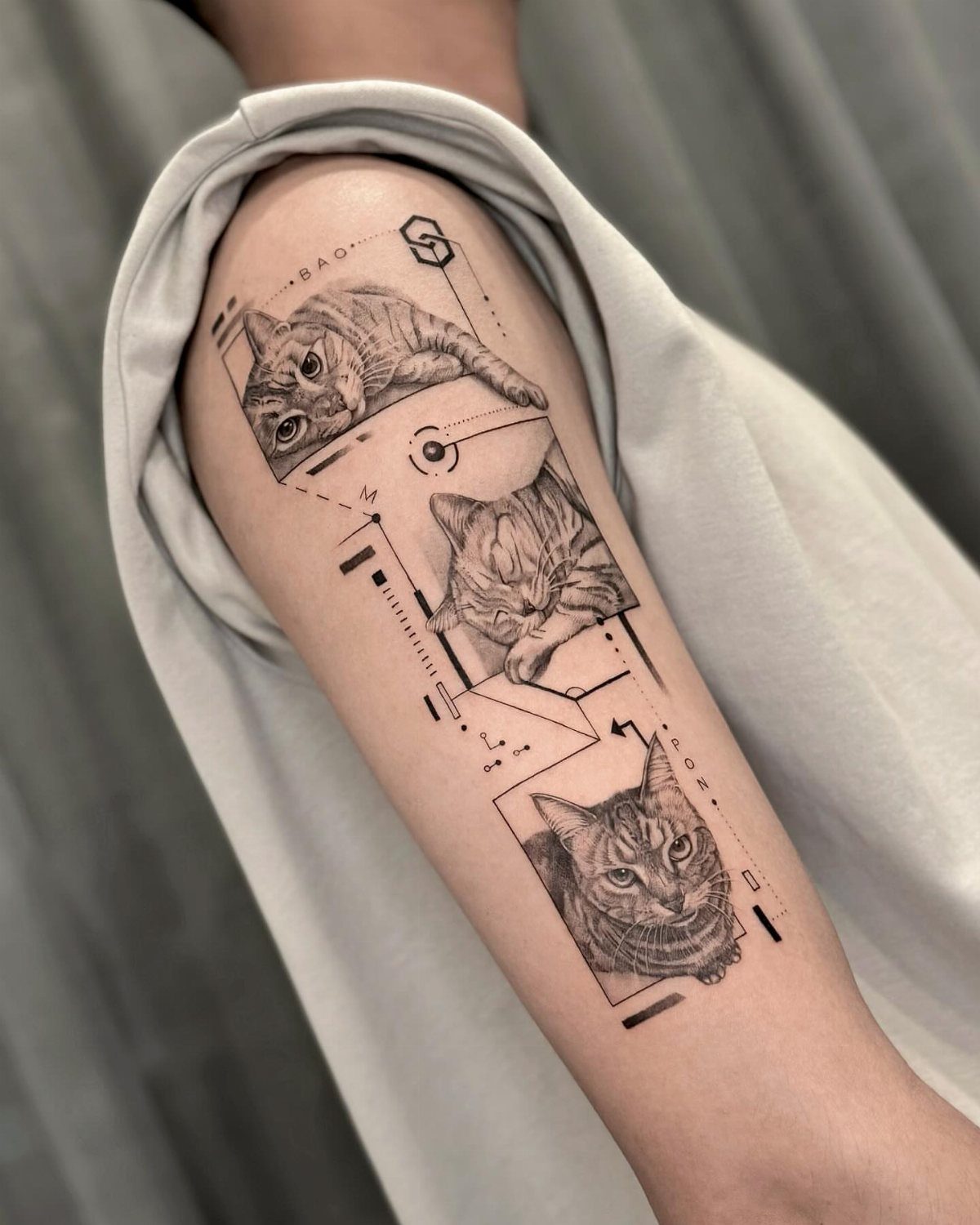
Realistic cat faces sit inside a geometric frame, the portraits rendered with shading and detail while the surrounding structure stays linear. Combining the 2 styles gives you a specific subject without losing the clean edges geometry offers.
Upper arm placement centers the design where it’s easy to see and easy to cover. The composition can expand up toward the shoulder or down toward the elbow if you want more surrounding pattern later.
Pure geometric work won’t give you the portrait detail.
17. Geometric Butterfly Tattoo
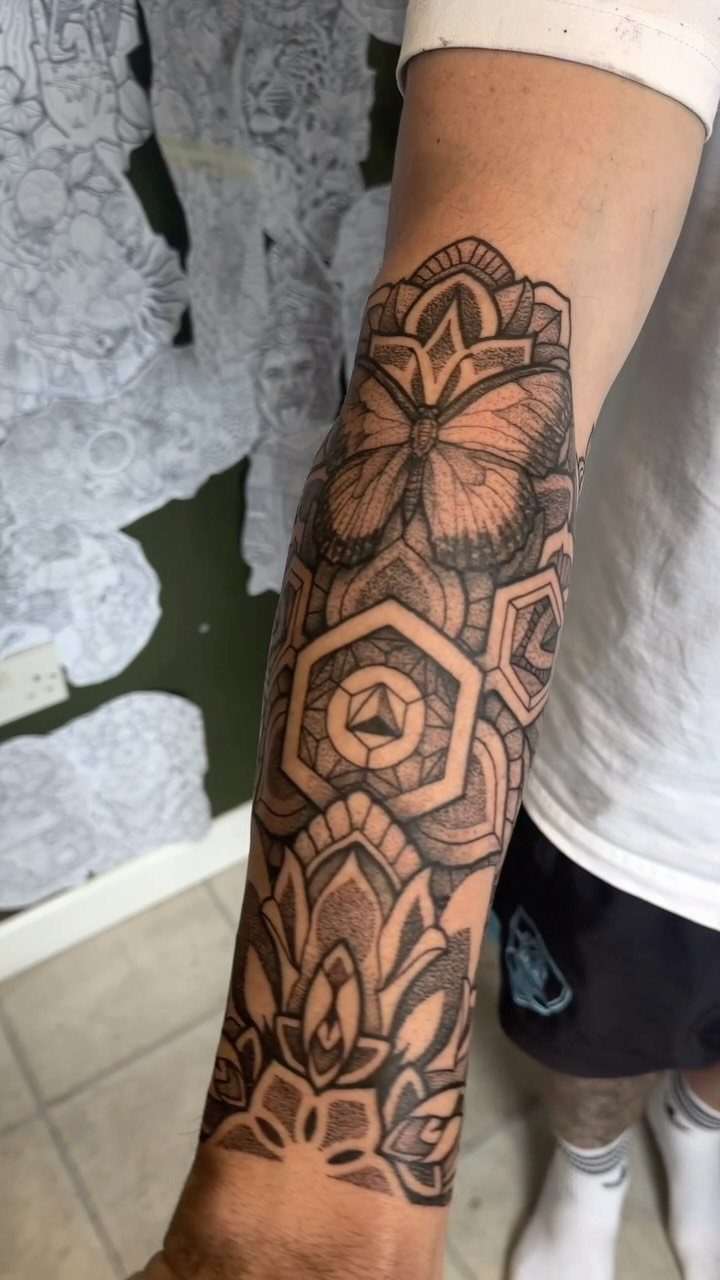
The butterfly’s wings become mandalas, symmetry meeting symmetry. Transformation and beauty translate cleanly into pattern, and the design holds symbolic weight without needing realism.
Forearm placement keeps the design visible and gives you room for the surrounding hexagons and circles. The composition can scale down to fit a wrist or ankle, but you’ll lose some of the surrounding detail at smaller sizes.
The pattern relies on clean lines, and color can soften the geometric precision.
18. Geometric Landscape Tattoo
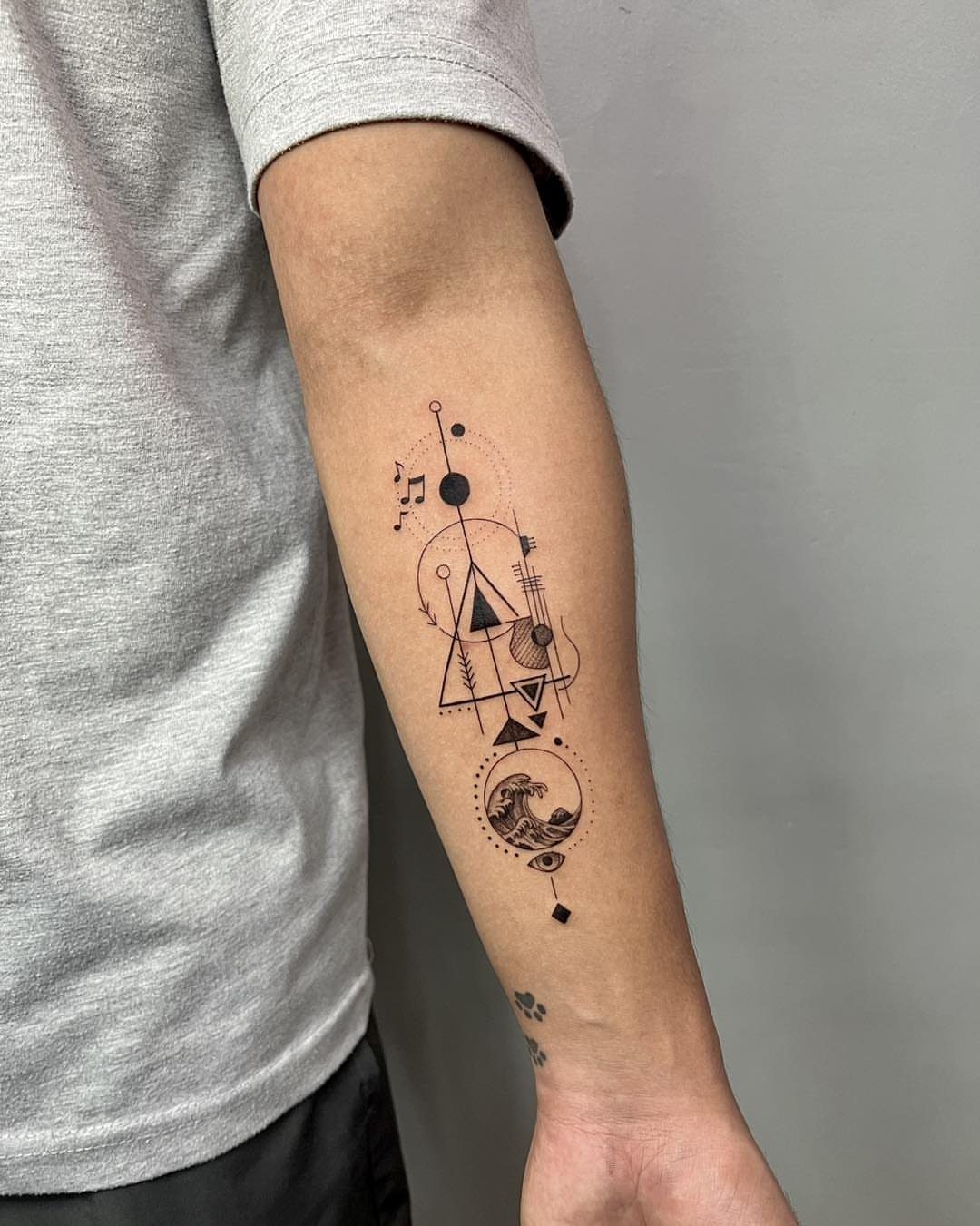
Mountains and waves reduce to triangles, arcs and straight edges, the recognizable shapes of nature held inside geometric structure. A landscape this stylized reads at a distance and ages better than realism because it never relied on fine detail.
The flat surface lets every layer sit cleanly, so nothing distorts when your arm moves. Smaller versions work on the wrist, but the composition needs room to separate the shapes clearly.
What you leave blank defines the shapes just as much as what you fill. Sharp line weight and open areas keep the elements from blurring together over time.
19. Geometric Skull Tattoo
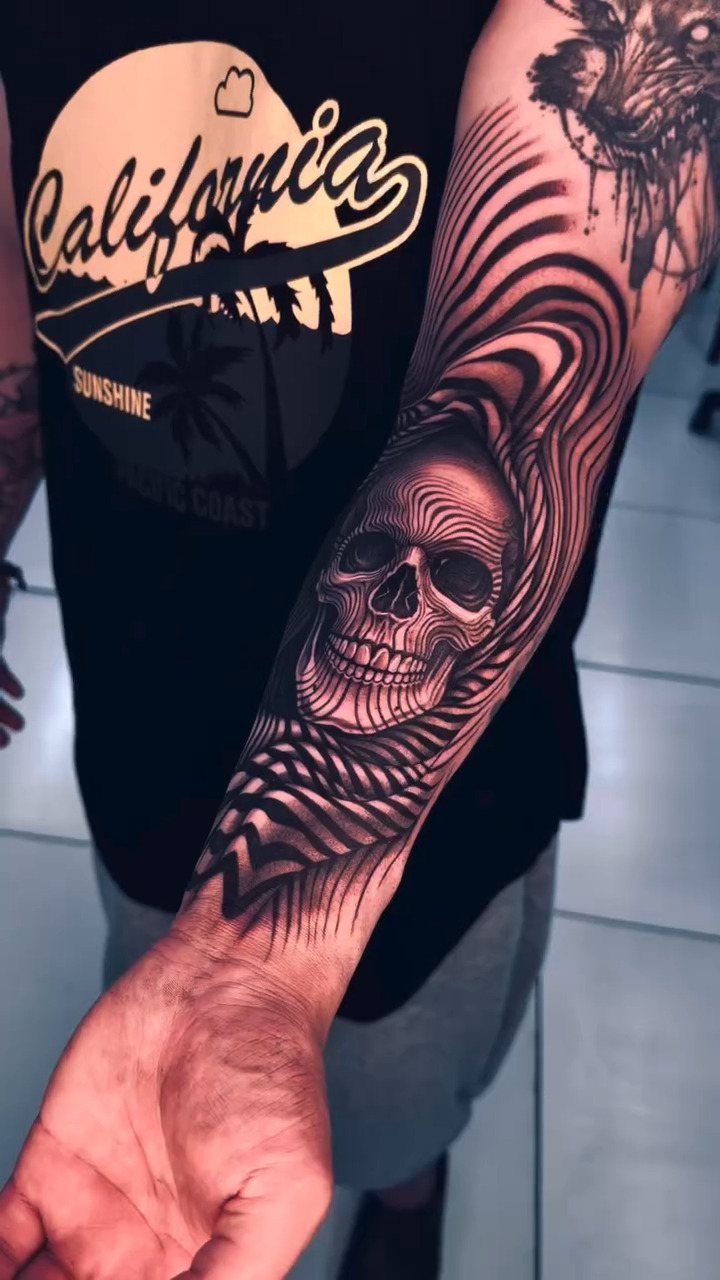
Parallel lines curve around the skull’s contours, wrapping from crown to jaw without breaking the flow. The geometry stays visible, but the skull itself reads immediately because the lines follow its form instead of dividing it into facets.
Forearm placement gives you room for the full skull without compressing the detail. The design scales well because the linework doesn’t rely on fine shading that blurs over time.
Too tight and the pattern looks muddled, too loose and the skull loses definition.
20. Geometric Origami Tattoo
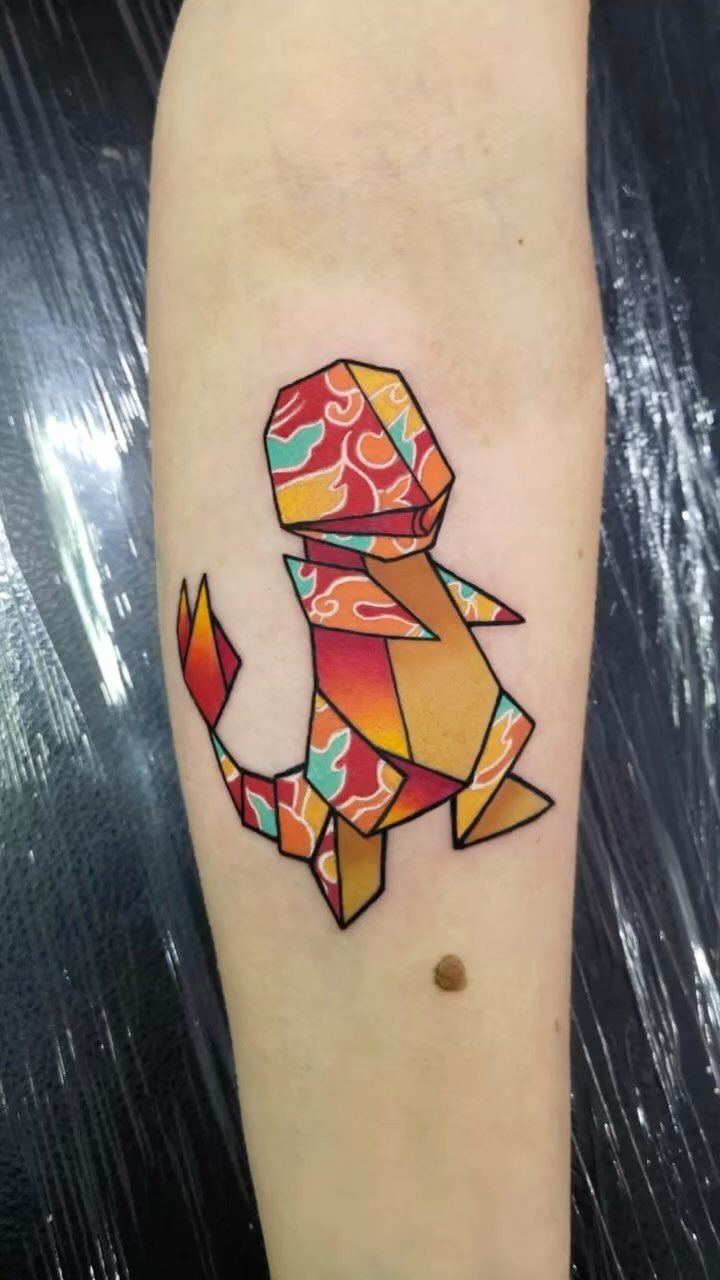
Folded paper rendered in flat color blocks, the creases mapped as hard edges where one plane meets the next. Origami animals carry the geometry built into the paper itself, and the design stays playful without losing structure.
Find an artist who can keep color saturation even across large fills. Patchy color makes the folds harder to read.
21. Geometric Elephant Tattoo
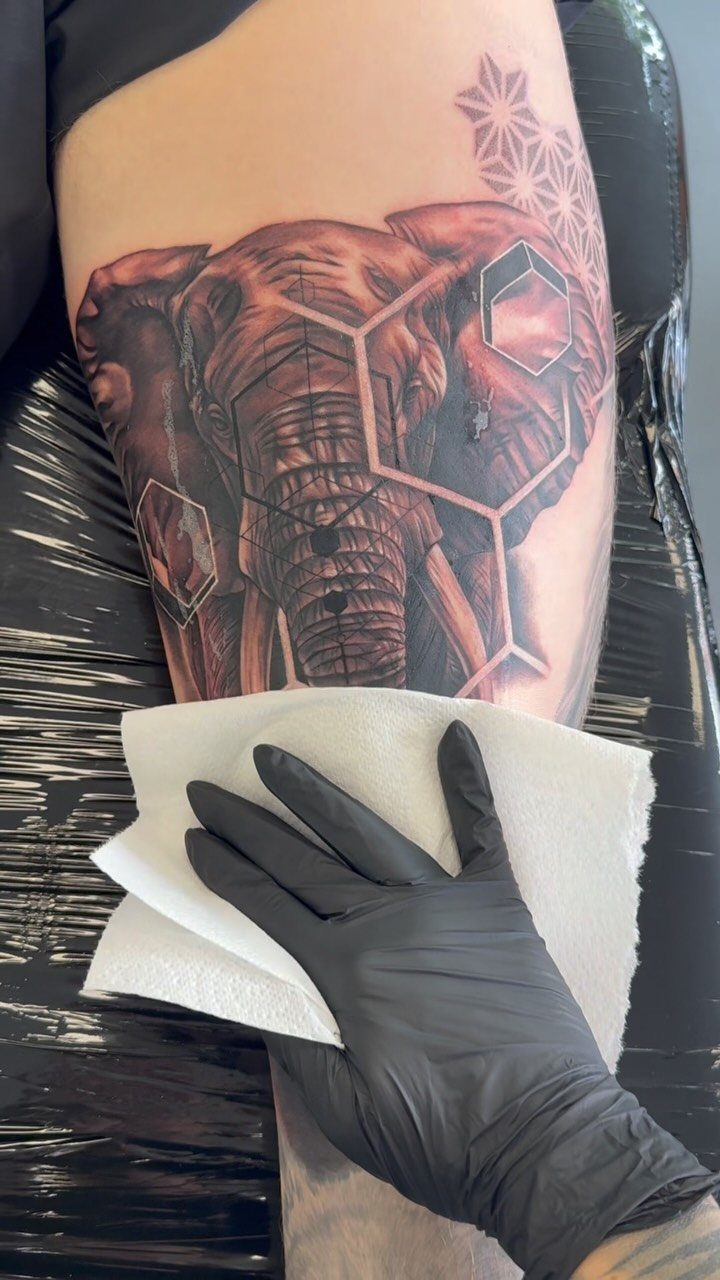
A realistic elephant overlaid with geometric hexagons, the animal rendered in full detail while the pattern floats on top. The two layers stay separate, so you get both subject and structure without one erasing the other.
The thigh gives you space for a design this large without needing multiple sessions to complete coverage.
Overlays work best when the underlying subject has enough contrast to show through the geometry.
22. Geometric Stag Head Tattoo
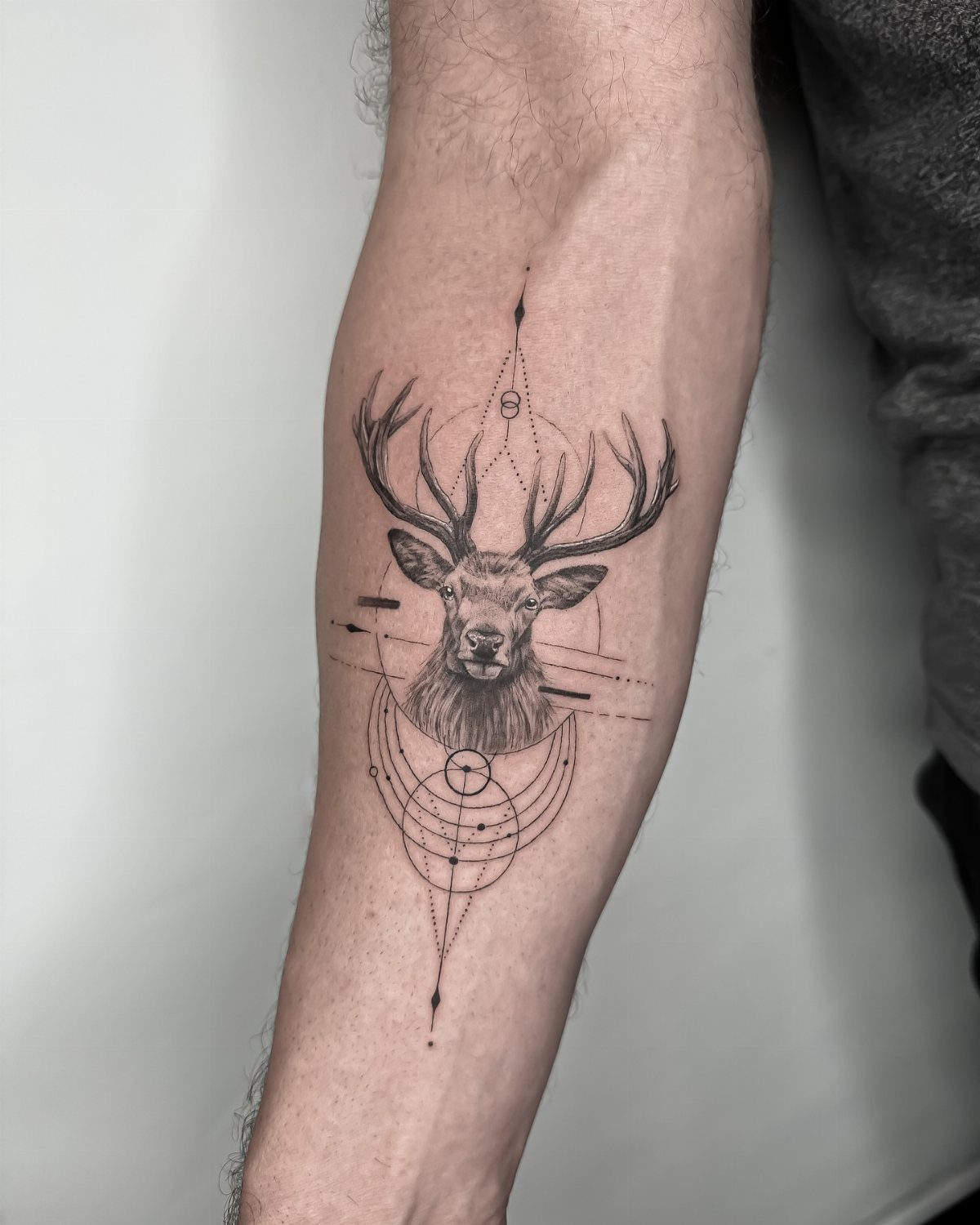
Circles and straight lines frame the stag’s head, the antlers and face centered inside geometric structure. The animal stays detailed while the surrounding shapes keep the composition clean and contained.
Forearm placement centers the design where it won’t distort as your arm moves. The stag reads clearly at this size, and the surrounding geometry can expand later if you want more pattern.
The geometry relies on contrast to frame the subject cleanly.
23. Geometric Sound Waves Tattoo
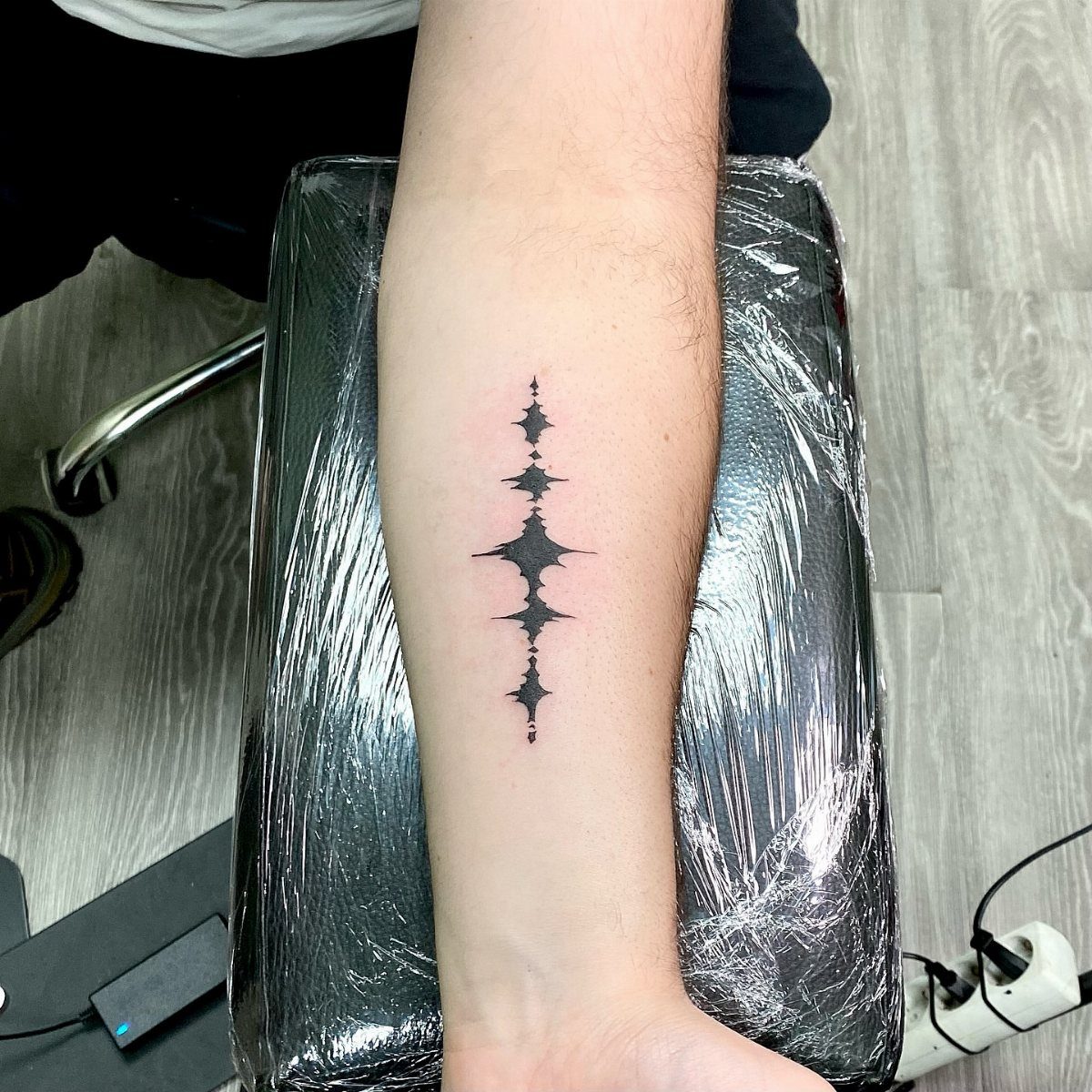
Vertical lines rise and fall to match a specific audio recording, the waveform itself becoming the pattern.
You can pull the waveform from a voice recording, a song, or any sound file that holds meaning, and the result is a tattoo only you can decode.
Inner forearm is the most common placement because the vertical format fits naturally. The design stays minimal, so it reads cleanly at smaller sizes.
Ask your artist how they convert audio files. Not every shop has the software to extract clean waveforms.
24. Geometric Nautilus Tattoo
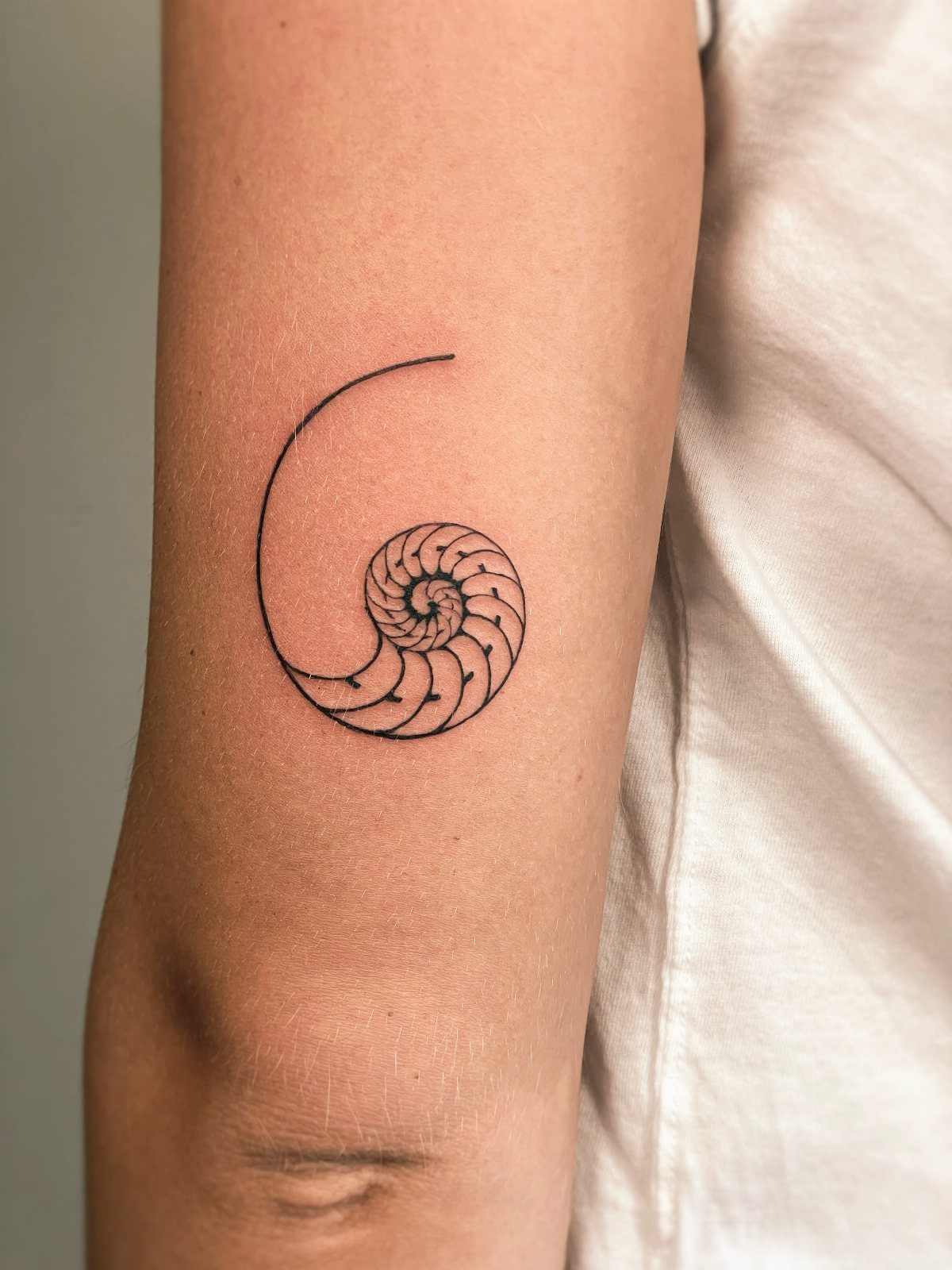
The spiral expands outward from a tight center coil, each chamber of the nautilus shell mapped as a polygon. Growth and proportion sit inside the design, the golden ratio made visible as ink.
The nautilus scales down well, but you lose some of the chambered detail at wrist size.
Variation makes the spiral look uneven.
25. Geometric Fractal Tattoo
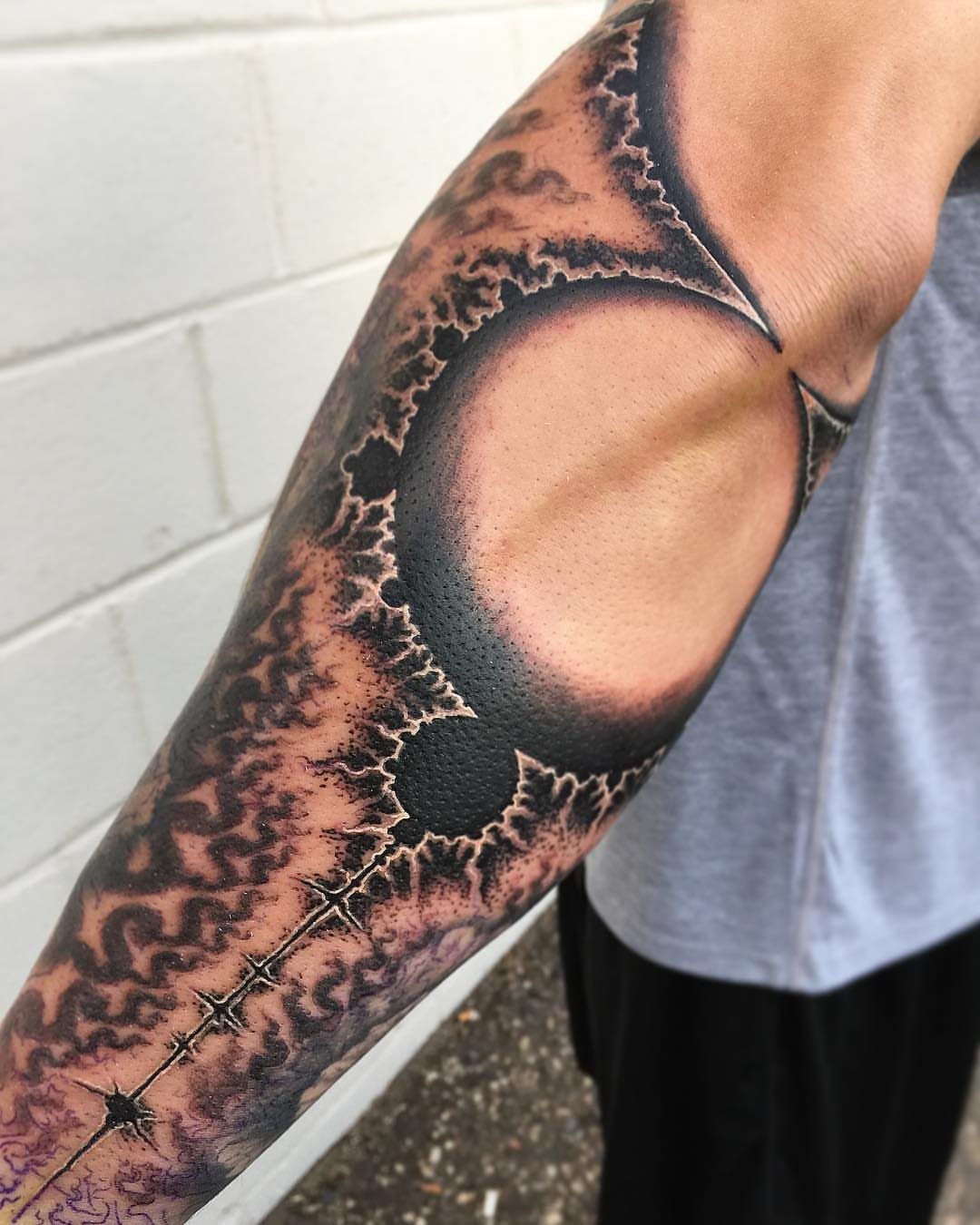
Repeating patterns branch and shrink, each iteration a smaller copy of the whole. Fractals mimic coastlines, lightning and tree roots, the math of self-similarity made permanent.
The design reads cleanly in black ink, and the repetition holds up as the tattoo ages because it never relied on fine detail.
Line weight needs to stay consistent. If the smallest branches blur, the fractal loses its structure.
26. Geometric Dotwork Sleeve Tattoo
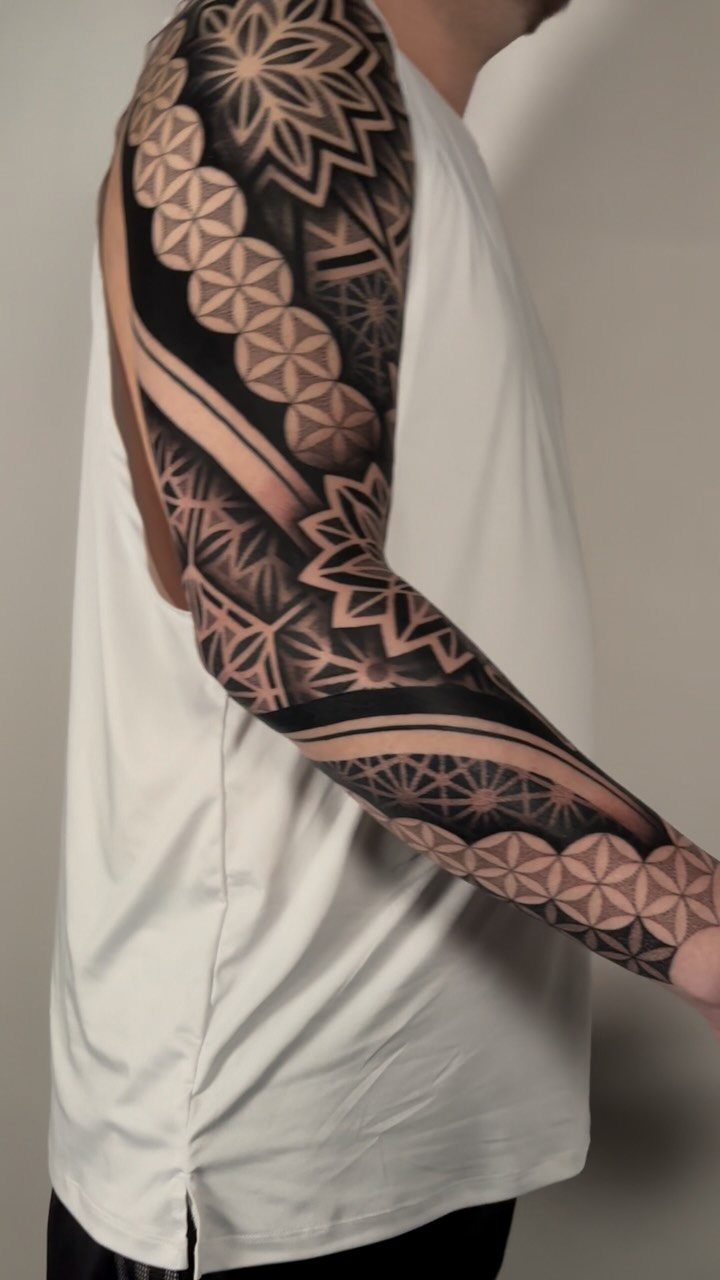
Thousands of dots build the pattern instead of solid lines, each mark placed individually to create tone and texture.
Dotwork gives geometric tattoos depth without shading, and a full sleeve in this style takes multiple sessions because the coverage moves slowly.
Healing between sessions is part of the timeline. A sleeve this dense takes multiple appointments to avoid overworking the skin.
Meaning of Shapes
Circles show up in spiritual art everywhere because the form has no start and no end, which makes it a natural stand-in for eternity.
Triangles shift meaning based on direction: pointing up reads as strength, fire and masculine energy, while pointing down signals femininity, water and the receptive principle.
Squares feel grounded because each side locks to a cardinal point, and that symmetry ties the design to order and the physical plane.
Spirals that follow the Fibonacci sequence copy the way a nautilus shell or a galaxy arm grows outward, math turned visible.
The shape you choose carries weight whether you intend it or not, so pick one that aligns with what the piece means to you.
Placement Considerations
Chest pieces centered on the sternum suit symmetrical compositions, sacred geometry and mandalas sitting naturally where the design mirrors your build.
The calf works for vertically oriented designs, geometric patterns building upward along the elongated surface.
Pick placement before you finalize the design. A composition that works on the forearm may not translate to the thigh without adjusting proportions.
Combining Styles
Geometric elements layer cleanly over floral or animal subjects, the straight lines and compass curves adding structure without erasing the organic forms underneath.
The contrast pulls attention because the styles handle form differently. Realism relies on shading and gradients, geometry on hard edges and repetition, and placing them side by side makes each style sharper.
Others overlay geometric patterns on top of a detailed animal, the 2 layers staying separate so both read clearly.
Frequently Asked Questions
What do geometric tattoos symbolize?
The clean lines and repeated shapes speak to order and balance, while the symmetry itself suggests harmony.
Specific patterns carry their own meaning: mandalas represent the universe and balance, the Flower of Life ties to creation and existence, and triangles can stand for stability or change depending on orientation.
Are geometric tattoos more expensive?
Geometric tattoos often cost more because the precision required slows the work down, and a single crooked line stays visible forever.
How long does a geometric tattoo take?
Expect 2 to 4 hours for something palm-sized, and anywhere from 20 to 40+ hours across several sittings for a full sleeve. Precision matters more than speed here, so rushing the linework produces errors you can’t fix later.
Can geometric tattoos be combined with other tattoo styles?
Geometric shapes combine cleanly with realism, dotwork, and illustrative styles because the hard edges create contrast against organic subjects.
You can frame a realistic animal inside geometric structure, overlay hexagons on a portrait, or blend half a face into polygons while leaving the other half shaded.