Traditional Japanese tattoos range from a single motif on the hand to a full bodysuit that takes years and leaves only the hands, feet and a center strip bare.
If you need the design to read from across the room and hold up decades later, bold outlines and high-contrast shading in subjects like dragons, koi and samurai deliver that durability.
1. Dragons, Koi, and Samurai
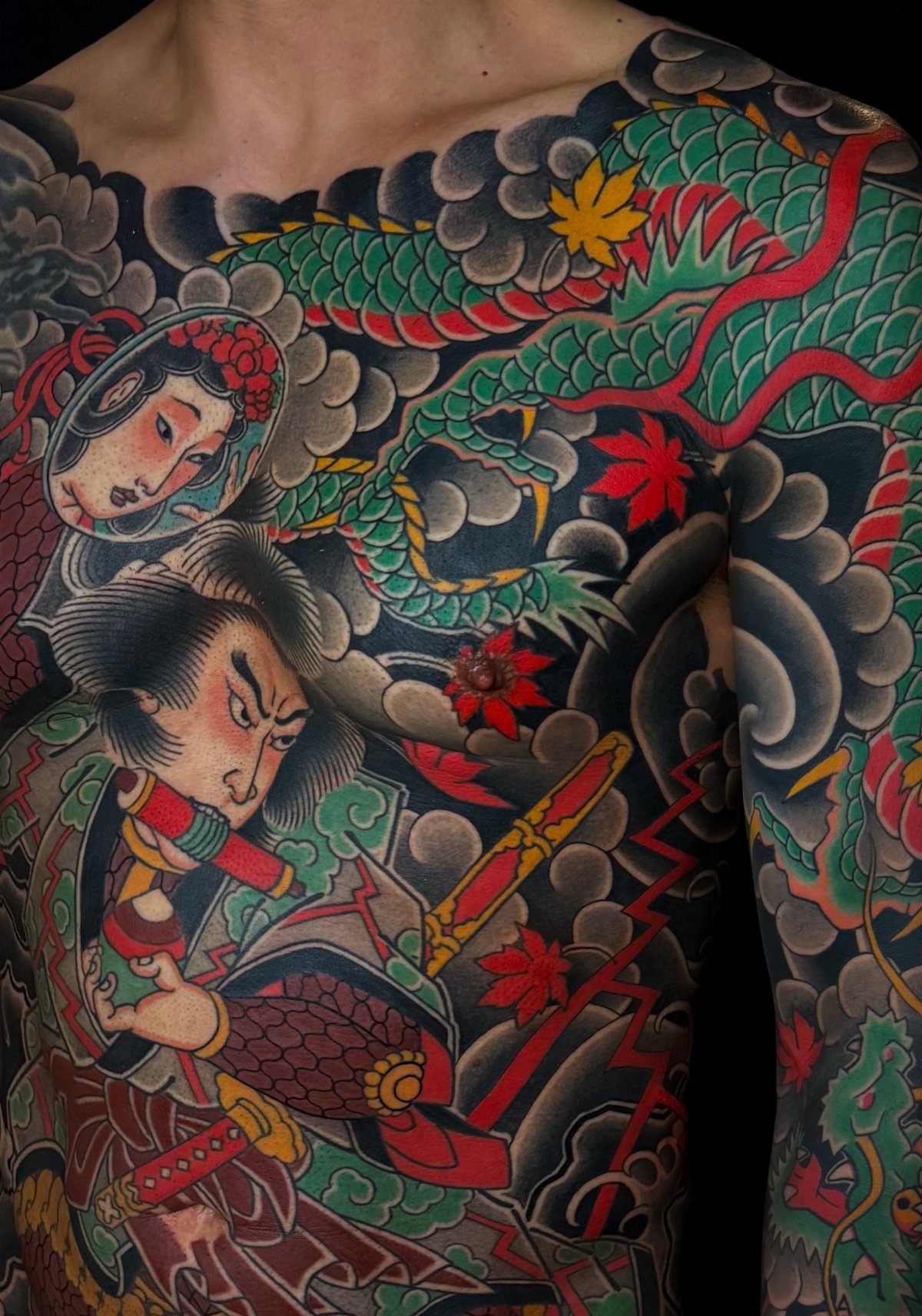
Dragons coil across the chest, koi swim up the ribs, samurai hold their ground from shoulder to elbow.
These 3 subjects anchor most traditional Japanese work because each carries weight: the dragon for strength and wisdom, koi for perseverance, samurai for honor and discipline.
Any of these will read clearly from across the room and age well.
Bold outlines and high contrast keep the image sharp even as the ink settles. Expect multiple sessions for anything larger than a half-sleeve, and budget accordingly.
2. Irezumi
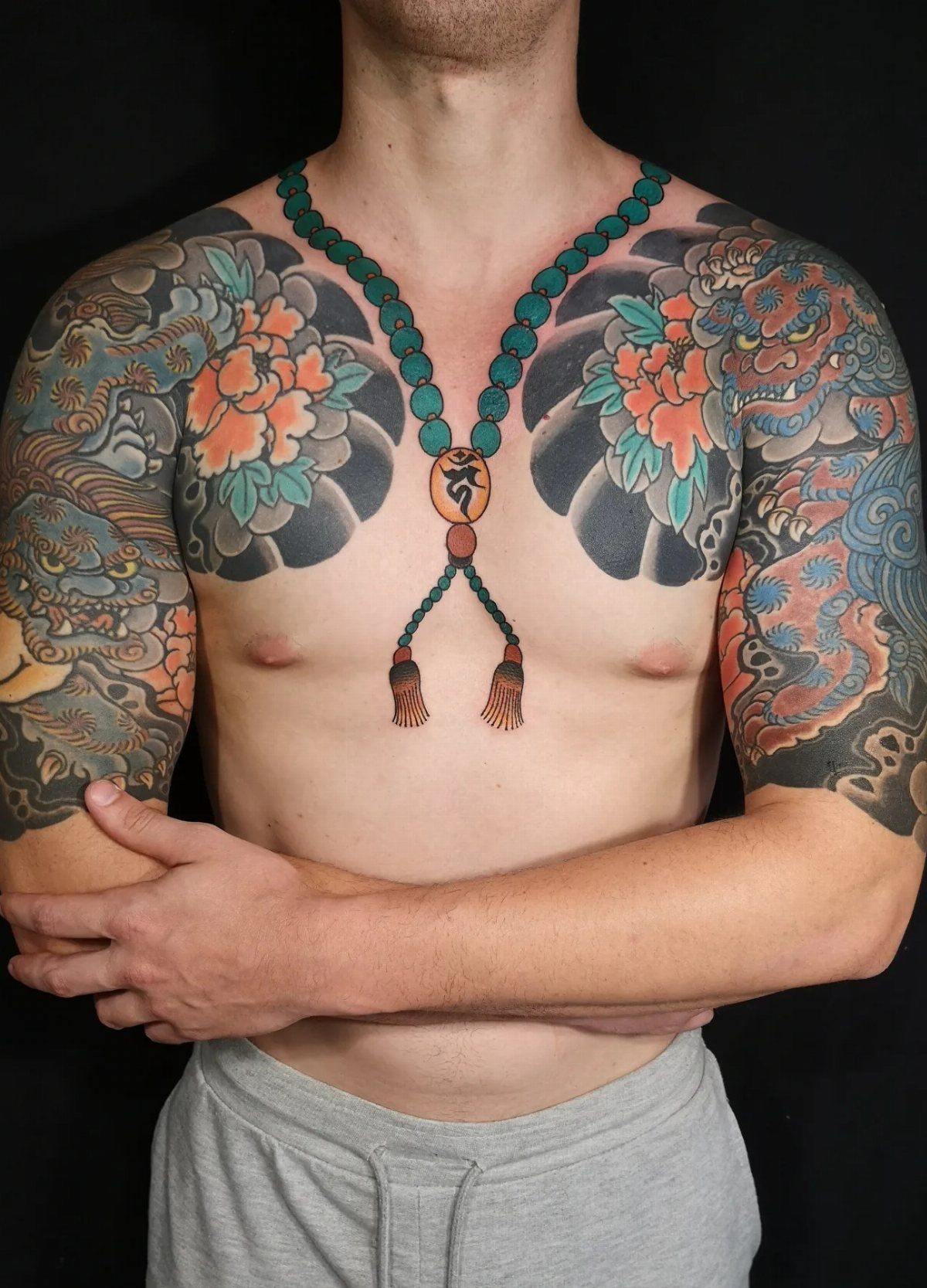
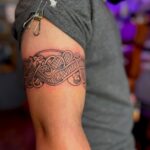
Irezumi is the Japanese term for tattooing, and the traditional method uses steel needles bundled on a wooden handle.
The process takes longer than machine work and costs more, but the ink sits differently in the skin. Shading has a softer gradient, and the design carries a texture you don’t get from coils.
Most artists working this way learned under someone who did the same. For the real thing, ask how they were trained and expect to wait months for an appointment.
3. Japanese Bodysuit Tattoos
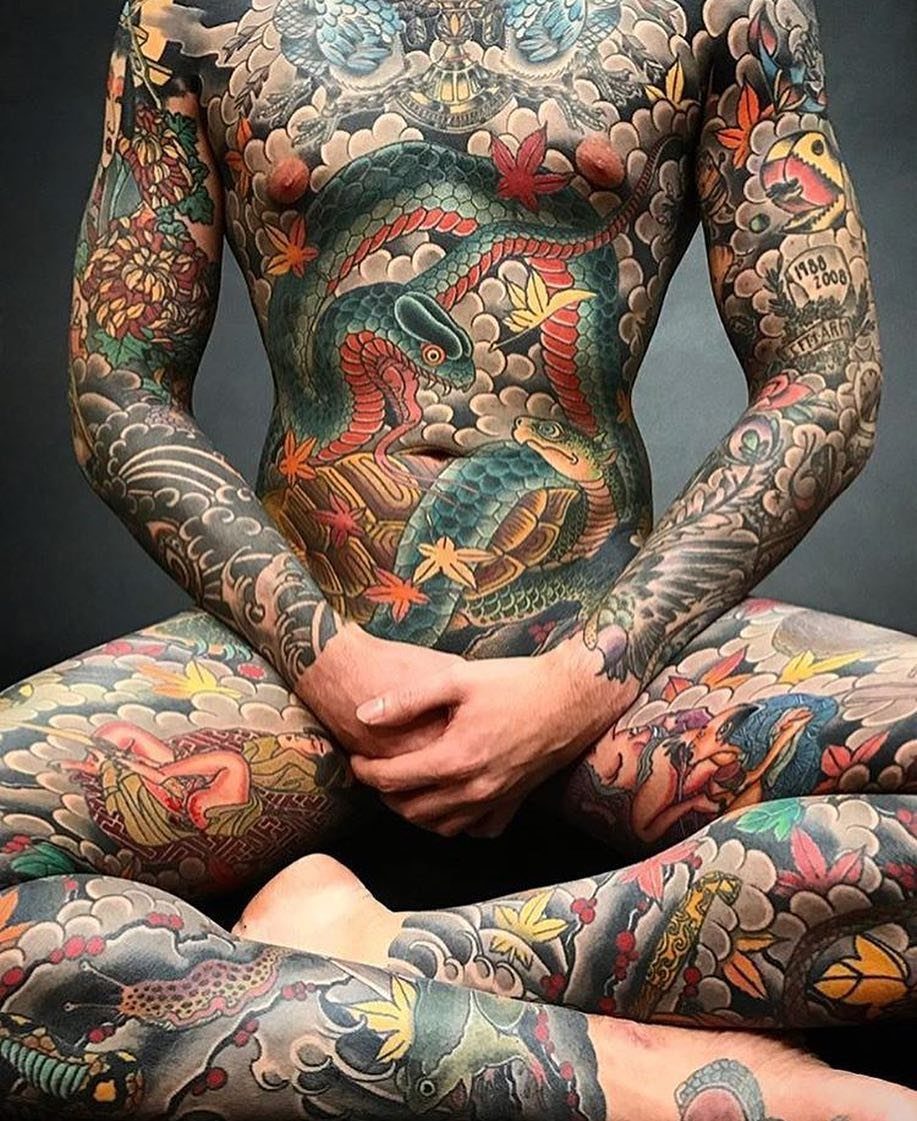
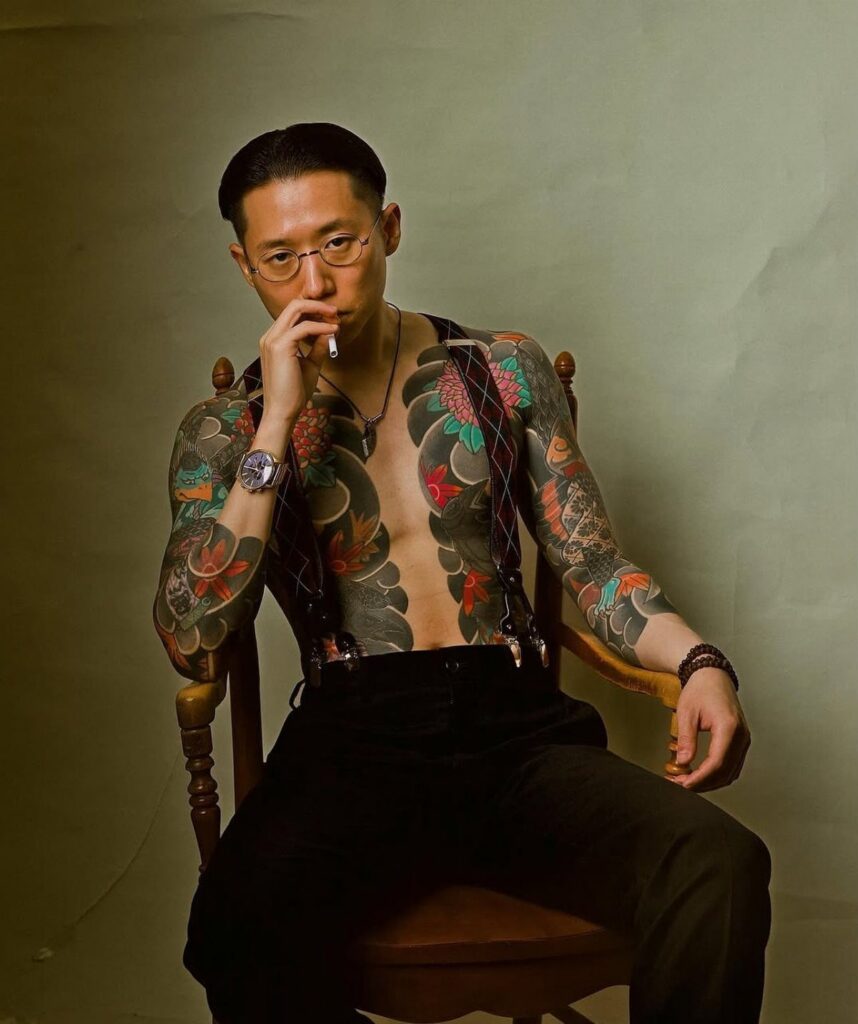
A bodysuit runs from the collarbones to the ankles, leaving the hands, feet, and a vertical strip down the center of the torso bare.
The design wraps the body as one image: waves connect to clouds, dragons move between the chest and thighs, peonies fill the gaps.
Finishing one takes years.
Sessions happen every few weeks, and coverage depends on how much black background you include. The result is a single piece that moves with you, not a collection of separate tattoos.
4. Neo-Japanese Tattoos
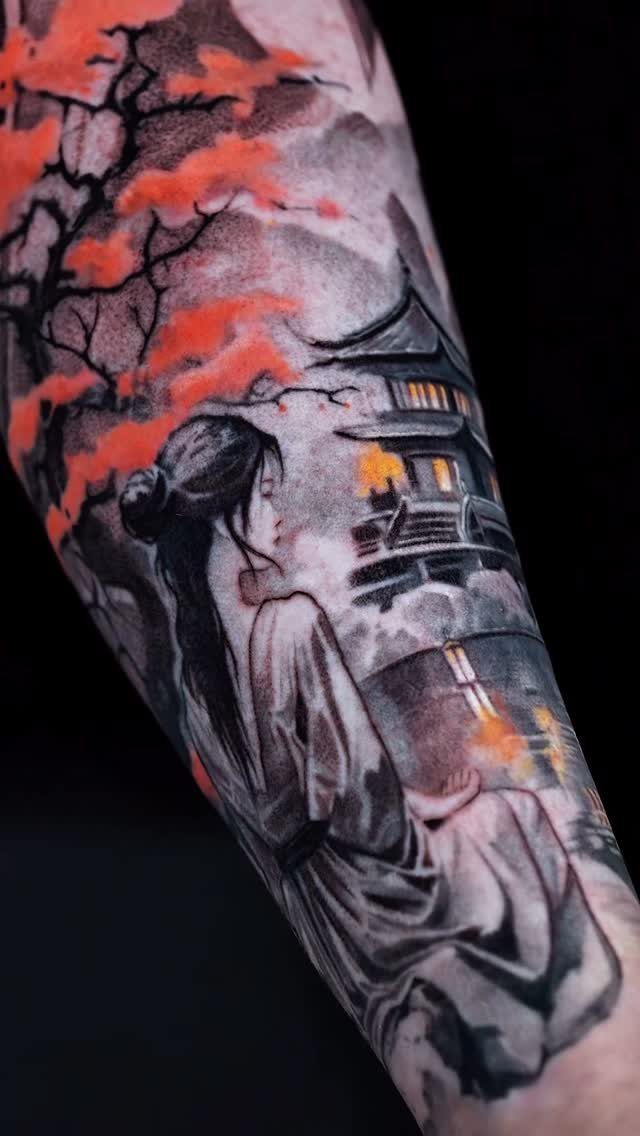
Neo-Japanese takes the structure of traditional work and loosens the rules.
You still get bold outlines and saturated color, but the subjects shift: a woman in a kimono stands beside a pagoda, maple leaves scatter against a clouded sky, and the composition breathes instead of filling every inch.
This style works for the look of Irezumi without committing to full coverage.
Artists can mix softer shading with traditional elements, and the designs often leave more skin showing. It’s a middle ground that still holds up over time.
5. Japanese Snake and Peony Hand
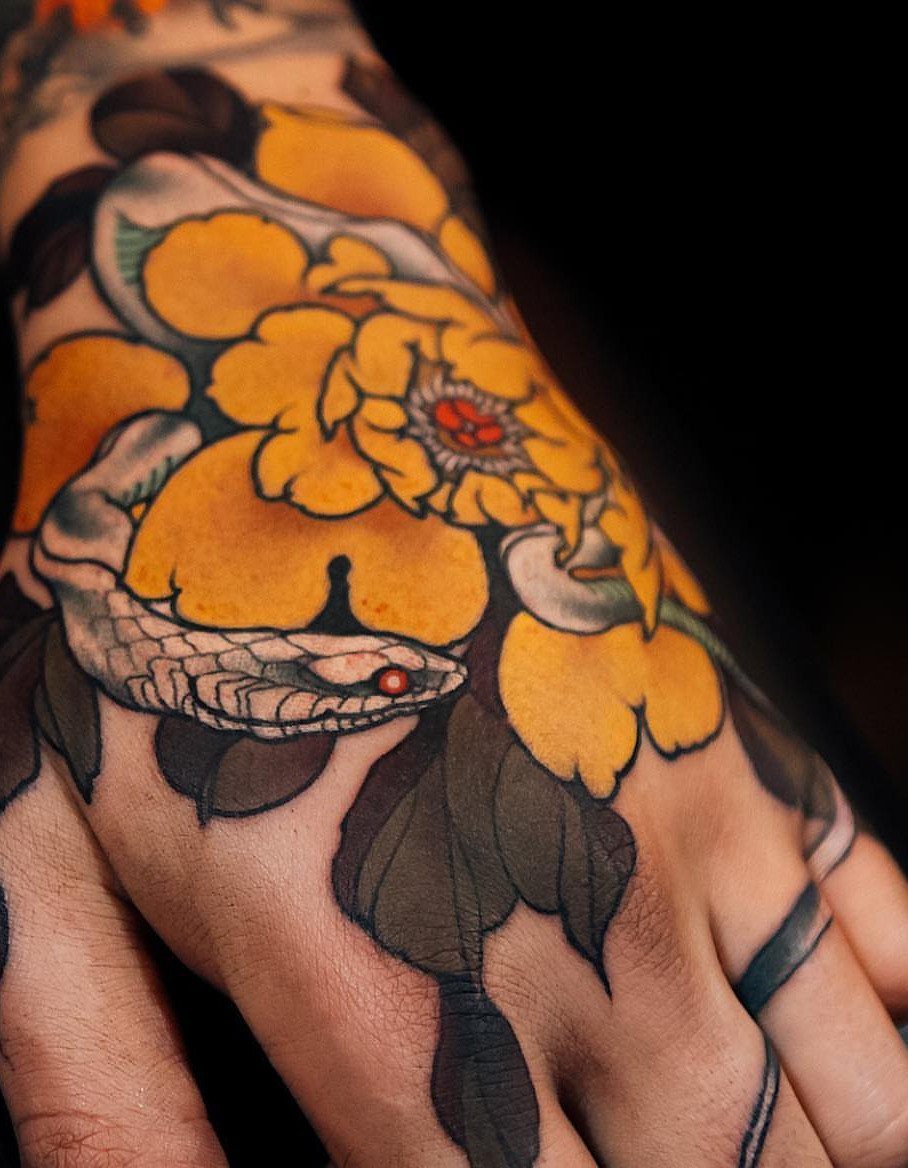
A yellow peony wraps across the knuckles and a white snake curves around the thumb, both set against dark shading that makes the colors pop.
Hand tattoos hurt more than most placements because the skin sits close to bone, and they fade faster from sun and washing.
If you work a job where visible ink matters, this won’t hide.
But if your hands are already covered or you don’t need to tuck it away, the combination of snake and peony is one of the strongest pairings in Japanese tattooing.
The peony represents wealth and good fortune; the snake, protection and rebirth.
6. Traditional Japanese Sleeve Tattoos
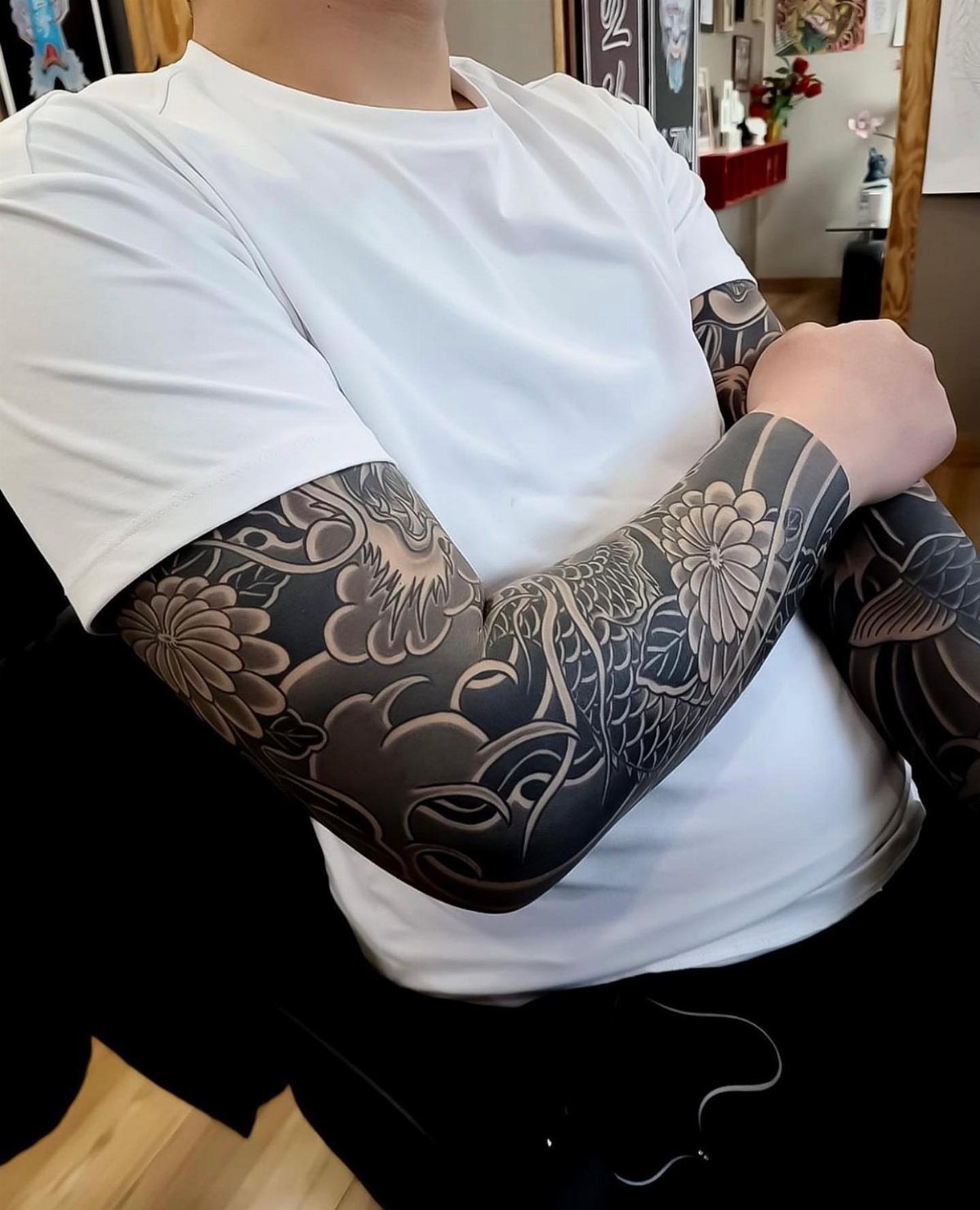
A sleeve covers the arm from shoulder to wrist in one continuous design.
Waves crash into clouds, flowers bloom between gaps in the black background, and the design reads as a single image no matter which angle you see it from.
Most artists plan the sleeve as one piece from the beginning, so bring reference images and be ready to commit to their layout.
7. Traditional Japanese Leg Tattoos
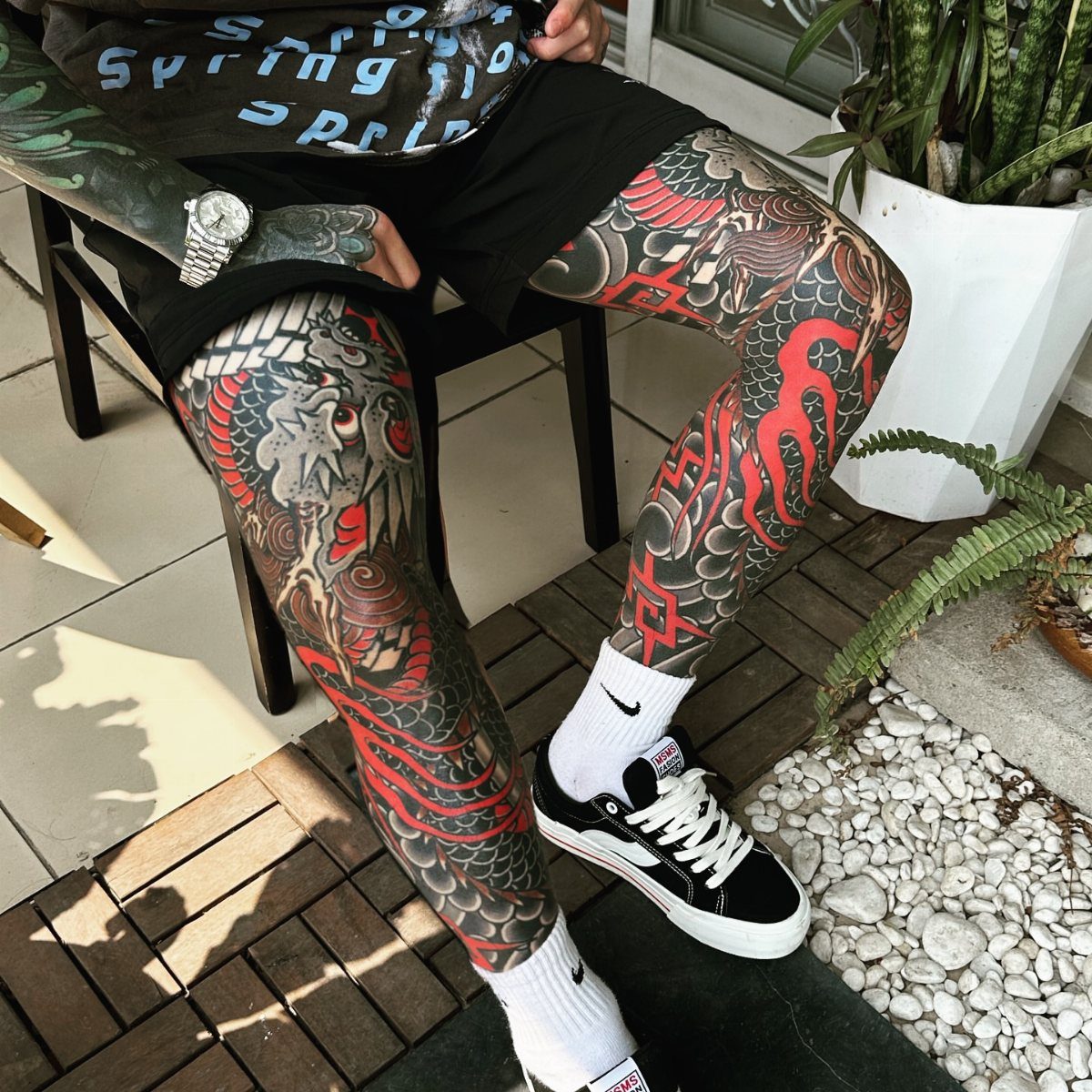
Legs give you room to work with waves, dragons, and koi without splitting the design across multiple body parts.
The lower leg, from knee to ankle, handles bold images well because the muscle holds ink cleanly and the shape lends itself to vertical compositions.
Pain stays manageable on the calf but picks up around the shin and ankle, where bone sits closer to the surface.
Sessions add up fast if you’re covering both legs, so ask your artist to map the full design before you start. A matched pair reads stronger than 2 separate ideas.
8. Hannya Mask Arm Tattoo
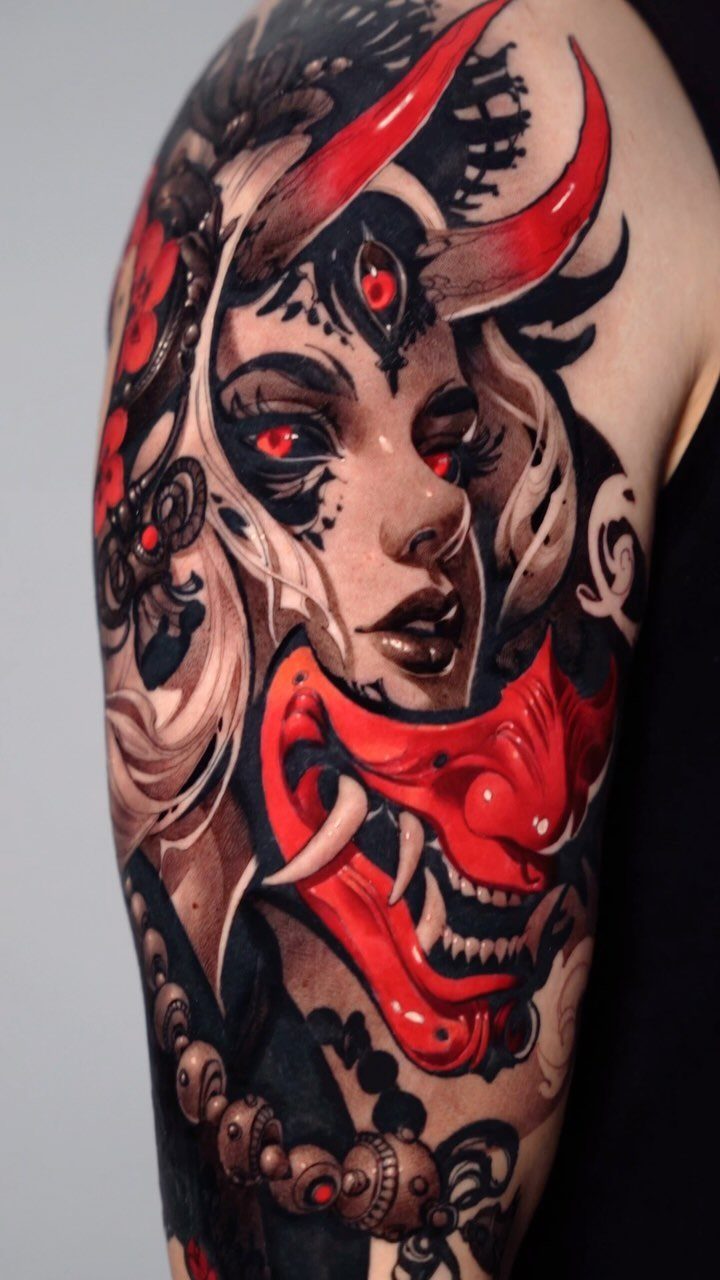
The Hannya mask, with its horns, wide eyes, and sharp teeth, represents a woman consumed by jealousy or rage.
Paired here with a horned figure, the design pulls from Japanese theater and folklore, where the mask shows transformation and raw emotion.
Upper arm placement keeps the face visible without covering the entire arm, and the curve of the bicep follows the mask’s contours.
Red ink dominates traditional Hannya work, and it holds its intensity longer than softer colors. Masks with a softer expression feel less aggressive, but that changes what the design means.
Tattooing Process
Large Japanese tattoos take time.
A back piece or full sleeve typically requires 6 to 12 sessions spaced weeks apart, depending on how much background fill your artist uses and how your skin heals between appointments. You book the next session after the last area settles.
Tebori, the hand-poked method using bamboo or steel rods, moves slower than machine work. Artists trained in this technique insert ink stroke by stroke, which gives softer gradients in shading but doubles or triples the hours.
Most tebori artists learned under someone who worked the same way, so availability is limited and wait times stretch to months.
If you want traditional technique, ask how the artist was trained and look at healed photos of their work before you commit.
Cultural Respect
Japanese tattoo imagery carries specific meanings rooted in folklore, theater, and spirituality.
A dragon represents wisdom and strength, a koi climbing upstream means perseverance, and a Hannya mask shows jealousy or transformation. Wearing one without understanding what it says can feel hollow at best.
Before you settle on a design, research what the symbol actually means and decide if that meaning fits what you want to carry. Some images, particularly religious or ceremonial ones, hold cultural weight that goes beyond decoration.
If you plan to travel or live in Japan, know that visible tattoos still carry stigma in certain spaces. Public baths, gyms, and some hotels restrict entry for people with ink, a policy tied to historical associations that persist today.
Placement Considerations
Japanese tattoos need room. The level of detail in waves, scales, petals, and background shading works best across large, uninterrupted areas: the back, a full arm, an entire leg, or multiple panels that connect as one design.
The back offers the most space and lets an artist build a composition without breaking it at joints. Arms and legs work when the design wraps the limb as a single image rather than splitting into separate pieces.
Small placements don’t support traditional Japanese work well. Cramming a dragon or koi into a small patch loses the line weight and shading that make the style recognizable, and the design will blur as it ages.
If you want the look but can’t commit to large coverage, neo-Japanese adapts better to smaller areas by simplifying backgrounds and leaving more skin visible.
While in the West tattoos were, and still are, usually single pieces on different sections of the skin, the traditional Japanese style was a single tattoo that occupied most of a person’s body.
Frequently Asked Questions
What are those Yakuza tattoos called?
The hand-poked method uses steel needles bundled on bamboo, and an artist drives pigment into the dermis one strike at a time.
Each session runs longer and the total price climbs higher, but the hand delivers pressure a machine can’t match.
What does neo trad tattoo mean?
Neo-Japanese keeps the bold line and color saturation but opens the subject matter and pacing.
What kind of tattoo to get in Japan?
A dragon wraps the torso, koi climb the ribcage, a samurai fills the upper arm in a single sitting or three.
These motifs dominate for good reason: dragon signals power and protection, koi means endurance through struggle, samurai stands for loyalty and resolve.
Are tattoos culturally acceptable in Japan?
Ink still limits access in Japan. Each image pulls from Noh theater, Buddhist cosmology, or Edo-period woodblock prints, so know the story attached to the snake, peony, or wave before it goes on.